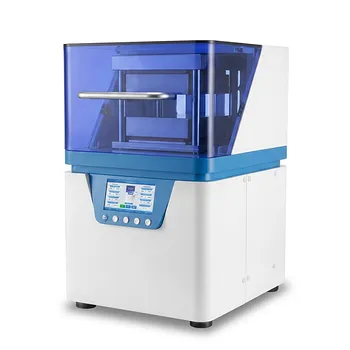
Powered hydraulic presses are automated systems driven by electric motors, specifically engineered to eliminate the variability of manual operation. These machines are designed to meet the demands of high-throughput environments, making them the standard choice for facilities that must produce large volumes of identical products or pellets. They are broadly categorized into two main variations: standard models and advanced units equipped with LED touchscreens and custom programmable loads.
The Core Value of Automation While manual presses rely on operator physical effort, powered hydraulic presses utilize electric motors to deliver consistent force and automated cycling. This capability is essential for applications requiring strict reproducibility, as it removes human error and fatigue from the equation.
The Architecture of Powered Presses
Electric Motor Integration
Unlike manual versions that require a hand pump, powered presses are driven by an electric motor.
This provides the foundation for automated operation, significantly increasing convenience and operational efficiency.
Primary Variations
According to industry standards, these presses generally fall into two categories.
The first is a standard powered configuration for basic, repetitive tasks. The second includes LED touchscreens and programmable logic, allowing for complex, multi-stage pressing cycles.
Component Reliability
High-quality powered presses integrate well-known, standardized electronic components.
This design choice ensures long-term stability and significantly reduces both maintenance costs and unexpected downtime.
Advanced Control Capabilities
Programmable Logic
A defining characteristic of modern powered presses is the ability to utilize pre-stored programs.
This allows operators to switch between different working modes quickly, adapting the machine to various industrial or laboratory requirements without manual recalibration.
Cycle Customization
For precise sample preparation, these presses offer customizable programming features.
Key functions include timers for exact duration control and step functions that allow for gradual load increases, which is critical for delicate materials.
The Auto Top-Up Feature
One of the most valuable technical characteristics is the auto top-up function.
This feature automatically maintains a consistent load over time, compensating for any pressure loss during the cycle. This is vital for applications requiring sustained pressure, such as hot embossing or lamination.
Applications and Performance
High-Volume Consistency
The primary operational strength of a powered press is its ability to produce a large volume of identical products.
This makes them ideal for research facilities creating pellets for analysis or industries manufacturing uniform components.
Specific Use Cases
Due to their precision, these presses are frequently used for Industrial XRF (X-ray fluorescence) sample preparation.
They are also the preferred tool for creating thin films from polymers and performing complex molding tasks.
Safety and Durability
Powered units are designed to withstand heavy-duty usage and high force output.
They incorporate critical safety features, such as pressure relief valves and emergency stops, to prevent sudden failures and protect the operator.
Understanding the Trade-offs
Complexity and Cost
While powered presses offer superior consistency, they introduce electronic complexity that manual presses lack.
Organizations must balance the need for high-throughput automation against the higher initial investment compared to simple, handheld manual options.
Space Requirements
Powered hydraulic presses generally require a dedicated workspace and power source.
Facilities with extremely limited space or those needing portable solutions may find the larger footprint of a powered unit less suitable than compact manual alternatives.
Making the Right Choice for Your Goal
To maximize the utility of a powered hydraulic press, align the specific feature set with your operational objectives:
- If your primary focus is high-throughput consistency: Select a programmable model to ensure every sample cycle is identical, removing operator variance.
- If your primary focus is complex material testing: Prioritize units with the auto top-up and step functions to manage pressure retention and gradual force application accurately.
Ultimately, a powered hydraulic press is not just a tool for applying force; it is an instrument for ensuring the scientific validity and repeatability of your production process.
Summary Table:
| Feature | Description | Key Benefit |
|---|---|---|
| Electric Drive | Motor-driven pump system | Eliminates manual labor and operator fatigue |
| Programmable Logic | LED touchscreens with stored programs | Ensures 100% reproducibility across batches |
| Auto Top-Up | Automatic pressure maintenance | Prevents load decay during long cycles |
| Custom Cycles | Timers and step-loading functions | Critical for delicate materials and thin films |
| Safety Systems | Pressure relief valves & e-stops | Protects equipment and operators during high-force use |
Maximize Your Laboratory Efficiency with KINTEK
Precision and repeatability are the cornerstones of successful research. KINTEK specializes in comprehensive laboratory pressing solutions, offering a versatile range of manual, automatic, heated, multifunctional, and glovebox-compatible models, alongside advanced cold and warm isostatic presses widely applied in battery research and material science.
Whether you need high-throughput XRF sample preparation or complex polymer molding, our expert team is ready to help you select the ideal powered press for your specific requirements.
Ready to automate your workflow? Contact KINTEK Today to Find Your Perfect Press Solution
Related Products
- Automatic Hydraulic Hot Press with Large Plate and Precision Temperature Control for Advanced Material Sample Preparation and Industrial Research
- Automatic Hydraulic Heat Press Machine with Multi Stage Programmable Control and Integrated Water Cooling Plate Size 180x180mm
- Automatic Heated Hydraulic Press Machine with Heated Plates for Laboratory
- Automatic Heated Hydraulic Press Machine with Hot Plates for Laboratory
- Automatic High Temperature Heated Hydraulic Press Machine with Heated Plates for Lab
People Also Ask
- What are the specific features and applications of hydraulic hot press machines? Precision Solutions for Modern Labs
- How does an automatic hydraulic press operate? Achieve Precision and Consistency in Lab Pelleting
- What are the advantages and common applications of an automatic hydraulic press? Elevate Your Lab's Precision
- What is the technical significance of setting a precise dwell time? Achieve Peak Material Density and Stability
- When is an automatic hydraulic press more suitable than a manual press? Scale Your Lab with Precision & Speed