
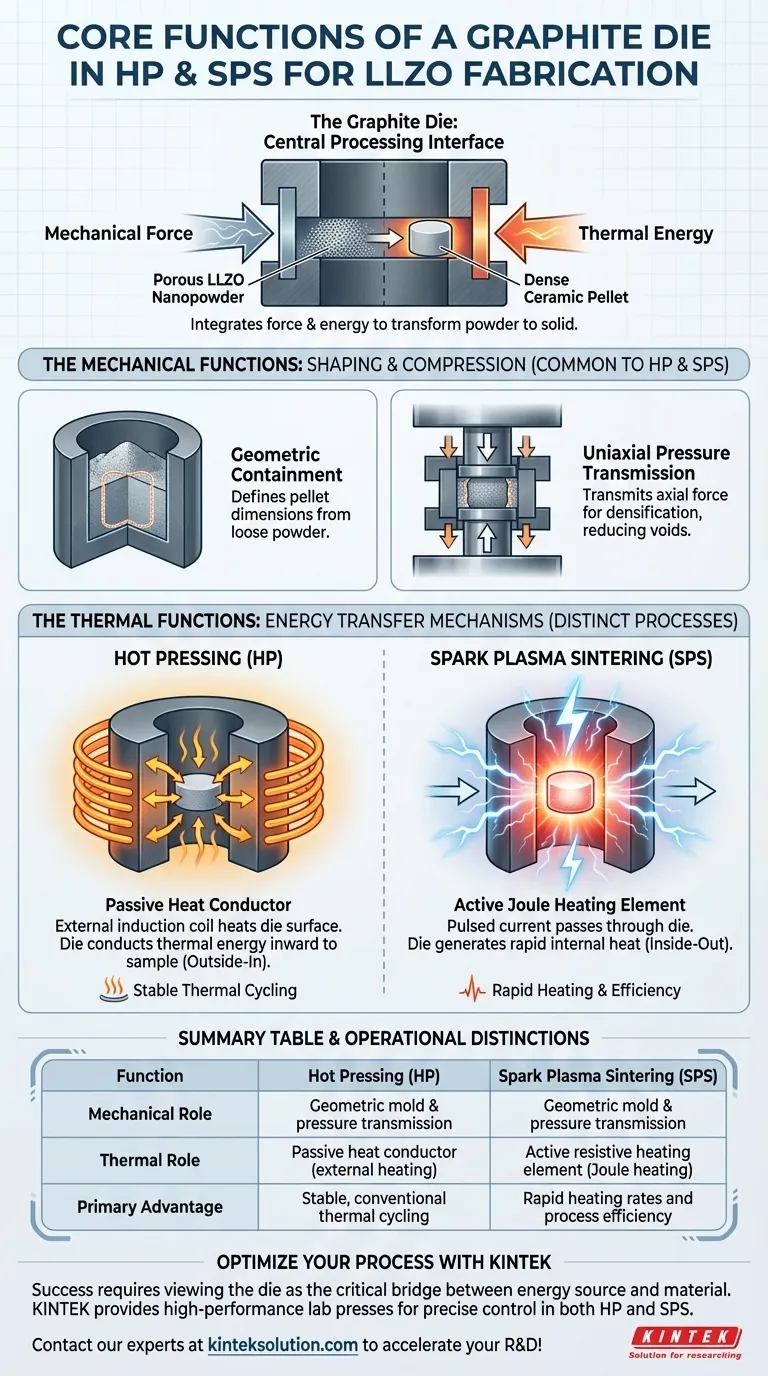
The graphite die serves as the central processing interface in the fabrication of LLZO solid-state electrolytes using Hot Pressing (HP) and Spark Plasma Sintering (SPS). It performs three simultaneous, critical functions: it acts as the geometric mold that defines the pellet's dimensions, transmits the uniaxial mechanical pressure required for densification, and serves as the primary medium for transferring thermal energy to the ceramic powder.
Core Insight: In pressure-assisted sintering, the graphite die is not merely a passive container; it is an active component that integrates mechanical force and thermal energy to transform porous LLZO nanopowder into a dense, structural ceramic.
The Mechanical Functions: Shaping and Compression
Geometric Containment
The most immediate function of the graphite die is to serve as a physical mold.
It confines the loose Al-doped LLZO nanopowder or the pre-compacted "green pellet" within a specific volume.
This containment defines the final shape and dimensions of the sintered electrolyte, typically resulting in a circular pellet form.
Uniaxial Pressure Transmission
Beyond simple containment, the die assembly acts as the transmission vehicle for mechanical force.
In both HP and SPS, the press rams apply significant axial pressure (often measured in kilonewtons) to the die plungers.
The die transmits this pressure directly onto the powder, compacting the particles to reduce internal voids and ensure high final density.
The Thermal Functions: Energy Transfer Mechanisms
Heat Conduction in Hot Pressing (HP)
In a Hot Pressing system, the graphite die acts primarily as a thermal conductor.
An external induction coil generates heat, which is then absorbed by the outer surface of the die.
The die conducts this thermal energy inward to the LLZO sample, relying on the thermal conductivity of the graphite to heat the powder.
Active Joule Heating in Spark Plasma Sintering (SPS)
In the SPS process, the role of the die changes from a passive conductor to an active heating element.
The system passes a high-density pulsed electrical current directly through the conductive graphite die mold.
This current generates rapid Joule heating within the die itself, allowing for faster heating rates compared to external induction methods.
Understanding the Operational Distinctions
While the mechanical role remains consistent, the method of heat generation creates a distinct trade-off between the two processes.
The Source of Heat Generation
In HP, the thermal gradient moves from the outside in, as the die transfers heat from the external coil to the core.
In SPS, the die generates its own heat internally through electrical resistance, placing the heat source in immediate proximity to the sample.
Implication for Process Control
The choice of process dictates how you manage the graphite die's thermal properties.
For HP, you rely on the graphite's ability to conduct heat evenly over time.
For SPS, you rely on the graphite's electrical resistance to generate rapid, controllable temperature spikes.
Making the Right Choice for Your Goal
The specific role the graphite die plays depends heavily on which sintering technology aligns with your fabrication requirements.
- If your primary focus is rapid heating and efficiency: Utilize Spark Plasma Sintering (SPS), where the die functions as an active resistive heater to minimize processing time.
- If your primary focus is conventional thermal cycling: Utilize Hot Pressing (HP), where the die serves as a stable medium to conduct externally generated induction heat.
Success in fabricating LLZO electrolytes requires viewing the graphite die not just as a mold, but as the critical bridge between your energy source and your material.
Summary Table:
| Function | Hot Pressing (HP) | Spark Plasma Sintering (SPS) |
|---|---|---|
| Mechanical Role | Geometric mold & pressure transmission | Geometric mold & pressure transmission |
| Thermal Role | Passive heat conductor (external heating) | Active resistive heating element (Joule heating) |
| Primary Advantage | Stable, conventional thermal cycling | Rapid heating rates and process efficiency |
Ready to Optimize Your LLZO Electrolyte Fabrication Process?
The right lab press is essential for achieving the perfect balance of pressure and temperature in your sintering process. At KINTEK, we specialize in high-performance laboratory press machines, including automatic lab presses, isostatic presses, and heated lab presses designed for advanced materials research.
Our equipment provides the precise control and reliability needed for both Hot Pressing and Spark Plasma Sintering applications. Let us help you enhance your solid-state battery development with technology that bridges your energy source and material perfectly.
Contact our experts today to discuss how our lab press solutions can accelerate your research and development!
Visual Guide
Related Products
- Lab Heat Press Special Mold
- Lab Ring Press Mold for Sample Preparation
- Lab Infrared Press Mold for No Demolding
- Lab XRF Boric Acid Powder Pellet Pressing Mold for Laboratory Use
- Lab Cylindrical Press Mold with Scale
People Also Ask
- How is a laboratory heat press used to evaluate bio-based aliphatic polyesters? Prepare Reliable Samples for Analysis
- How is a laboratory heat press utilized in MEA preparation? Achieve High-Efficiency Iron-Chromium Redox Flow Batteries
- Why is a laboratory heat press necessary for biodegradable films? Unlock Precision Bonding and Barrier Performance
- What is the purpose of incorporating cartridge heaters into a lab press mold for MLCC block compression? Optimize Results
- Why is a high-precision laboratory heated press required for self-healing polyurethane? Optimize Molecular Repair



















