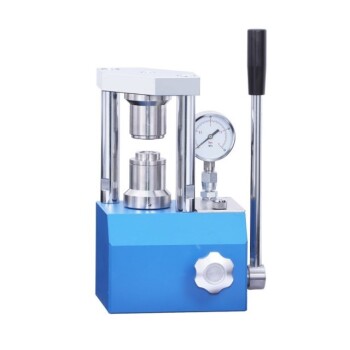
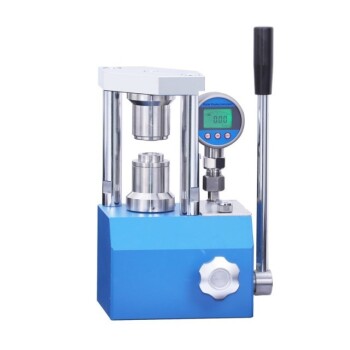
To execute the step-by-step pressing process effectively, you must utilize a laboratory hydraulic press characterized by a wide pressure range and exceptional control capabilities. Specifically, the equipment must be capable of delivering a precise two-stage compression protocol: an initial application of approximately 180 MPa to shape the electrolyte layer, followed by a subsequent application of 360 MPa to co-press the final composite stack.
Success in solid-state battery assembly relies on more than just force; it requires a press that offers precise pressure gradient control to shape layers individually before co-pressing. This capability is critical for creating the mechanical interlocking and tight chemical interfaces necessary to prevent delamination and ensure long cycle life.
Critical Equipment Capabilities
To replicate the step-by-step process accurately, your equipment must meet specific functional standards.
Wide Pressure Range Versatility
The pressing equipment must support a broad spectrum of force application. It needs the sensitivity to apply lower pressure (approx. 180 MPa) for the initial shaping of the electrolyte layer.
Simultaneously, it must possess the power to double that force (approx. 360 MPa) for the final co-pressing of the cathode, electrolyte, and anode stack. Equipment limited to lower pressure ranges will fail to achieve the necessary densification for the final assembly.
Precision Gradient Control
Raw power is insufficient without control. The hydraulic press must allow for a controlled "gradient" of pressure application.
This ensures that the transition between shaping the electrolyte and compressing the full stack is deliberate. Precise control allows for the distinct formation of layers without disturbing the structural integrity established in the previous step.
Uniaxial Force Application
The press must apply pressure uniaxially (from one direction) to create dense, disc-shaped pellets.
This uniform directionality is essential for compressing powdered solid-state electrolytes and electrode materials into a cohesive unit. It ensures that the densification occurs evenly across the entire surface area of the battery pellet.
The Engineering Behind the Requirements
Understanding why these specifications are required allows you to better evaluate potential equipment.
Achieving High Densification
The high-pressure capability (up to 360 MPa) is non-negotiable for overcoming contact resistance between powder particles.
This pressure forces the sulfide or ceramic electrolyte powders to densify fully. It eliminates internal micro-cracks and voids that typically act as short-circuit risks or bottlenecks for ion transport.
Optimizing Interface Mechanics
The step-by-step pressure application induces plastic deformation, particularly in the lithium metal components.
This deformation forces the materials into tight physical contact, reducing interfacial impedance. The result is a "solid-solid" interface that is mechanically interlocked and chemically connected, facilitating efficient ion transport channels.
Preventing Structural Failure
The specific two-step protocol is designed to prevent delamination.
By establishing the electrolyte layer first and then co-pressing the stack, the equipment helps maintain contact integrity. This prevents the layers from separating (delaminating) during the expansion and contraction inherent in battery charging and discharging cycles.
Understanding the Trade-offs
While the primary requirement is pressure control, specialized variations exist based on material chemistry.
Pressure vs. Thermal Capability
For many solid-state setups, a standard "cold" hydraulic press with high pressure is sufficient and follows the primary step-by-step protocol.
However, if you are working with polymer composite electrolytes, pressure alone may be insufficient. In these cases, a heated laboratory hydraulic press becomes necessary.
The Role of Heat
Heat softens the polymer matrix, allowing it to fill gaps between ceramic fillers more effectively.
While this improves wetting and molecular chain entanglement, it adds complexity and cost to the equipment. You must determine if your specific chemistry requires this thermal field or if the high-pressure mechanical interlocking described in the standard step-by-step process is sufficient.
Making the Right Choice for Your Goal
Selecting the right press depends on ensuring the equipment specs align with your specific assembly protocol.
- If your primary focus is the Standard Step-by-Step Protocol: Prioritize a press with a verified range of at least 180–375 MPa and digital precision control to manage the two-stage pressure gradient.
- If your primary focus is Sulfide-Based Electrolytes: Ensure the press can sustain the upper end of the pressure range (360+ MPa) to overcome powder contact resistance and ensure full densification.
- If your primary focus is Polymer/Composite Electrolytes: Select a press that integrates a controlled thermal field (hot pressing) to facilitate polymer softening alongside mechanical compression.
Your equipment must do more than compress materials; it must act as a precision tool for engineering atomic-level interfaces.
Summary Table:
| Requirement | Specification / Value | Purpose |
|---|---|---|
| Initial Pressing | ~180 MPa | Shaping the electrolyte layer |
| Co-pressing | ~360 MPa | Final composite stack densification |
| Pressure Control | Precision Gradient | Prevents delamination and structural failure |
| Force Direction | Uniaxial | Ensures uniform density in battery pellets |
| Optional Feature | Thermal Field (Heating) | Necessary for softening polymer electrolytes |
Elevate Your Battery Research with KINTEK Precision
To achieve high-performance all-solid-state batteries, you need equipment that masters the balance of force and finesse. KINTEK specializes in comprehensive laboratory pressing solutions, offering manual, automatic, heated, multifunctional, and glovebox-compatible models, as well as cold and warm isostatic presses tailored for battery research.
Our systems deliver the precise gradient control and high-pressure capacity (up to 360+ MPa) required to eliminate contact resistance and prevent delamination in your composite stacks. Whether you are working with sulfide powders or polymer electrolytes, our team is ready to help you configure the perfect setup for your specific material chemistry.
Ready to optimize your assembly process? Contact our laboratory specialists today to find the right press for your research goals.
References
- Zeyi Wang, Chunsheng Wang. Interlayer Design for Halide Electrolytes in All‐Solid‐State Lithium Metal Batteries. DOI: 10.1002/adma.202501838
This article is also based on technical information from Kintek Solution Knowledge Base .
Related Products
- Warm Isostatic Press for Solid State Battery Research Warm Isostatic Press
- Laboratory Hydraulic Press Lab Pellet Press Button Battery Press
- Button Battery Sealing Press Machine for Lab
- Lab Infrared Press Mold for Laboratory Applications
- Lab Button Battery Tablet Press Sealing Mold
People Also Ask
- Why must composite cathodes be sealed in vacuum lamination bags for WIP? Ensure Battery Stability and Density
- How do sacrificial volume materials (SVM) maintain microchannels in isostatic pressing? Ensure Structural Integrity
- What is the function of elastic molds in warm isostatic pressing? Achieve Uniform Density in Composite Particles
- What is the mechanism of a Warm Isostatic Press (WIP) on cheese? Master Cold Pasteurization for Superior Safety
- What is the significance of temperature control in Warm Isostatic Pressing? Unlock Uniform Densification and Process Stability