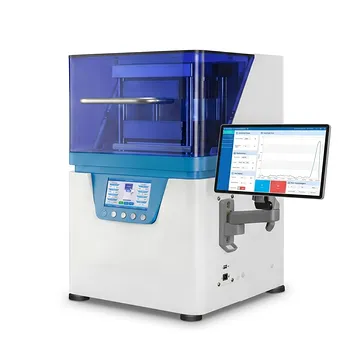
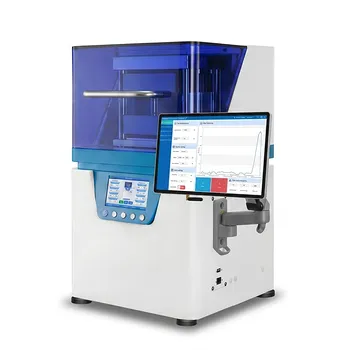
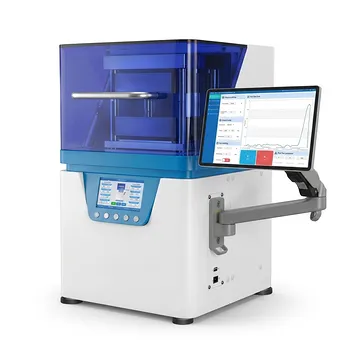
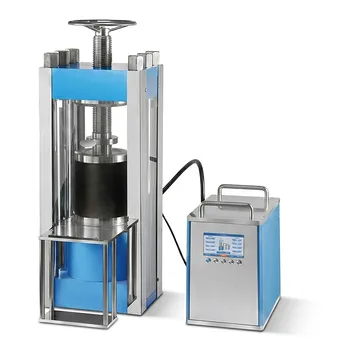
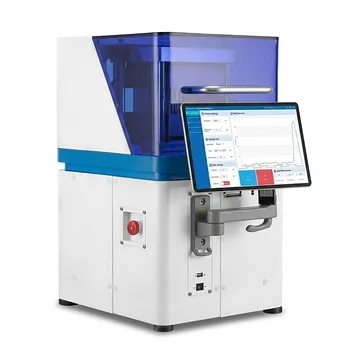
The primary function of a high-precision laboratory heated press in the fabrication of $WO_3$/silicone rubber composite sheets is to provide a controlled, sealed environment that simultaneously applies high pressure and constant temperature. This dual action facilitates the vulcanization of the silicone rubber while molding the material into a uniform, high-density film suitable for rigorous scientific testing.
The laboratory heated press acts as the critical bridge between raw chemical mixtures and finished composite sheets. By synchronizing thermal energy and mechanical force, it ensures the material achieves its necessary chemical cross-linking, geometric uniformity, and internal structural integrity.
Driving Molecular Cross-Linking and Vulcanization
Facilitating the Chemical Transformation
The heated press provides the constant thermal energy, typically maintained at 140 °C, required to trigger the cross-linking reaction within the silicone rubber. This process, known as vulcanization, transforms the raw, plastic-like rubber mixture into a stable elastomer with permanent mechanical properties.
Ensuring Reaction Consistency
The high-precision nature of the press ensures that heat is distributed evenly across the entire surface of the sample. This uniformity prevents localized under-curing or over-curing, which is essential for creating a composite with stable mechanical properties and dimensional stability.
Managing the Molding Stage
During the designated vulcanization time, the press ensures the silicone matrix flows adequately to encapsulate the $WO_3$ particles. This molten state allows the resin to bind tightly with the fillers, determining the final hardness and structural integrity of the composite sheet.
Precision Morphological and Geometric Control
Achieving Uniform Thickness
One of the most vital functions of the press is its ability to compress the material into films with a precise thickness, such as 1 mm. Maintaining a tight thickness tolerance is crucial because variations in geometry can lead to significant errors during subsequent gas permeability testing.
Producing Smooth Surfaces
The high-pressure application results in sheets with exceptionally smooth surfaces and excellent flatness. These refined surfaces are not merely aesthetic; they are required for consistent interface contact in various experimental setups and sensors.
Controlling Material Density
By applying uniaxial pressure, the press forces the molecular chains into a tight arrangement, increasing the overall material density. This controlled compression ensures that the final $WO_3$/silicone rubber sheet meets the specific physical requirements for its intended application.
Structural Integrity and Void Elimination
Removing Internal Air Bubbles
The application of high pressure is the primary mechanism for eliminating internal voids and air bubbles trapped during the initial mixing of $WO_3$ and silicone. Removing these defects is critical, as internal pores act as stress concentrators and can skew the results of physical property measurements.
Enhancing Interfacial Bonding
The press ensures that the silicone rubber matrix and the $WO_3$ filler particles are tightly bonded at the molecular level. Effective mechanical interlocking and uniform distribution of the filler are achieved through this pressure-assisted processing, which directly impacts the composite’s performance.
Reducing Experimental Data Scatter
By ensuring that every test specimen has a consistent internal structure and identical physical dimensions, the heated press minimizes variables. This leads to higher reproducibility in the lab and significantly reduces "data scatter" in experimental results.
Understanding the Trade-offs
The Risk of Thermal Degradation
While heat is necessary for curing, excessive temperatures or prolonged exposure can lead to the thermal degradation of the silicone rubber. If the press is not calibrated correctly, the polymer chains may begin to break down, resulting in a brittle material rather than a flexible elastomer.
Managing Pressure and "Flash"
Applying too much pressure can cause "flash," where the material is forced out of the mold cavity, leading to sheets that are thinner than intended. Conversely, insufficient pressure fails to eliminate all internal pores, potentially compromising the accuracy of gas permeability and mechanical strength tests.
The Importance of the Cooling Cycle
Rapid cooling after pressing can sometimes induce internal stresses or affect the microstructure of the composite. A high-precision press must manage the transition from high heat to room temperature carefully to "fix" the geometric dimensions without introducing structural flaws.
How to Apply This to Your Project
Recommendations for Fabrication
When using a high-precision heated press for $WO_3$/silicone rubber composites, your settings should be dictated by your primary analytical goal.
- If your primary focus is gas permeability accuracy: Prioritize the elimination of internal voids by maintaining high, steady pressure throughout the entire curing cycle.
- If your primary focus is mechanical durability: Focus on the precise calibration of the 140 °C temperature to ensure a complete and uniform vulcanization of the silicone matrix.
- If your primary focus is material comparison: Use a standardized molding spacer to ensure every sample maintains an identical 1 mm thickness to reduce variables during testing.
Precise control over the thermo-pressure environment is the only way to ensure that the resulting $WO_3$/silicone rubber composite is both structurally sound and scientifically valid.
Summary Table:
| Function | Description | Key Benefit |
|---|---|---|
| Vulcanization | Provides 140°C thermal energy for cross-linking | Transforms raw rubber into a stable elastomer |
| Geometric Control | Maintains precise 1mm thickness tolerances | Eliminates errors in gas permeability testing |
| Void Elimination | Uses high pressure to remove internal air bubbles | Prevents structural defects and data scatter |
| Interfacial Bonding | Forces tight molecular contact with WO3 fillers | Ensures high material density and integrity |
Enhance Your Composite Research with KINTEK
Precision is the difference between inconsistent results and scientific breakthroughs. KINTEK specializes in comprehensive laboratory pressing solutions tailored for demanding applications like material science and battery research.
Our extensive range includes manual, automatic, heated, multifunctional, and glovebox-compatible models, as well as cold and warm isostatic presses. We provide the thermal and mechanical control necessary to achieve uniform vulcanization, eliminate internal voids, and ensure perfect geometric consistency for your samples.
Optimize your material density and structural integrity today.
Contact KINTEK for a Consultation
References
- Lin Wang, Zhe Yang. Characterization of WO3/Silicone Rubber Composites for Hydrogen-Sensitive Gasochromic Application. DOI: 10.3390/molecules29153499
This article is also based on technical information from Kintek Solution Knowledge Base .
Related Products
- Automatic Hydraulic Hot Press with Large Plate and Precision Temperature Control for Advanced Material Sample Preparation and Industrial Research
- Automatic High Temperature Heated Hydraulic Press Machine with Heated Plates for Lab
- Automatic Heated Hydraulic Lab Press with Programmable Touch Screen Controls and Precision Temperature Regulation
- Lab Heat Press Special Mold
- 24T 30T 60T Heated Hydraulic Lab Press Machine with Hot Plates for Laboratory
People Also Ask
- What are the specific features and applications of hydraulic hot press machines? Precision Solutions for Modern Labs
- How does an automatic hydraulic press operate? Achieve Precision and Consistency in Lab Pelleting
- What are the advantages and common applications of an automatic hydraulic press? Elevate Your Lab's Precision
- What is the technical significance of setting a precise dwell time? Achieve Peak Material Density and Stability
- When is an automatic hydraulic press more suitable than a manual press? Scale Your Lab with Precision & Speed