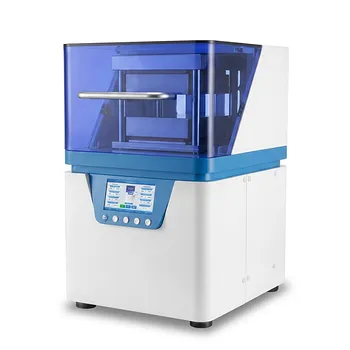
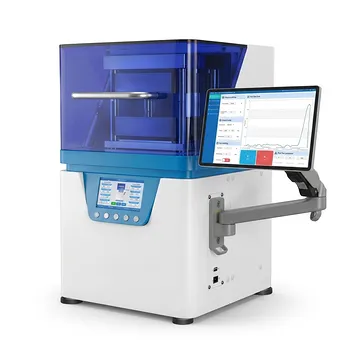
Laboratory hydraulic presses are distinct from industrial models primarily in their scale and operational priority. While industrial presses are massive machines engineered for high-force capacity and heavy manufacturing, laboratory presses are compact units designed for lower force loads but superior precision and control, making them indispensable for research and analytical testing.
The core distinction lies in the trade-off between power and accuracy. Industrial units provide the sheer force necessary for manufacturing and bulk processing, whereas laboratory units prioritize the controlled, repeatable pressure required for delicate sample preparation and material characterization.
The Divide Between Power and Precision
Capacity and Physical Scale
Industrial presses are characterized by their high force capacity. They are typically large, floor-standing machines capable of exerting the immense pressure needed for tasks like crushing vehicles or heavy manufacturing.
Conversely, laboratory presses are significantly smaller and more compact. They are designed to sit on a workbench, saving valuable laboratory space while providing sufficient force for experimental and preparatory tasks.
The Priority of Accuracy
The defining advantage of a laboratory press is its precision. While industrial machines focus on brute force, laboratory models allow for the fine-tuning of pressure application.
This level of control is critical for research consistency. It ensures that the pressure applied to a sample is uniform and repeatable, which is vital when comparing results across different experiments or batches.
Specific Application Ecosystems
Laboratory Use Cases
Laboratory presses are predominantly used for sample preparation and material testing. A primary application is pressing pellets for spectroscopic analysis, which requires highly uniform samples.
Specifically, they are the standard tool for creating potassium bromide (KBr) pellets used in Fourier transform infrared spectroscopy (FTIR). They are also essential for preparing sample pellets for X-ray fluorescence (XRF) analysis.
Beyond spectroscopy, these presses allow researchers to test material durability. They are used to investigate how high pressure impacts various substances, offering insights into material behavior under extreme conditions.
Industrial Use Cases
Industrial hydraulic presses are employed for high-pressure manufacturing tasks. Their ability to apply large forces makes them suitable for powder metallurgy, ceramic preparation, and composite material creation.
They are also utilized in heavy-duty recycling operations. For example, industrial presses are powerful enough to crush cars, a task that illustrates the vast difference in force capability compared to laboratory equipment.
Understanding the Trade-offs
Cost vs. Throughput
While laboratory presses are generally more cost-effective than industrial versions, there is a divergence within the category itself.
Automatic hydraulic presses offer high consistency and can operate autonomously once programmed. However, they come at a higher price point and are best suited for high-throughput labs requiring frequent processing.
Manual vs. Automated Control
Manual hydraulic presses are the most affordable option. They are simple to operate but require significant physical effort and hands-on involvement, which can introduce human error or fatigue.
These are ideal for laboratories with infrequent pressing needs or tight budgets. However, for labs prioritizing speed and absolute consistency, the manual operation represents a trade-off in efficiency compared to automatic or industrial solutions.
Making the Right Choice for Your Goal
Selecting the correct press depends entirely on the volume of work and the precision required by your application.
- If your primary focus is analytical accuracy (FTIR/XRF): Choose a laboratory hydraulic press to ensure the superior precision and control needed for creating uniform pellets.
- If your primary focus is heavy manufacturing or bulk processing: Choose an industrial hydraulic press to access the high force capacity and durability required for production environments.
- If your primary focus is budget optimization for low-volume tasks: Choose a manual laboratory press, which offers a cost-effective solution for occasional sample preparation.
By aligning the machine's capabilities with your specific testing or production requirements, you ensure both the integrity of your data and the efficiency of your workflow.
Summary Table:
| Feature | Laboratory Hydraulic Press | Industrial Hydraulic Press |
|---|---|---|
| Primary Goal | Precision and Repeatability | High Force and Mass Production |
| Physical Size | Compact / Benchtop | Large / Floor-standing |
| Force Capacity | Lower (Optimized for samples) | Immense (Tons to thousands of tons) |
| Applications | FTIR/XRF Pellets, Material Research | Manufacturing, Metallurgy, Recycling |
| Control | Fine-tuned / Programmable | Manual or Automated Bulk Output |
Optimize Your Lab Precision with KINTEK
Are you looking for high-quality, repeatable results in your material research? KINTEK specializes in comprehensive laboratory pressing solutions tailored for your exact needs. From manual and automatic models to heated, multifunctional, and glovebox-compatible presses—as well as specialized cold and warm isostatic presses—we provide the tools essential for advanced battery research and sample preparation.
Don't compromise on precision. Contact KINTEK today to discover how our expert-engineered laboratory presses can enhance your research efficiency and accuracy.
Related Products
- Automatic Hydraulic Hot Press with Large Plate and Precision Temperature Control for Advanced Material Sample Preparation and Industrial Research
- Automatic Hydraulic Heat Press Machine with Multi Stage Programmable Control and Integrated Water Cooling Plate Size 180x180mm
- Automatic High Temperature Heated Hydraulic Press Machine with Heated Plates for Lab
- Automatic Heated Hydraulic Lab Press with Programmable Touch Screen Controls and Precision Temperature Regulation
- Manual Heated Hydraulic Lab Press with Integrated Hot Plates Hydraulic Press Machine
People Also Ask
- What are the specific features and applications of hydraulic hot press machines? Precision Solutions for Modern Labs
- How does an automatic hydraulic press operate? Achieve Precision and Consistency in Lab Pelleting
- What are the advantages and common applications of an automatic hydraulic press? Elevate Your Lab's Precision
- What is the technical significance of setting a precise dwell time? Achieve Peak Material Density and Stability
- When is an automatic hydraulic press more suitable than a manual press? Scale Your Lab with Precision & Speed