The KBr pellet method relies on the precise management of three critical variables: moisture control, particle size reduction, and the application of mechanical pressure. While it is a versatile technique for solid-phase infrared spectroscopy, failing to strictly regulate the environment or the physical preparation will result in opaque pellets and compromised spectral data.
Core Takeaway The effectiveness of a KBr pellet depends entirely on creating an optically transparent medium. The primary obstacles to this are atmospheric moisture, which creates spectral interference, and improper physical preparation, which causes light scattering and structural failure.
Environmental and Chemical Limitations
The Challenge of Hygroscopy
Potassium Bromide (KBr) is naturally hygroscopic, meaning it readily absorbs moisture from the surrounding air. This is the most pervasive limitation of the method.
Absorbed water compromises the physical transparency of the pellet, making it cloudy. Furthermore, water introduces broad, intense absorption bands in the IR spectrum, which can obscure the spectral features of your actual sample.
Environmental Control
To mitigate moisture absorption, preparation should ideally occur in a dry environment or under an infrared lamp.
Additionally, to form a stable and transparent pellet, you must apply a vacuum (several mm Hg) to the die set before pressing. This step is essential to eliminate trapped air and moisture that leads to opacity.
Physical Preparation Constraints
Particle Size and Light Scattering
Achieving a high-quality spectrum requires that both the sample and the KBr powder be finely ground.
If the particles are too coarse, they will scatter infrared light rather than allowing it to pass through. This scattering results in a sloping baseline and poor signal-to-noise ratio, rendering the data difficult to interpret.
Sample Homogeneity
The sample must be thoroughly mixed with the KBr powder to ensure homogeneity.
KBr acts as a dispersing medium; if the sample is not evenly distributed, the IR light will not interact uniformly with the sample molecules. Typically, a concentration of only 1-2% sample by weight is required.
Mechanical and Operational Considerations
The "Goldilocks" Pressure Zone
Pressure control is critical and requires a delicate balance. The standard requirement is often around 8 tons of force maintained for several minutes.
If you apply insufficient pressure, the KBr particles will not fuse completely, resulting in an opaque pellet with white spots. Conversely, excessive pressure can cause the pellet to crack or shatter upon ejection.
Quantity Limitations
One of the most common operational errors is using too much KBr powder.
Compressing a thick layer of powder requires significantly more force than a standard hydraulic press provides. This leads to pellets that wedge in the die or contain white spots indicating an incomplete press.
Understanding the Trade-offs
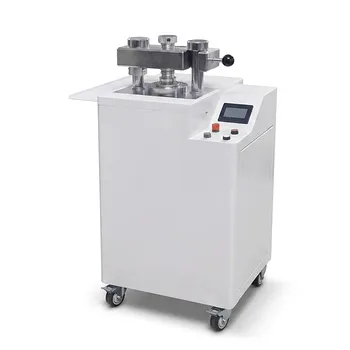
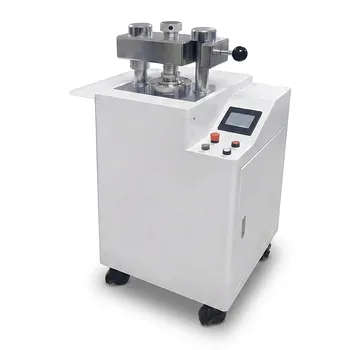
Equipment: Hydraulic vs. Hand Press
While hand presses offer portability and speed, they come with distinct limitations compared to hydraulic presses.
Pellets made with hand presses are not well-suited for long-term storage and often lack the clarity of those made with evacuable dies. A hydraulic press with a vacuum line remains the gold standard for high-quality, reproducible spectra.
Safety Protocols
The method involves inherent physical risks due to the use of high-pressure equipment.
Operators must strictly adhere to manufacturer guidelines to prevent mechanical failure during compression. Furthermore, because KBr is a chemical irritant, appropriate PPE (gloves and safety glasses) is mandatory during handling and grinding.
Making the Right Choice for Your Goal
- If your primary focus is High-Resolution Spectral Quality: Use a hydraulic press with an evacuable die set to ensure total air removal and maximum transparency.
- If your primary focus is Speed and Portability: A hand press is sufficient, but ensure you analyze the sample immediately as the pellet will degrade quickly.
- If your primary focus is Sample Preservation: Ensure you do not use excessive force, which fractures the pellet, and store the final product in a desiccator to prevent moisture attack.
Mastering the KBr pellet method is less about the pressing itself and more about the rigorous preparation that precedes it.
Summary Table:
| Factor | Potential Issue | Mitigation Strategy |
|---|---|---|
| Moisture | Cloudiness & Spectral Interference | Use a vacuum die, IR lamps, and desiccators |
| Particle Size | Light Scattering (Sloping Baseline) | Fine grinding of both sample and KBr powder |
| Pressure | Structural Failure or Opacity | Maintain ~8 tons of force; avoid over/under pressing |
| Concentration | Signal Saturation/Poor S/N Ratio | Keep sample concentration at 1-2% by weight |
| Equipment | Poor Reproducibility | Use a hydraulic press over a hand press for quality |
Elevate Your Spectroscopy with Kintek Precision
Don't let poor pellet quality compromise your research data. KINTEK specializes in comprehensive laboratory pressing solutions designed to overcome the challenges of moisture and pressure control. From manual and automatic hydraulic presses to heated and glovebox-compatible models, we provide the tools necessary for perfect sample preparation in battery research and material science.
Ready to achieve superior spectral clarity? Contact KINTEK Today to Find Your Pressing Solution
Related Products
- Laboratory Hydraulic Press 2T Lab Pellet Press for KBR FTIR
- XRF KBR Plastic Ring Lab Powder Pellet Pressing Mold for FTIR
- Laboratory Hydraulic Pellet Press for XRF KBR FTIR Lab Press
- Automatic Laboratory Hydraulic Press for XRF and KBR Pellet Pressing
- Lab Infrared Press Mold for No Demolding
People Also Ask
- What is the role of a laboratory pressure machine and KBr in FTIR? Master Sample Preparation for Flame Retardants
- What is the role of a laboratory hydraulic press in high-loading NCM811 cathode prep for solid-state batteries?
- What role does a laboratory hydraulic press play in reaction pellets? Optimizing Lunar Soil and Metal Fuel Density
- Why is a laboratory hydraulic press necessary for sample preparation? Precise Pelleting for Spiro Heterocyclic Analysis
- Why is uniform encapsulation pressure necessary for lithium-metal battery assembly? Achieve Flawless In-Situ Results