
The primary advantage of using a laboratory press for sulfide electrolytes is the ability to achieve high material density and ionic conductivity through mechanical force alone, completely bypassing the need for high-temperature thermal treatment. Because sulfide materials possess excellent intrinsic plasticity and ductility, a laboratory press can cold-press powders into a dense pellet, significantly simplifying cell assembly and reducing energy consumption compared to sintering methods used for oxide ceramics.
Core Takeaway Unlike brittle oxide electrolytes that require heat to fuse, soft sulfide electrolytes can be densified via plastic deformation. Using a laboratory press exploits this material property to create continuous lithium-ion pathways at room temperature, offering a faster, more energy-efficient route to high-performance solid-state batteries.
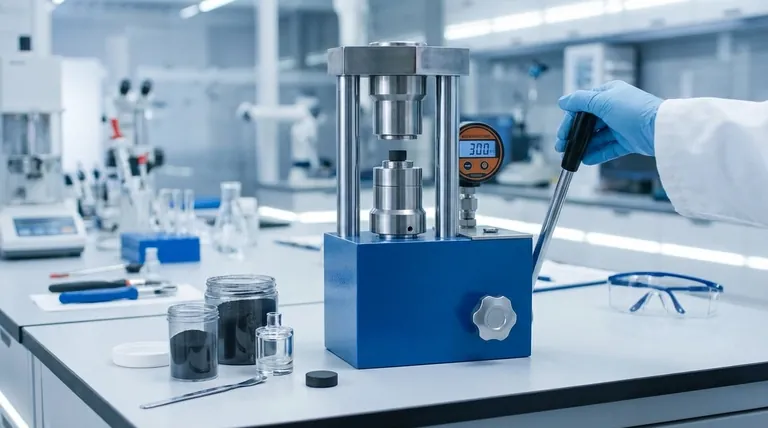
The Material Advantage: Plasticity vs. Heat
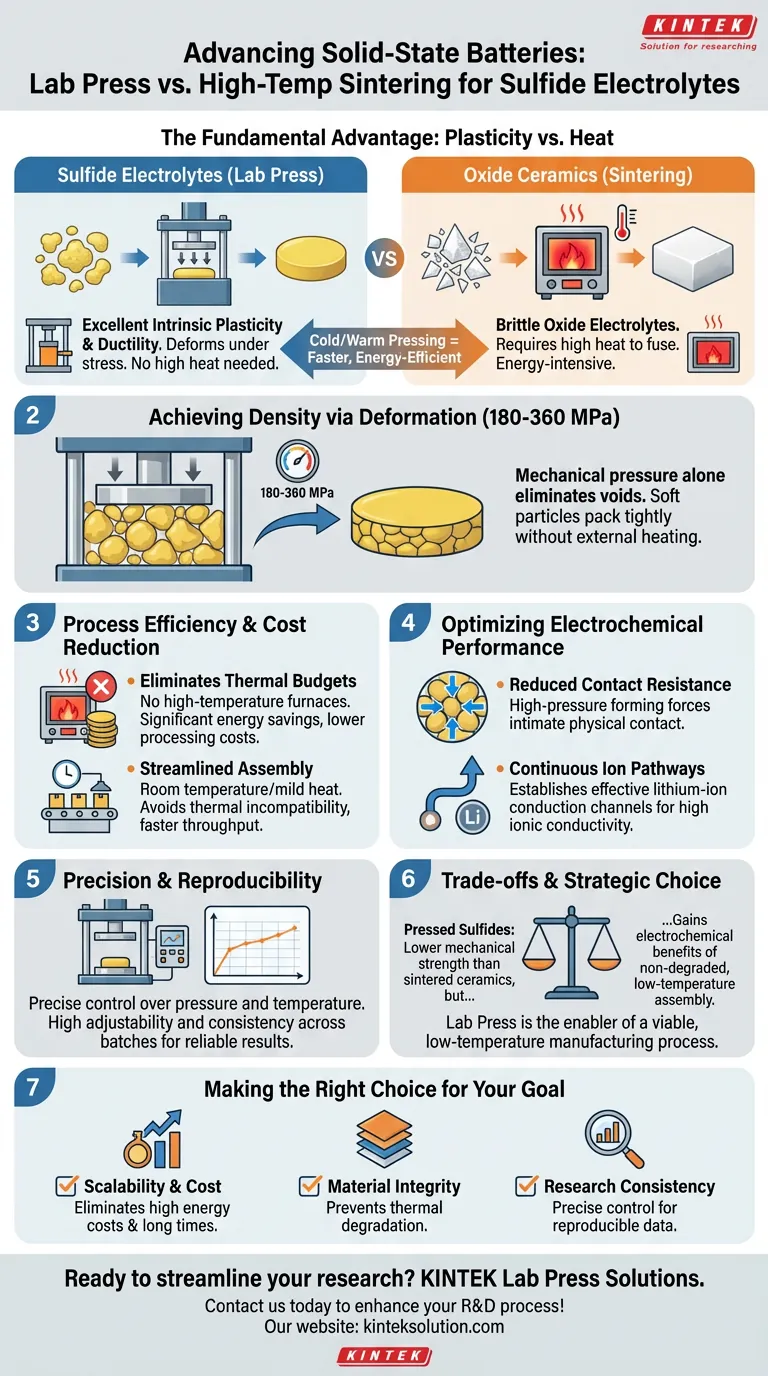
The fundamental difference between pressing sulfides and sintering oxides lies in the mechanical properties of the material itself.
Leveraging Intrinsic Ductility
Sulfide solid-state electrolytes are distinctively soft materials. They possess excellent intrinsic plasticity and ductility, which allows them to deform under stress rather than fracture.
This physical characteristic means that mechanical pressure alone is sufficient to mold the material. You do not need the high thermal energy required to fuse brittle oxide particles.
Achieving Density via Deformation
To create a functional electrolyte, you must eliminate voids between particles. A laboratory press typically applies pressures ranging from 180 to 360 MPa to the sulfide powder.
At these pressures, the soft sulfide particles undergo plastic deformation. They change shape to fill the gaps, packing tightly together to form a dense, cohesive pellet without external heating.
Process Efficiency and Cost Reduction
Switching from high-temperature sintering to cold or warm pressing dramatically alters the manufacturing landscape.
Eliminating Thermal Budgets
Sintering requires maintaining high temperatures for extended periods, which is energy-intensive and costly. By using a laboratory press, you remove the need for high-temperature furnaces during the final assembly.
This results in significant reductions in energy consumption and lowers the overall processing cost, a critical factor for large-scale production viability.
Streamlining Cell Assembly
High-temperature co-sintering often introduces chemical instability or unwanted side reactions between the electrolyte and electrode materials. Cold pressing is conducted at room temperature or under mild heat, circumventing these thermal compatibility challenges.
This simplifies the assembly process, allowing for faster throughput and fewer manufacturing defects related to thermal stress.
Optimizing Performance Metrics
The method of formation directly impacts the electrochemical performance of the solid-state cell.
Reducing Contact Resistance
High ionic conductivity relies on the movement of ions from particle to particle. The high-pressure forming method forces particles into intimate physical contact.
This reduces interfacial contact resistance and establishes continuous lithium-ion conduction pathways, which are fundamental for the battery's efficiency.
Precision and Reproducibility
Laboratory presses offer precise control over pressure and temperature parameters. This allows for high adjustability and consistency across batches.
Researchers can ensure that every sample is subjected to the exact same conditions, leading to highly reproducible data and reliable experimental results.
Understanding the Trade-offs
While pressing offers clear advantages for sulfides, it is essential to understand the limitations compared to sintering.
Mechanical Integrity
While pressed sulfide pellets are dense, they rely on mechanical interlocking and cohesion rather than the chemical fusion achieved during sintering. Consequently, pressed pellets may have lower mechanical strength than sintered ceramics, making them potentially more fragile during handling.
Reactant Preparation vs. Final Forming
It is worth noting that presses are sometimes used before sintering in other contexts to increase the contact area of reactant powders. However, for the specific goal of forming the final sulfide electrolyte layer, the trade-off is often acceptable: you sacrifice the extreme hardness of a sintered ceramic to gain the electrochemical benefits of a non-degraded, low-temperature assembly.
Making the Right Choice for Your Goal
The decision to use a laboratory press relies on your specific material constraints and production targets.
- If your primary focus is Scalability and Cost: The press is superior because it eliminates the high energy costs and long processing times of thermal sintering.
- If your primary focus is Material Integrity: The press is essential for sulfides to prevent the thermal degradation that occurs at the high temperatures required for sintering oxides.
- If your primary focus is Research Consistency: A hydraulic press provides the precise parameter control needed to isolate variables and ensure reproducible data across different sample batches.
Ultimately, for sulfide electrolytes, the laboratory press is not just a tool for shaping; it is the enabler of a viable, low-temperature manufacturing process.
Summary Table:
| Advantage | Key Benefit |
|---|---|
| Material Property Utilization | Leverages intrinsic sulfide plasticity for cold densification. |
| Process Efficiency | Eliminates energy-intensive sintering, reducing costs and time. |
| Performance Optimization | Creates dense pellets with high ionic conductivity and low contact resistance. |
| Precision & Reproducibility | Offers exact control over pressure for consistent, reliable results. |
Ready to streamline your solid-state battery research with a reliable, efficient laboratory press?
KINTEK specializes in lab press machines (including automatic, isostatic, and heated lab presses) designed to meet the precise demands of laboratory environments. Our equipment empowers researchers like you to achieve high-density sulfide electrolytes through controlled cold pressing, accelerating your path to innovation while reducing energy consumption and costs.
Contact us today to discuss how a KINTEK lab press can enhance your specific research and development process!
Visual Guide
Related Products
- Electric Lab Cold Isostatic Press CIP Machine
- Electric Split Lab Cold Isostatic Pressing CIP Machine
- Manual Cold Isostatic Pressing CIP Machine Pellet Press
- Cylindrical Lab Electric Heating Press Mold for Laboratory Use
- Automatic Laboratory Hydraulic Press for XRF and KBR Pellet Pressing
People Also Ask
- What role do electric lab cold isostatic presses play in industrial contexts? Bridge R&D and Manufacturing with Precision
- What are the applications of electric lab cold isostatic presses in research settings? Advance Material R&D with High-Pressure CIPs
- How does electrical Cold Isostatic Pressing (CIP) contribute to cost savings? Unlock Efficiency and Reduce Expenses
- What are some research applications of electric lab CIPs? Unlock Uniform Powder Densification for Advanced Materials
- What are the characteristics of standard off-the-shelf electric lab CIP solutions? Achieve Immediate, Cost-Effective Processing












