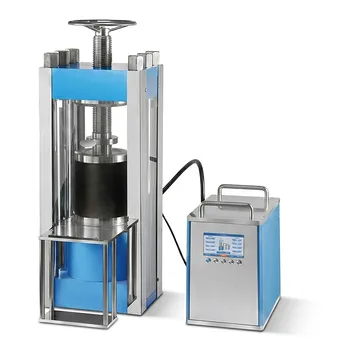
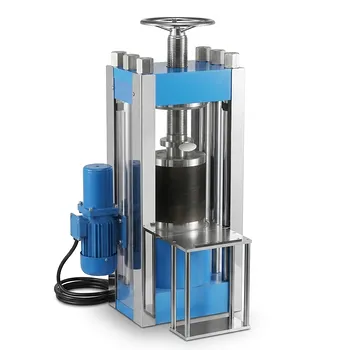
The heated laboratory press is the essential tool for transforming bulk ZnO-modified LDPE into functional, standardized films. It provides simultaneous heat and pressure to melt the polymer matrix, ensuring a uniform thickness (such as 0.3mm) and a dense, bubble-free internal structure. This process creates the precise geometry and structural integrity required for accurate testing of UV shielding, mechanical strength, and antimicrobial properties.
The primary function of the heated laboratory press is to standardize the physical state of the composite by eliminating structural defects and ensuring dimensional consistency. This normalization is critical because it ensures that experimental results reflect the material’s chemical properties rather than inconsistencies in the fabrication process.
Structural Homogenization and Densification
Elimination of Voids and Internal Pores
The application of high, constant pressure during the heating cycle forces air out of the molten LDPE matrix. This eliminates internal bubbles and micropores that would otherwise act as stress concentrators or optical defects. A pore-free structure is vital for achieving the theoretical density of the ZnO-modified composite.
Facilitating Interfacial Bonding
Precise temperature control ensures the LDPE matrix reaches a sufficient state of flow to "wet" the ZnO nanoparticles. This thermal environment, coupled with pressure, facilitates tight interfacial contact between the inorganic fillers and the organic polymer. Strong bonding at this interface is what ultimately determines the composite's final mechanical and barrier properties.
Regulating Polymer Morphology
While the press provides heat to melt the material, it also plays a role in the crystallization behavior of the polyolefin. Controlled cooling within the press allows the LDPE chains to reorganize around the ZnO particles in a stable manner. This results in a consistent microstructure that prevents data scatter during downstream thermal or chemical analysis.
Geometric Standardization and Precision
Achieving Uniform Film Thickness
The press uses calibrated molds or spacers to compress the melt-mixed pellets into films with a standardized thickness, such as 0.3mm. Consistency in thickness is non-negotiable for optical tests, such as ultraviolet (UV) shielding performance. If thickness varies across the sample, the UV absorbance data will be unreliable and incomparable across different batches.
Ensuring Surface Flatness and Quality
The polished platens of the laboratory press impart a smooth, flat surface to the composite film. This high surface quality is essential for photocatalytic degradation experiments and antimicrobial testing, where surface area and contact points must be uniform. A flat specimen also ensures that mechanical grips can hold the sample securely during tensile testing without causing premature failure.
Producing Reliable Test Specimens
By producing specimens with stable geometric dimensions, the press minimizes physical specification differences. This standardization is the foundation for rigorous scientific evaluation. It allows researchers to attribute changes in performance directly to the concentration or modification of the ZnO particles rather than variations in sample shape.
Understanding the Trade-offs
Thermal Degradation vs. Flowability
Setting the temperature too high may improve the flow of the LDPE and the wetting of ZnO, but it risks thermal degradation of the polymer chains. Overheating can lead to chain scission, which artificially lowers the mechanical strength and discolors the film. Finding the "sweet spot" where the polymer flows sufficiently without breaking down is a critical balancing act.
Pressure-Induced Particle Agglomeration
While high pressure is necessary to eliminate voids, excessive force can sometimes cause ZnO nanoparticles to agglomerate or migrate within the melt. If the pressure is not applied evenly, it may create regions of high and low filler concentration. This internal heterogeneity can lead to inconsistent UV shielding or "weak spots" during mechanical tensile experiments.
Optimizing the Pressing Process for Your Goals
How to Apply This to Your Project
The specific settings of your heated laboratory press should be dictated by the primary performance metric you intend to measure in your ZnO-LDPE films.
- If your primary focus is UV Shielding or Optical Clarity: Prioritize thickness precision and surface flatness to ensure consistent light path lengths across the specimen.
- If your primary focus is Mechanical Tensile Strength: Prioritize the elimination of micropores and the optimization of interfacial bonding through precise pressure and "soak time" at peak temperature.
- If your primary focus is Antimicrobial or Photocatalytic Activity: Prioritize surface quality and the prevention of thermal degradation to ensure the ZnO particles remain chemically active at the film surface.
By mastering the balance of heat and pressure, you ensure that your composite films are truly representative of your material innovations.
Summary Table:
| Key Function | Role in ZnO-LDPE Process | Primary Scientific Benefit |
|---|---|---|
| Structural Homogenization | Eliminates voids and internal pores | High theoretical density and bubble-free structure |
| Interfacial Bonding | Facilitates LDPE flow to "wet" ZnO particles | Strengthened mechanical and barrier properties |
| Geometric Standardization | Fixes uniform film thickness (e.g., 0.3mm) | Reliable UV shielding and optical absorbance data |
| Surface Quality | Imparts a smooth, flat surface finish | Consistent photocatalytic and antimicrobial activity |
| Morphology Regulation | Controls polymer crystallization behavior | Stable microstructure and reproducible thermal data |
Elevate Your Material Research with KINTEK Precision Presses
To achieve consistent, high-performance results in ZnO-modified composites and battery research, precise control over heat and pressure is non-negotiable. KINTEK specializes in comprehensive laboratory pressing solutions, offering a versatile range of equipment including manual, automatic, heated, multifunctional, and glovebox-compatible models, as well as advanced cold and warm isostatic presses.
Whether you need to standardize film thickness for UV shielding or ensure perfect interfacial bonding for mechanical testing, our experts are here to help you select the ideal equipment for your specific application.
Ready to optimize your sample preparation? Contact us today to explore our pressing solutions!
References
- Ludmila Motelică, Alina Maria Holban. Antimicrobial Packaging for Plum Tomatoes Based on ZnO Modified Low-Density Polyethylene. DOI: 10.3390/ijms25116073
This article is also based on technical information from Kintek Solution Knowledge Base .
Related Products
- 24T 30T 60T Heated Hydraulic Lab Press Machine with Hot Plates for Laboratory
- Automatic Heated Hydraulic Lab Press 120x120mm Plate Fully Automated Material Research Press
- Automatic Heated Hydraulic Lab Press with Programmable Touch Screen Controls and Precision Temperature Regulation
- Automatic Heated Hydraulic Lab Press Machine 200x200 Plate Size for Battery Research and Materials Science
- Automatic Large Format Laboratory Heated Hydraulic Press 400x400mm Plate Capacity
People Also Ask
- What is the critical role of a laboratory heated hydraulic press? Mastering PVC Sample Prep for Testing
- Why is a laboratory heated hydraulic press essential for PHB films? Achieve Flawless Material Characterization
- Why is a laboratory heated hydraulic press utilized during the lamination stage of NASICON green tapes?
- What is the primary function of a laboratory heated hydraulic press? Mastering Thermoplastic Carbon Fiber Composites
- What role does a laboratory heated hydraulic press play in LTCC? Essential for High-Density Ceramic Lamination