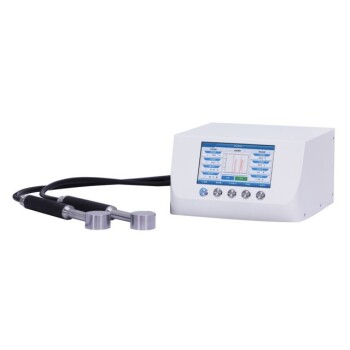
The primary functions of heavy-duty stainless steel platens are twofold: to mechanically simulate underground geological pressure and to provide a sealed pathway for fluid injection. These components apply constant axial stress to mimic the weight of the earth while simultaneously directing pressurized fluid into the sample's core without leaks.
The platens act as the critical interface between laboratory equipment and the sample, transforming a standalone cylinder into a realistic geological model by combining overburden simulation with precise, leak-free fluid delivery.
Simulating Geological Conditions
To generate valid experimental data, laboratory setups must replicate the physical stresses found deep underground. The platens are the primary mechanism for achieving this state.
Application of Constant Axial Stress
The fundamental mechanical role of the stainless steel platen is to apply a constant axial stress to the cylindrical sample. This ensures the sample is under continuous vertical compression throughout the experiment.
Replicating Overburden Pressure
This axial stress is not arbitrary; it is calculated to simulate overburden pressure. By maintaining this load, the platens recreate the specific environmental conditions found at targeted geological depths.
Managing Fluid Injection and Sealing
Beyond mechanical loading, the platens serve as the delivery system for the hydraulic fracturing fluid. This requires precise engineering to ensure the fluid travels only where intended.
Integrated Injection Channels
The platens feature built-in fluid injection channels located in their center. These channels provide a direct conduit for cyclic pressure fluid to enter the pre-drilled central borehole of the sample.
Achieving a Reliable Seal
To control the fluid path, the platens utilize Nitrile Butadiene Rubber (NBR) O-rings. These components form a robust end-face seal where the metal platen meets the rock surface.
Preventing Lateral Leakage
The combination of the heavy-duty stainless steel structure and the NBR O-rings ensures fluid containment. This design prevents lateral leakage, guaranteeing that pressure is applied exclusively to the borehole walls.
Operational Considerations and Dependencies
While these platens are robust, their effectiveness relies on specific operational conditions. Understanding these dependencies is vital for experimental success.
Reliance on Seal Integrity
The accuracy of the hydraulic data hinges on the condition of the NBR O-rings. If the O-ring fails or the end-face contact is uneven, the fluid will bypass the borehole, invalidating the test.
Sensitivity to Axial Load Stability
The simulation assumes the applied stress represents a static geological depth. Any inability of the platens to maintain constant stress will disrupt the overburden model and compromise the realism of the experiment.
Ensuring Experimental Success
- If your primary focus is Geological Realism: Verify that the platens are capable of maintaining a strictly constant axial stress to accurately reflect the overburden pressure of your target depth.
- If your primary focus is Data Accuracy: regularly inspect the NBR O-rings and the platen surface to ensure a perfect end-face seal that prevents lateral leakage during fluid injection.
The integrity of your hydraulic fracturing experiment depends on the platens' ability to unify mechanical load and fluid isolation into a single, reliable system.
Summary Table:
| Feature | Primary Function | Laboratory Benefit |
|---|---|---|
| Heavy-Duty Construction | Applies Constant Axial Stress | Accurately replicates deep-earth overburden pressure |
| Integrated Channels | Directs Fluid Injection | Ensures pressurized fluid reaches the sample core precisely |
| NBR O-Rings | Creates End-Face Seal | Prevents lateral leakage and ensures data integrity |
| Stainless Steel Material | High Load Durability | Resists corrosion and maintains stability under cyclic pressure |
Optimize Your Geological Simulations with KINTEK Precision
Ready to enhance the reliability of your hydraulic fracturing studies? KINTEK specializes in comprehensive laboratory pressing solutions, offering a range of manual, automatic, and specialized presses designed for high-pressure environments. Our expertise in battery research, material science, and geological modeling ensures you receive equipment that delivers constant axial stress and leak-free fluid delivery every time.
Discover how our stainless steel solutions can transform your experimental accuracy.
Contact KINTEK Today for a Custom Solution
References
- Julien Mouli‐Castillo, Zoe K. Shipton. Cyclical hydraulic pressure pulses reduce breakdown pressure and initiate staged fracture growth in PMMA. DOI: 10.1007/s40948-024-00739-z
This article is also based on technical information from Kintek Solution Knowledge Base .
Related Products
- Split Automatic Heated Hydraulic Press Machine with Heated Plates
- Automatic High Temperature Heated Hydraulic Press Machine with Heated Plates for Lab
- Lab Double Plate Heating Mold for Laboratory Use
- Automatic Heated Hydraulic Press Machine with Heated Plates for Laboratory
- Infrared Heating Quantitative Flat Plate Mold for Precise Temperature Control
People Also Ask
- What are the requirements for electrode pressing with high-viscosity ionic liquids like EMIM TFSI? Optimize Performance
- How does a laboratory heated hydraulic press facilitate PBN sample prep for WAXS? Achieve Precise X-Ray Scattering
- What are the industrial applications of heated hydraulic presses? Master Heat & Force for Precision Manufacturing
- Why is a laboratory hydraulic press with heating plates required for PLA/TEC films? Achieve Precise Sample Integrity
- Function of a Laboratory Hydraulic Press with Heated Platens in SSE? Enhance Battery Density & Conductivity