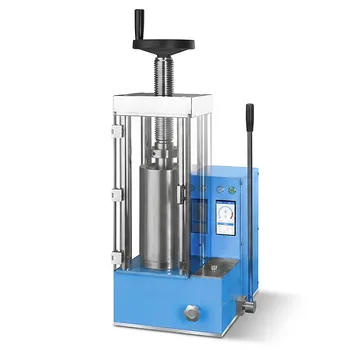
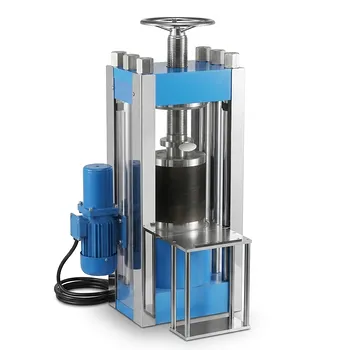
For the densification of powders and pastes, the typical operational values are significantly lower than those used for solid pellet formation. In a standard 13 mm diameter die, the recommended load is 0.5 tonnes. This application of force results in a pressure of 37 MPa.
Core Takeaway Distinct from creating fused solids, densification requires moderate pressure to reduce void volume without compromising the material's matrix. A load of 0.5 tonnes (37 MPa) is standard for pastes, whereas solid pelletization requires nearly 20 times that force.
The Mechanics of Densification
The Standard Configuration
In laboratory environments, the 13 mm diameter die is the standard vessel for processing small sample batches.
The geometry of the die directly dictates how applied force translates into internal pressure.
Operational Values for Pastes
When the objective is densification—removing air gaps from a powder or paste—high force is often detrimental.
A load of 0.5 tonnes is sufficient to pack the particles tightly.
This load generates 37 MPa of pressure, which consolidates the material while maintaining its semi-solid or paste-like consistency.
Distinguishing Densification from Pelletizing
The High-Pressure Alternative
It is vital not to confuse densification with the creation of standard-sized pellets (such as KBr pellets for FTIR analysis).
Creating a solid, fused pellet requires a significantly higher load of 10 tonnes.
The Pressure Gap
The difference in pressure between these two processes is drastic.
While densification occurs at 37 MPa, pelletizing subjects the sample to 739 MPa.
Applying pelletizing pressures to a densification task represents an increase of roughly 2000% over the required force.
Common Pitfalls and Trade-offs
The Risk of Over-Pressurization
Applying pelletizing loads (10 tonnes) to a paste intended for simple densification can destroy the sample.
Excessive pressure may squeeze liquid components out of a paste, altering its chemical composition.
It can also crush porous particles that were meant to remain intact.
The Risk of Under-Pressurization
Conversely, applying only 0.5 tonnes when attempting to make a solid pellet will fail.
The resulting disc will lack structural integrity.
It will likely crumble immediately upon ejection from the die or during subsequent handling.
Making the Right Choice for Your Goal
To ensure sample integrity, match your load settings to your specific processing objective.
- If your primary focus is densifying powders or pastes: Apply a load of 0.5 tonnes (37 MPa) to reduce volume without fusing the material.
- If your primary focus is creating solid, durable pellets: Increase the load to 10 tonnes (739 MPa) to force particle fusion and create a stable disc.
Precision in pressure application is the single most important factor in preserving the physical fidelity of your sample.
Summary Table:
| Process Type | Die Diameter | Recommended Load | Resulting Pressure | Objective |
|---|---|---|---|---|
| Densification | 13 mm | 0.5 Tonnes | 37 MPa | Reduce void volume in pastes/powders |
| Pelletizing | 13 mm | 10.0 Tonnes | 739 MPa | Create solid, fused discs (e.g., KBr) |
Elevate Your Material Research with KINTEK Precision
Don't risk sample integrity with imprecise pressure application. KINTEK specializes in comprehensive laboratory pressing solutions tailored for advanced research. Whether you are densifying sensitive pastes for battery research or creating durable solid pellets, our range of manual, automatic, heated, and multifunctional presses provides the exact control you need.
From glovebox-compatible models to cold and warm isostatic presses, we deliver the reliability essential for modern material science. Contact KINTEK today to find the perfect pressing solution for your lab and ensure consistent, high-quality results every time.
Related Products
- Electric Isostatic Pressing Machine 40 Tons Automatic Laboratory Powder Compacting Press
- Split Warm Isostatic Lab Press 200 Ton Powder Compaction Chamber for Battery Research and Material Science
- XRF KBR Plastic Ring Lab Powder Pellet Pressing Mold for FTIR
People Also Ask
- What are the key characteristics of the isostatic pressing process? Unlock Uniform Density and Complex Geometries
- Why is vacuum-sealed packaging necessary before isostatic pressing of CuPc thin films? Protect Integrity & Uniformity
- How is pressure applied to the material during isostatic pressing? Master Uniform Density and Complex Geometries
- How does pressure distribute during isostatic pressing of aluminum? Achieve Uniform Density for Your Lab Materials
- What are the applications of isostatic pressing in the automotive industry? Precision Manufacturing for High-Performance Parts