
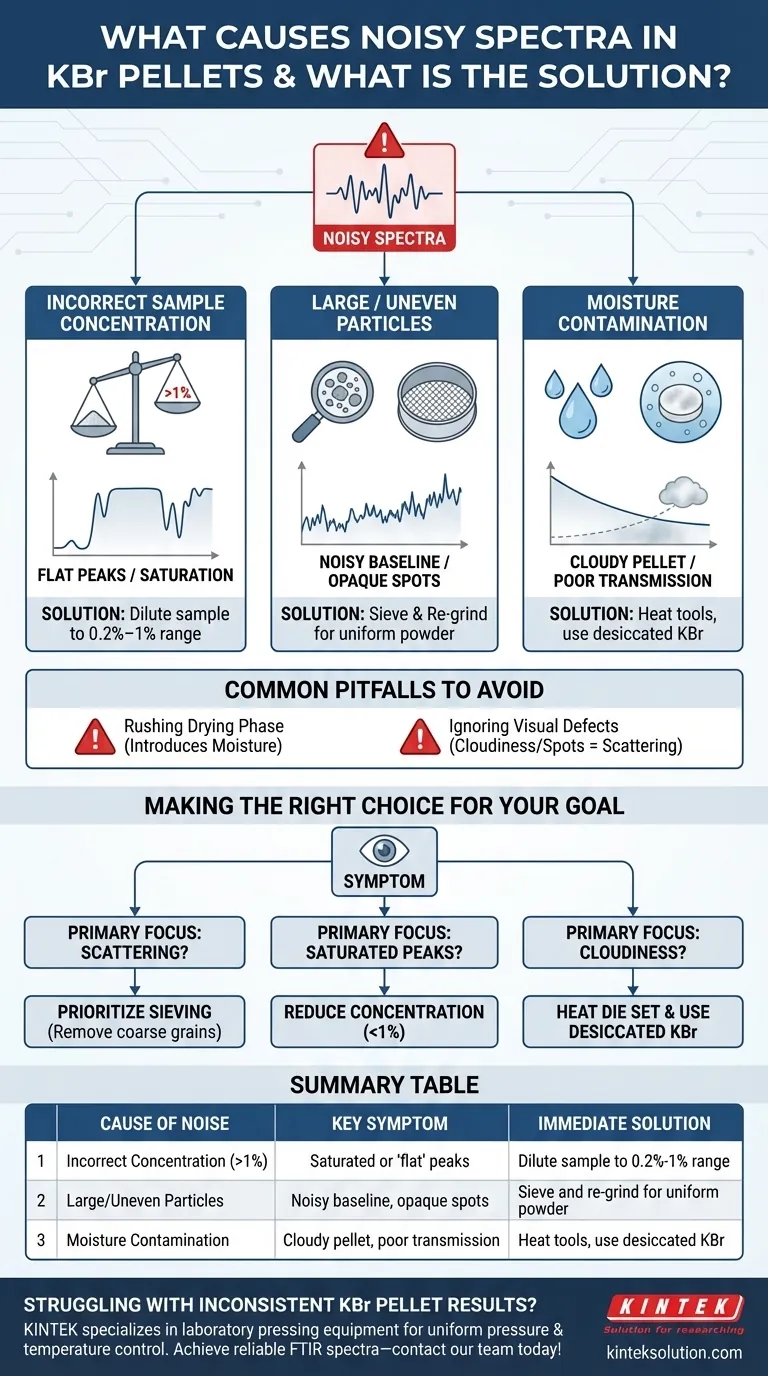
Noisy spectra in KBr pellet analysis are primarily caused by three physical factors: incorrect sample concentration, retained moisture, or uneven particle distribution. The immediate solution requires adjusting your sample-to-KBr ratio to the 0.2%–1% range, thoroughly drying your materials and tools, and ensuring a uniformly fine powder consistency.
Achieving a high-quality spectrum relies on minimizing light scattering and preventing detector saturation. Most noise issues are not instrumental faults, but rather physical defects within the pellet matrix itself.
Optimizing Sample Concentration
The Ideal Ratio
To prevent signal distortion, the sample concentration within the KBr matrix must be precise. The recommended range is strictly between 0.2% and 1% by weight.
The Consequences of Excess
Exceeding this concentration range leads to over-absorption. When the sample is too dense, it blocks too much energy from reaching the detector, resulting in "flat" peaks and significant noise.
Correcting the Mix
If your spectra appear noisy or saturated, you must dilute the sample. Adjust the ratio by adding more KBr powder until the concentration falls back within the optimal window.
Managing Particle Size and Distribution
The Impact of Large Particles
Large or coarse particles within the pellet do not transmit infrared light effectively. Instead, they cause light scattering, which manifests as a noisy baseline or opaque spots in the pellet.
Ensuring Homogeneity
Visual inspection is a key diagnostic tool; a clear pellet indicates good distribution. If you see opaque spots, the powder distribution is uneven.
The Mechanical Solution
To fix scattering issues, the powder should be sieved to remove coarse grains. If the mix is already blended, you may need to re-grind the mixture and re-press it to form a uniform, transparent pellet.
Combating Moisture Contamination
The Hygroscopic Challenge
Moisture is the most critical variable in KBr analysis. Because KBr is hygroscopic, it absorbs ambient humidity, leading to cloudy pellets and poor spectral quality.
Thermal Preparation
The first step in any preparation protocol must be moisture removal. You should heat the anvils and die set to drive off residual moisture on the metal surfaces.
Material Storage
Never leave KBr powder exposed to the atmosphere. Use high-quality powder that has been stored in a heated case or a desiccator to ensure it remains completely dry.
Common Pitfalls to Avoid
Rushing the Drying Phase
It is often tempting to skip heating the die set to increase throughput. However, skipping this step introduces moisture that causes cloudiness, forcing you to restart the entire process.
Ignoring Visual Defects
Attempting to analyze a pellet that contains visible opaque spots or cloudiness is rarely productive. These visual cues are reliable indicators of scattering; re-grinding or re-pressing immediately is more efficient than analyzing a bad pellet.
Making the Right Choice for Your Goal
To solve your specific noise issue, look at the characteristics of your bad spectrum:
- If your primary focus is reducing baseline scattering: Prioritize sieving your powder to remove coarse grains and ensure a uniform particle size.
- If your primary focus is resolving saturated or noisy peaks: Reduce your sample concentration to ensure it is strictly below the 1% threshold.
- If your primary focus is eliminating cloudiness: Heat your die set and use desiccated KBr powder to eliminate moisture.
Mastering the physical preparation of the pellet is the single most effective way to improve your spectral data.
Summary Table:
| Cause of Noise | Key Symptom | Immediate Solution |
|---|---|---|
| Incorrect Sample Concentration (>1%) | Saturated or 'flat' peaks | Dilute sample to 0.2%-1% range |
| Large/Uneven Particles | Noisy baseline, opaque spots | Sieve and re-grind for uniform powder |
| Moisture Contamination | Cloudy pellet, poor transmission | Heat tools, use desiccated KBr |
Struggling with inconsistent KBr pellet results? KINTEK specializes in laboratory pressing equipment, including automatic lab presses and heated lab presses, designed to deliver the uniform pressure and temperature control essential for producing clear, high-quality pellets. Let our expertise help you achieve reliable FTIR spectra—contact our team today to discuss your specific application needs!
Visual Guide
Related Products
- XRF KBR Plastic Ring Lab Powder Pellet Pressing Mold for FTIR
- Laboratory Hydraulic Press 2T Lab Pellet Press for KBR FTIR
- XRF KBR Steel Ring Lab Powder Pellet Pressing Mold for FTIR
- Automatic Laboratory Hydraulic Press for XRF and KBR Pellet Pressing
- Laboratory Hydraulic Pellet Press for XRF KBR FTIR Lab Press
People Also Ask
- What is the purpose of making KBr pellets for FTIR? Achieve Precise Molecular Analysis with Solid Samples
- What factors should be considered when choosing a lab press for XRF pellet preparation? Ensure Accurate and Consistent Results
- Why are pellets used in XRF analysis, and what is their limitation? Boost Accuracy and Speed in Your Lab
- How are pellets prepared for XRF analysis and what is a potential drawback? Master XRF Sample Prep and Accuracy
- What checklist of factors should be considered when choosing an XRF pellet press? Ensure Accurate Sample Preparation















