
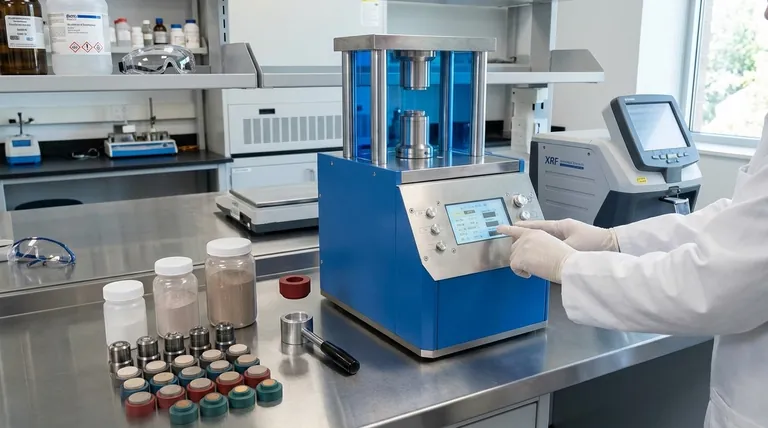
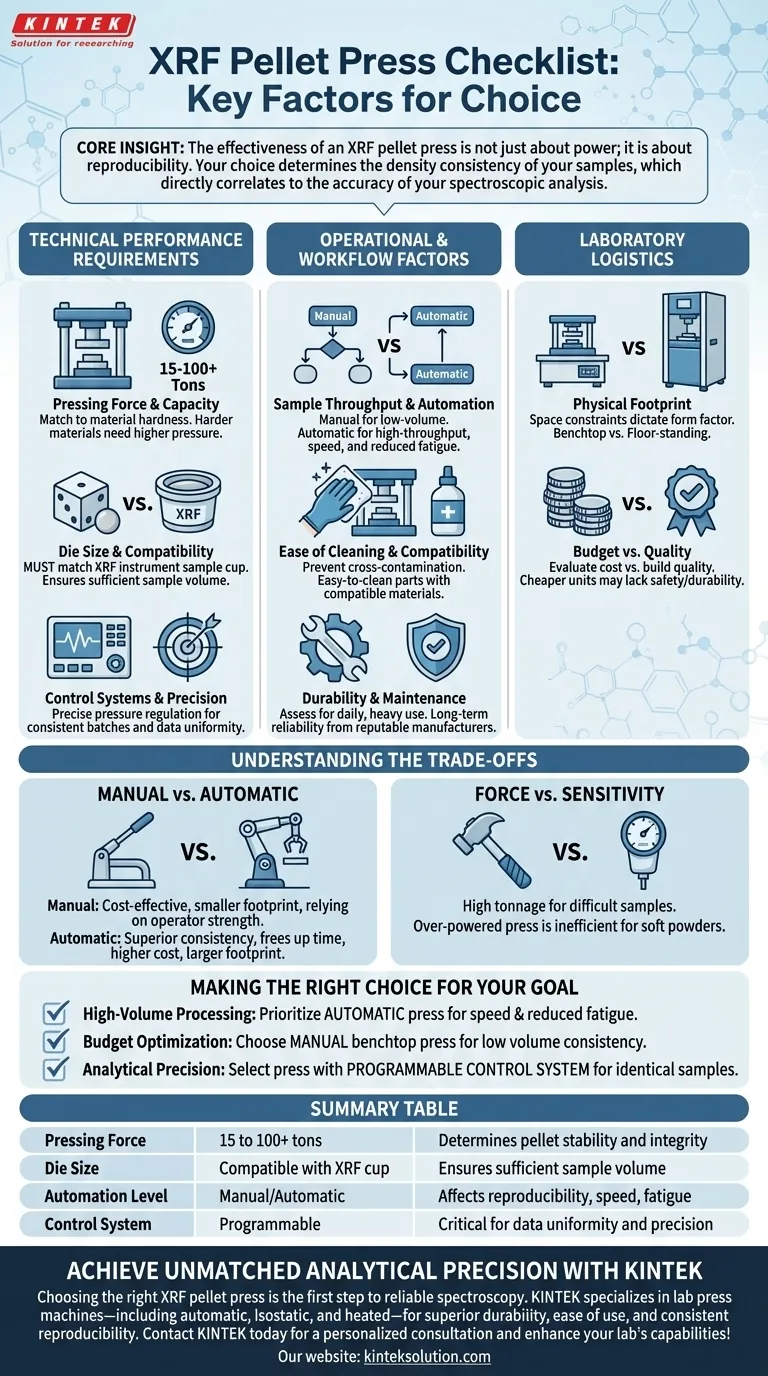
Choosing the right XRF pellet press requires balancing technical specifications with your laboratory's specific workflow demands. Key factors include the required pressing force (typically ranging from 15 to over 100 tons), die size compatibility with your XRF instrument, sample throughput volume, and physical workspace constraints.
Core Insight: The effectiveness of an XRF pellet press is not just about power; it is about reproducibility. Your choice determines the density consistency of your samples, which directly correlates to the accuracy of your spectroscopic analysis.
1. Technical Performance Requirements
Pressing Force and Capacity
You must select a press that provides adequate pressing force for your specific material types.
Standard presses typically offer ranges from 15 tons to over 100 tons.
Harder materials generally require higher pressure to form stable pellets, while softer materials may require less.
Die Size and Compatibility
The die size is a critical specification that must match your XRF instrument's sample cup.
If the die is too small, the resulting pellet may not contain enough sample for accurate analysis.
Ensure the die size also accommodates the volume of sample material you typically generate.
Control Systems and Precision
Consider the features of the control system, specifically regarding pressure regulation.
Precise control allows you to maintain consistent pressure across different batches, ensuring data uniformity.
2. Operational and Workflow Factors
Sample Throughput and Automation
Your choice between manual and automatic presses should depend on your sample volume.
Manual presses are generally sufficient for low-volume laboratories with simple sample needs.
Automatic presses are necessary for high-throughput environments where speed and operator fatigue are concerns.
Ease of Cleaning and Material Compatibility
Cross-contamination is a major risk in XRF analysis; the press must be easy to clean between samples.
Parts that contact the sample should be made of compatible materials that do not introduce elemental contamination.
Durability and Maintenance
Assess the machine's durability and stability, especially if it will be subjected to daily, heavy use.
Investigate the reputation of the manufacturer regarding long-term reliability.
3. Laboratory Logistics
Physical Footprint
Space constraints often dictate the form factor of the machine.
Determine if your lab requires a compact benchtop model or can accommodate a larger floor-standing unit.
Budget vs. Quality
Evaluate the overall cost relative to the build quality and performance needs.
While budget is a primary factor, purchasing a cheaper unit that lacks necessary safety features or durability often costs more in the long run.
Understanding the Trade-offs
Manual vs. Automatic Operation
Manual presses are cost-effective and have a smaller footprint, making them ideal for field work or occasional testing.
However, they rely on operator strength, which can lead to inconsistencies in pellet density and lower reproducibility.
Automatic presses provide superior consistency and free up technician time, but they come with a significantly higher price tag and larger physical footprint.
Force vs. Sensitivity
While high tonnage is useful for difficult samples, an "over-powered" press may be unnecessary for soft powders.
Buying a 100-ton press for samples that only require 15 tons is an inefficient allocation of budget and space.
Making the Right Choice for Your Goal
To select the correct press, align the specifications with your primary laboratory objective:
- If your primary focus is high-volume processing: Prioritize an automatic press to ensure throughput speed and reduce operator fatigue.
- If your primary focus is budget optimization: Choose a manual benchtop press, provided your sample volume is low enough to maintain consistency.
- If your primary focus is analytical precision: Select a press with a programmable control system to guarantee identical pressure and dwell times for every sample.
The best pellet press is the one that delivers the highest consistency your budget allows, ensuring that sample preparation never becomes the bottleneck in your analysis.
Summary Table:
| Factor | Key Consideration | Impact on Analysis |
|---|---|---|
| Pressing Force | 15 to 100+ tons; match to material hardness | Determines pellet stability and integrity |
| Die Size | Must be compatible with XRF instrument sample cup | Ensures sufficient sample volume for accurate reading |
| Automation Level | Manual for low volume; Automatic for high throughput | Affects reproducibility, speed, and operator fatigue |
| Control System | Programmable for precise pressure and dwell time | Critical for data uniformity and analytical precision |
Achieve Unmatched Analytical Precision with KINTEK
Choosing the right XRF pellet press is the first step to reliable spectroscopy. KINTEK specializes in lab press machines—including automatic lab presses, isostatic presses, and heated lab presses—designed to meet the rigorous demands of laboratory sample preparation. Our presses are engineered for superior durability, ease of use, and most importantly, consistent reproducibility, ensuring your sample preparation never compromises your analysis.
Let our experts help you select the perfect press for your throughput, budget, and precision goals. Contact KINTEK today for a personalized consultation and enhance your lab's capabilities!
Visual Guide
Related Products
- XRF KBR Plastic Ring Lab Powder Pellet Pressing Mold for FTIR
- Lab XRF Boric Acid Powder Pellet Pressing Mold for Laboratory Use
- XRF KBR Steel Ring Lab Powder Pellet Pressing Mold for FTIR
- Laboratory Hydraulic Pellet Press for XRF KBR FTIR Lab Press
- Automatic Laboratory Hydraulic Press for XRF and KBR Pellet Pressing
People Also Ask
- What is the purpose of making KBr pellets for FTIR? Achieve Precise Molecular Analysis with Solid Samples
- What factors should be considered when choosing a lab press for XRF pellet preparation? Ensure Accurate and Consistent Results
- Why are pellets used in XRF analysis, and what is their limitation? Boost Accuracy and Speed in Your Lab
- How are pellets prepared for XRF analysis and what is a potential drawback? Master XRF Sample Prep and Accuracy
- What are the main methods for preparing XRF pellets? Boost Accuracy and Efficiency in Your Lab



















