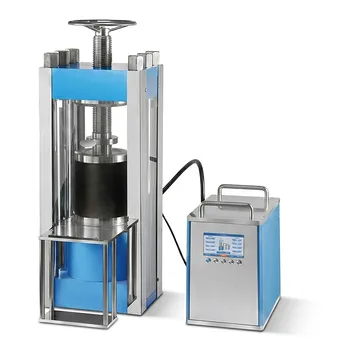
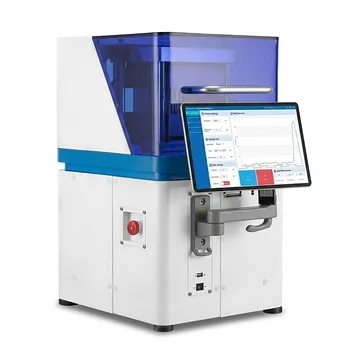
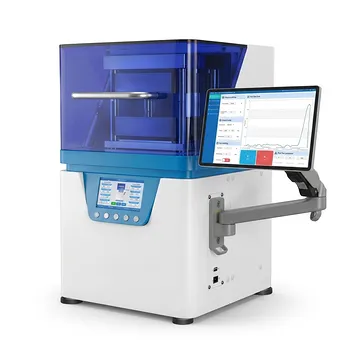
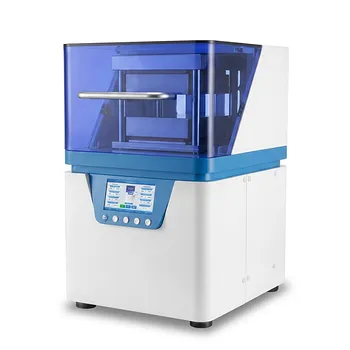
The control system of a laboratory hot press relies on four fundamental components to ensure process consistency and safety. These core elements are a Temperature Controller (typically utilizing PID logic), a Pressure Controller, a Timer for stage management, and a Human-Machine Interface (HMI) for operator input and monitoring.
Core Takeaway: While the frame and platens provide the physical force and heat, the control system is the "brain" that synchronizes these elements. It transforms raw mechanical potential into a precise, repeatable scientific process by strictly regulating heating rates, dwell times, and pressure application.
The Architecture of Precision Control
To understand how a laboratory hot press delivers consistent results, you must look at how its control components interact. Each component manages a specific variable of the thermodynamic process.
Temperature Management
The Temperature Controller is responsible for the thermal profile of the operation. It manages not only the target temperature but also the heating rate and holding time.
Most modern systems use PID (Proportional-Integral-Derivative) control. This advanced algorithm minimizes temperature overshoot and ensures the platens remain stable at the specific set point required for your material.
Force Regulation
The Pressure Controller commands the hydraulic or pneumatic systems to apply force to the ram. Its primary function is to set and rigorously maintain the target pressure throughout the cycle.
This component ensures that the material acts under constant compaction, compensating for any changes in material viscosity or volume during the heating phase.
Temporal Synchronization
The Timer dictates the duration of the various process stages. It coordinates the holding time, ensuring the sample is exposed to heat and pressure for the exact amount of time needed for curing or consolidation.
In automated cycles, the timer also triggers the transition between heating, holding, and cooling phases.
The Operator Interface
The Human-Machine Interface (HMI) serves as the bridge between the user and the machine. This is typically a touch screen or keypad where operators input parameters.
Beyond data entry, the HMI allows for real-time monitoring of the process, giving the operator visibility into current temperature and pressure readings against the set targets.
Advanced Data Capabilities
High-end models extend beyond basic control to include data logging. This feature records process variables over time, creating a digital audit trail of the experiment.
Common Pitfalls to Avoid
When evaluating control systems, it is vital to understand the trade-offs between simplicity and capability.
The Limitation of Basic Controllers
A basic system may reach a target temperature, but without PID control, it may heat up too quickly or fluctuate around the set point. This lack of precision can induce thermal stress in sensitive samples or lead to uneven curing.
The "Black Box" Problem
Systems without data logging or a detailed HMI leave the operator blind to historical performance. If a sample fails, you cannot retroactively check if a pressure drop or temperature spike occurred during the unattended holding stage.
Making the Right Choice for Your Goal
Selecting the right control configuration depends heavily on the complexity of your materials and the purpose of your lab.
- If your primary focus is repeatable production: Prioritize a system with a programmable Timer and intuitive HMI to ensure different operators can run the exact same cycle without error.
- If your primary focus is material research and development: Require a system with PID temperature control and data logging to precisely manipulate heating rates and analyze the exact conditions the sample experienced.
The best control system is one that removes variability from your equation, allowing you to focus on the material rather than the machine.
Summary Table:
| Component | Primary Function | Key Feature |
|---|---|---|
| Temperature Controller | Manages thermal profiles and heating rates | PID Logic for stability |
| Pressure Controller | Regulates hydraulic/pneumatic force | Maintains constant compaction |
| Timer | Synchronizes process stages and holding times | Automates cycle transitions |
| HMI (Interface) | Human-machine interaction and monitoring | Real-time data visualization |
| Data Logger | Records experimental variables | Digital audit trail for R&D |
Elevate Your Material Research with KINTEK Precision
Don't let equipment variability compromise your scientific results. KINTEK specializes in comprehensive laboratory pressing solutions, offering a versatile range of manual, automatic, heated, multifunctional, and glovebox-compatible models, as well as cold and warm isostatic presses widely applied in advanced battery research.
Whether you need granular PID temperature control for R&D or automated timers for repeatable production, our systems are engineered to turn raw mechanical potential into a precise scientific process.
Ready to optimize your lab’s efficiency? Contact our technical experts today to find the perfect press for your specific application.
Related Products
- Automatic Hydraulic Hot Press with Large Plate and Precision Temperature Control for Advanced Material Sample Preparation and Industrial Research
- Automatic Heated Hydraulic Lab Press with Programmable Touch Screen Controls and Precision Temperature Regulation
- Automatic Heated Hydraulic Press Machine with Hot Plates for Laboratory
- Split Hot Isostatic Pressing Machine 150 Ton Laboratory Heated Isostatic Press
- Automatic High Temperature Heated Hydraulic Press Machine with Heated Plates for Lab
People Also Ask
- What are the specific features and applications of hydraulic hot press machines? Precision Solutions for Modern Labs
- How does an automatic hydraulic press operate? Achieve Precision and Consistency in Lab Pelleting
- What are the advantages and common applications of an automatic hydraulic press? Elevate Your Lab's Precision
- What is the technical significance of setting a precise dwell time? Achieve Peak Material Density and Stability
- When is an automatic hydraulic press more suitable than a manual press? Scale Your Lab with Precision & Speed