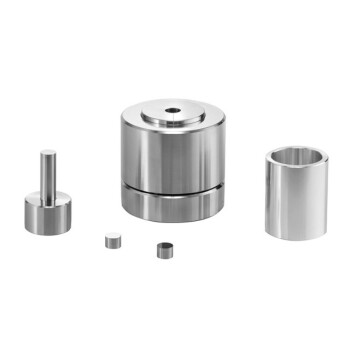
The laboratory hydraulic press serves as the fundamental mechanism for transforming raw Ge-S-Cd alloy powder into a testable solid state. By applying a substantial pressure of 6 tons per square centimeter, the device compresses ground powder into high-density solid disks—typically 3cm in diameter and 3mm thick—effectively eliminating inter-particle voids to prepare the material for electrical characterization.
Core Takeaway The hydraulic press is not merely a shaping tool; it is a data integrity device. By maximizing bulk density and eliminating air gaps, it ensures uniform current flow, which is the absolute prerequisite for obtaining reliable, repeatable resistivity and electrical conductivity measurements in Ge-S-Cd alloys.
Transforming Powder into Testable Samples
The Physics of Densification
The primary function of the press in this context is void elimination. Raw Ge-S-Cd powder consists of loose particles separated by air gaps.
When the hydraulic press applies 6 tons/cm² of pressure, it forces these particles together, collapsing the voids. This mechanical compaction increases the bulk density of the sample, turning a loose aggregate into a cohesive solid disk.
Standardization of Sample Geometry
The press allows for precise control over the dimensions of the sample.
In the case of Ge-S-Cd alloys, the standard output is a disk with a diameter of 3cm and a thickness of 3mm. Creating samples with identical geometry is essential for comparative analysis across different experiments.
Ensuring Data Integrity in Electrical Testing
Establishing Uniform Current Flow
The ultimate goal of molding these alloys is often to test resistivity and electrical conductivity.
If voids remain between particles, they act as electrical insulators, disrupting the path of the current. High-pressure molding creates a continuous material structure, ensuring that current flows uniformly through the sample rather than arcing across gaps.
Improving Experimental Repeatability
Without high-density compaction, data becomes noisy and unreliable.
By consistently applying high pressure, the hydraulic press guarantees that variations in test results are due to the material properties of the alloy itself, not inconsistencies in how the sample was packed. This leads to significantly improved reliability and repeatability of experimental data.
Understanding the Trade-offs
Pressure vs. Structural Integrity
While high pressure is necessary for density, there is a limit to the material's tolerance.
Excessive or uneven pressure can lead to lamination or cracking within the "green compact" (the pressed powder before any sintering). The pressure must be high enough to bond the particles but controlled enough to maintain the structural integrity of the disk.
The Limits of Cold Pressing
The process described for Ge-S-Cd appears to be a cold pressing operation (based on the primary text).
While effective for density, cold pressing relies purely on mechanical interlocking and plastic deformation. Unlike hot pressing, which induces thermal bonding, cold pressing requires rigorous adherence to pressure protocols to prevent the sample from crumbling during handling.
Making the Right Choice for Your Goal
To maximize the utility of your laboratory hydraulic press for Ge-S-Cd alloys, align your process with your specific analytical needs:
- If your primary focus is Electrical Conductivity: Ensure you reach the full 6 tons/cm² threshold to minimize contact resistance between particles.
- If your primary focus is Mechanical Stability: Verify that the pressure dwell time is sufficient to allow air to escape, preventing internal micro-cracks in the 3mm thick disk.
- If your primary focus is Comparative Data: Strictly standardize the mass of the powder loaded into the mold to ensure the resulting density is consistent across all samples.
By treating the molding stage as a precision process rather than a rough preparation step, you secure the validity of your downstream electrical measurements.
Summary Table:
| Parameter | Specification/Value | Importance in Ge-S-Cd Testing |
|---|---|---|
| Applied Pressure | 6 tons/cm² | Eliminates voids & maximizes bulk density |
| Sample Geometry | 3cm (D) x 3mm (T) | Ensures standardized dimensions for comparative analysis |
| Primary Goal | Void Elimination | Guarantees uniform current flow for electrical characterization |
| Key Outcome | Data Integrity | Improves reliability and repeatability of resistivity results |
Elevate Your Material Research with KINTEK Precision
Precision in the molding stage is the foundation of reliable experimental data. KINTEK specializes in comprehensive laboratory pressing solutions tailored for advanced material science. Whether you are conducting battery research or alloy characterization, our range of manual, automatic, heated, and glovebox-compatible models, as well as cold and warm isostatic presses, ensures the perfect density for every sample.
Don't let air gaps compromise your results. Partner with KINTEK to achieve the structural integrity your research demands.
Contact KINTEK for Your Pressing Solution Today
References
- Zainab Abd Al-hadi, Kareem A. Jasim. The Effect of Partial Substitution of Ge-S-Cd Alloys on the Density of Energy States. DOI: 10.30526/37.1.3314
This article is also based on technical information from Kintek Solution Knowledge Base .
Related Products
- 24T 30T 60T Heated Hydraulic Lab Press Machine with Hot Plates for Laboratory
- Laboratory Hydraulic Press 2T Lab Pellet Press for KBR FTIR
- Automatic Heated Hydraulic Press Machine with Hot Plates for Laboratory
- Automatic Heated Hydraulic Press Machine with Heated Plates for Laboratory
- Laboratory Hydraulic Press Lab Pellet Press Machine for Glove Box
People Also Ask
- Function of a Laboratory Hydraulic Press with Heated Platens in SSE? Enhance Battery Density & Conductivity
- Why is a laboratory hydraulic press with heating plates required for PLA/TEC films? Achieve Precise Sample Integrity
- What role does a laboratory heated hydraulic press play in LTCC? Essential for High-Density Ceramic Lamination
- What is the primary function of a laboratory heated hydraulic press? Mastering Thermoplastic Carbon Fiber Composites
- Why reduce load when applying composite strengthening tabs? Protect Specimen Integrity and Data Accuracy