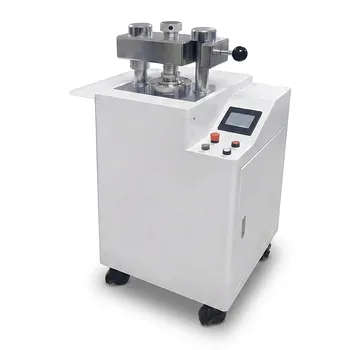
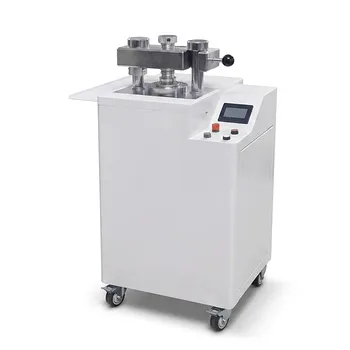
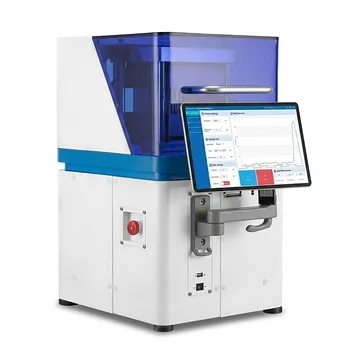
A laboratory pellet press is a precision instrument engineered specifically for sample preparation at a laboratory scale. Distinct from industrial manufacturing presses, its defining characteristic is the granular control it offers over processing parameters, allowing users to fine-tune pressure, temperature, and compression speed to meet exact experimental standards.
The core purpose of a laboratory pellet press is to transform loose powders into solid, uniform pellets required for analytical testing. Its value lies in reproducibility: ensuring that every sample is prepared under identical conditions to eliminate variables in your research data.
The Functional Mechanism
From Powder to Solid
The fundamental operation involves placing powdered materials into a rigid die or mold. The press utilizes a hydraulic system to generate significant force, which is transferred directly to the powder.
Achieving Uniformity
Under this pressure, the powder particles bind together to form a solid shape. For an experiment to be valid, the resulting pellets must maintain a consistent size, density, and shape, ensuring that any variations in test results are due to the material itself, not the preparation method.
Defining Characteristics
Precision Parameter Control
As noted in the primary definition, these machines excel in their adjustability. Operators can dictate the exact compression speed and pressure load, ranging typically from 15 to over 100 tons depending on the model.
Thermal Regulation capabilities
Many laboratory presses include heating elements. This allows for the preparation of distinct materials, such as polymer ultra-thin films. By applying pressure in a molten state, the press eliminates air bubbles and ensures uniform molecular distribution, which is critical for melt crystallization studies.
Batch Efficiency and Durability
Despite their smaller scale compared to industrial units, these presses are designed for batch production efficiency. They are constructed to be robust and stable, offering high reliability and durability for repeated use in a busy lab environment.
Understanding the Trade-offs
Footprint vs. Force
There is often a physical trade-off between power and space. Benchtop models save valuable laboratory real estate but may offer lower maximum pressure limits. Floor-standing models provide the high tonnage required for hard ceramics or metals but demand significant dedicated floor space.
Automation vs. Cost
Manual power systems are cost-effective and reliable for low-volume applications. However, they lack the data logging and automated consistency of electric or pneumatic systems. While automated systems ensure higher precision and reduce operator fatigue, they come with a higher financial cost and increased maintenance complexity.
Making the Right Choice for Your Goal
To select the correct press, you must evaluate your specific material behaviors and throughput needs.
- If your primary focus is basic sample analysis (e.g., FTIR/XRF): Prioritize a manual benchtop unit that balances sufficient tonnage with a compact footprint.
- If your primary focus is complex polymer research: Select a model with precise temperature control and cooling rates to manage melt crystallization and annealing steps.
- If your primary focus is high-throughput consistency: Invest in an automated electric system with programmable pressure cycles to remove operator variability.
The ideal laboratory pellet press is not the most powerful one, but the one that aligns its control capabilities with the sensitivity of your specific analytical method.
Summary Table:
| Feature | Description | Impact on Research |
|---|---|---|
| Pressure Control | Granular adjustment (15 to 100+ tons) | Ensures consistent pellet density and thickness |
| Thermal Regulation | Integrated heating and cooling elements | Facilitates polymer melting and crystallization studies |
| System Type | Manual, Electric, or Pneumatic | Balances cost-effectiveness with automated consistency |
| Form Factor | Benchtop vs. Floor-standing | Optimizes lab space vs. maximum force requirements |
| Application | FTIR, XRF, and Battery Research | Eliminates variables in analytical testing data |
Elevate Your Material Analysis with KINTEK
Precision starts with the perfect sample. KINTEK specializes in comprehensive laboratory pressing solutions tailored to your specific research needs. Whether you are conducting fundamental battery research or complex polymer studies, our range of manual, automatic, heated, and multifunctional models—including specialized glovebox-compatible and isostatic presses—ensures unmatched reproducibility.
Don't let sample variability compromise your data. Contact KINTEK today to find the ideal pressing solution for your lab and experience the benefits of expert-engineered durability and precision.
Related Products
- Laboratory Hydraulic Pellet Press for XRF KBR FTIR Lab Press
- Automatic Laboratory Hydraulic Press Lab Pellet Press Machine
- Laboratory Hydraulic Press Lab Pellet Press Machine for Glove Box
- Manual Laboratory Hydraulic Pellet Press Lab Hydraulic Press
- Laboratory Hydraulic Split Electric Lab Pellet Press
People Also Ask
- Laboratory Pellet Press for Solar PV Recycling: Ensuring High-Precision Material Analysis and Purity
- Why is a professional laboratory pellet press required for XRF of silica sand? Achieve +/- 0.10% Precision
- Why is precise pressure-holding control critical for biomass pellets? Master Your Densification Results
- What is the necessity of a laboratory pellet press for alcohol by-product fuels? Maximize Energy Density & Consistency
- What are the different types of pellet-making tools available for labs? Choose the Right Press for Your Sample