
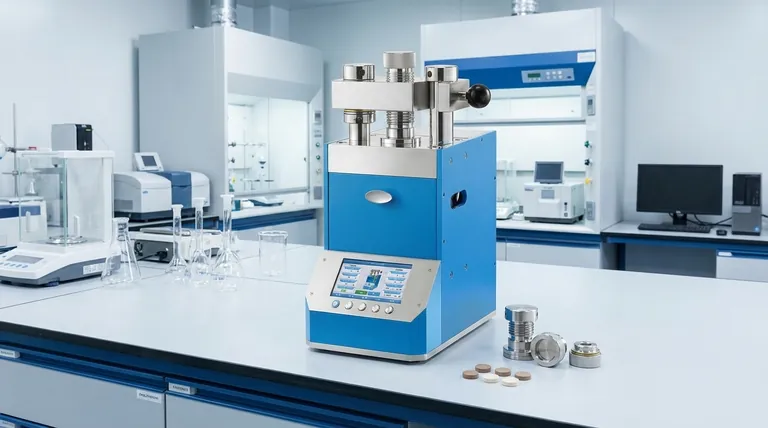
Automated XRF presses are high-performance hydraulic systems designed to standardize sample preparation and accelerate laboratory workflow. These units feature computer-controlled operation to apply precise, programmable pressure, often utilizing integrated dies and mechanical extraction systems to minimize cycle times. They are best suited for high-volume research and industrial laboratories where data reproducibility and throughput are critical operational metrics.
The primary advantage of an automated press is the decoupling of sample quality from operator skill. By standardizing pressure application and holding times, these machines ensure that every pellet is physically identical, a prerequisite for accurate quantitative XRF analysis.
Programmability and Consistency
Precise Parameter Control
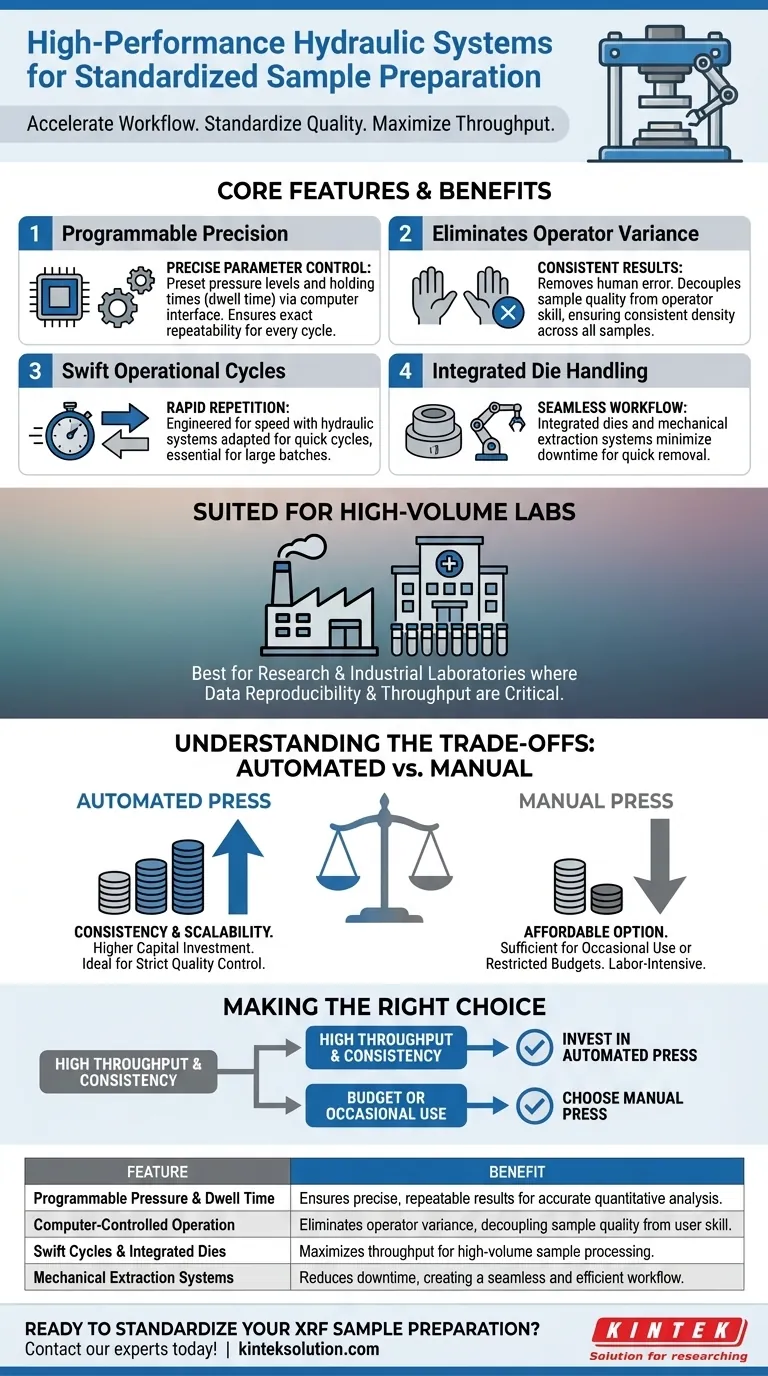
One of the defining features of automated presses is the ability to preset critical variables. Operators can program specific pressure levels and holding times (dwell time) via a computer interface. This ensures that delicate materials, such as polymers or pharmaceuticals, are treated with exact repeatability during every cycle.
Eliminating Operator Variance
Manual pellet preparation introduces human error, as applied force can vary significantly between technicians. Automated presses remove this variable entirely. The machine ensures consistent density and structural integrity across all samples, regardless of who is operating the equipment.
Maximizing Laboratory Throughput
Swift Operational Cycles
Automated presses are engineered for speed. They utilize hydraulic systems adapted for rapid repetition, offering swifter operational cycles compared to manual alternatives. This capability is essential for labs processing large batches of samples daily.
Integrated Die Handling
To further reduce cycle time, many automated units feature integrated pellet dies and mechanical extraction systems. These features allow for the quick removal of the finished pellet. This creates a seamless workflow where the press is immediately available for the next sample with minimal downtime.
Minimal Operator Intervention
Because the pressure cycle is computer-operated, the need for physical exertion and constant monitoring is reduced. This allows lab personnel to focus on other tasks while the press operates, effectively multiplying workforce efficiency.
Understanding the Trade-offs
Cost vs. Volume
While automated presses offer superior consistency, they represent a significant capital investment. Manual presses are a more affordable option and are generally sufficient for laboratories with restricted budgets. If your lab only processes samples occasionally, the cost of automation may not yield a positive return on investment.
Complexity of Requirements
Not all research requires high-throughput machinery. For small-scale operations or occasional research use, a manual press—though labor-intensive—provides adequate results. Automation is specifically a solution for scalability and strict quality control requirements.
Making the Right Choice for Your Lab
To select the correct equipment, you must evaluate your laboratory's daily volume and data quality requirements.
- If your primary focus is High Throughput and Consistency: Invest in an automated press to standardize sample density and maximize the number of samples processed per hour.
- If your primary focus is Budget or Occasional Use: A manual press is the logical choice, offering a cost-effective solution for low-volume sample preparation.
The goal is to match the sophistication of your equipment to the rigor of your analytical demands.
Summary Table:
| Feature | Benefit |
|---|---|
| Programmable Pressure & Dwell Time | Ensures precise, repeatable results for accurate quantitative analysis. |
| Computer-Controlled Operation | Eliminates operator variance, decoupling sample quality from user skill. |
| Swift Cycles & Integrated Dies | Maximizes throughput for high-volume sample processing. |
| Mechanical Extraction Systems | Reduces downtime, creating a seamless and efficient workflow. |
Ready to standardize your XRF sample preparation and maximize laboratory efficiency?
KINTEK specializes in high-performance lab press machines, including automated XRF presses, isostatic presses, and heated lab presses. Our solutions are designed to deliver the consistency and throughput required by high-volume research and industrial laboratories.
Contact our experts today to find the perfect press for your analytical demands!
Visual Guide
Related Products
- Automatic Laboratory Hydraulic Press for XRF and KBR Pellet Pressing
- Laboratory Hydraulic Pellet Press for XRF KBR FTIR Lab Press
- XRF KBR Plastic Ring Lab Powder Pellet Pressing Mold for FTIR
- Lab XRF Boric Acid Powder Pellet Pressing Mold for Laboratory Use
- XRF KBR Steel Ring Lab Powder Pellet Pressing Mold for FTIR
People Also Ask
- Why is pressing powder into a pellet critical before sintering? Ensure Dense, Conductive Solid-State Electrolytes
- What is the role of a laboratory pressure machine and KBr in FTIR? Master Sample Preparation for Flame Retardants
- What are the advantages of using a laboratory automatic hydraulic press for HEA green compact forming?
- What are the advantages of using a lab automatic hydraulic press for HEA green body molding? Ensure Material Integrity
- What are the advantages of using an automatic laboratory hydraulic press? Enhance Precision in Sample Preparation



















