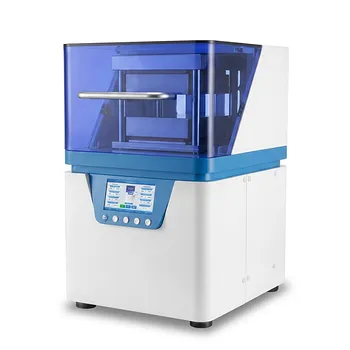
In spectroscopy, a hydraulic press serves a vital function in sample preparation: it converts loose powder mixtures into solid, uniform pellets or films suitable for analytical instruments. By applying immense, evenly distributed pressure, the press eliminates air gaps and transforms refractive particles into a cohesive, often transparent medium that light or X-rays can pass through or reflect off accurately.
Core Takeaway The accuracy of compositional analysis depends heavily on the physical state of the sample. A hydraulic press ensures that granular materials are compressed into dense, homogenous, and optically clear forms, preventing data distortion caused by light scattering or irregular sample density.
Transforming Powder into Data
The Mechanics of Compression
To analyze a material spectroscopically, the sample usually cannot remain in a loose powder form.
A hydraulic press exerts evenly distributed pressure on a powder mixture placed within a die.
This compression forces the particles together, eliminating void spaces and creating a solid, dense disc known as a pellet.
Achieving Optical Transparency
For many spectroscopic techniques, the sample must allow light to pass through it without significant scattering.
The press plays a critical role here by transforming a refractive material—which would normally scatter light—into a transparent film or pellet.
This transparency allows the spectrometer's beam to interact with the material's chemical bonds rather than bouncing off physical irregularities.
Specific Applications in the Laboratory
FTIR (Fourier Transform Infrared Spectroscopy)
The hydraulic press is a standard requirement for creating KBr pellets used in FTIR analysis.
In this process, a small amount of the sample is mixed with Potassium Bromide (KBr) powder.
Under high pressure, the KBr becomes transparent to infrared light, holding the sample particles in a suspension that allows for precise identification of chemical compounds.
XRF (X-ray Fluorescence)
For X-ray Fluorescence, the goal is slightly different but equally reliant on the press.
Here, the press compresses powders into uniform and dense pellets to ensure a perfectly flat surface and consistent material density.
This consistency is required to create a representative sample, ensuring that the X-ray signals detected correspond accurately to the material’s true elemental composition.
Understanding the Trade-offs: Precision vs. Pressure
While a hydraulic press is essential, the quality of the data is strictly limited by the quality of the pellet.
The Risk of Inconsistency
If the pressure applied is not high enough or not held long enough, the pellet may remain opaque or brittle.
An opaque pellet causes light scattering, which results in noisy spectral data and inaccurate baselines.
Homogeneity is Key
The press cannot correct a poorly mixed sample.
Before pressing, the sample and the matrix (like KBr) must be perfectly blended; otherwise, the pellet will have compositional "hotspots" that skew results.
Making the Right Choice for Your Goal
To maximize the quality of your spectroscopic data, you must align your pressing technique with your specific analytical method.
- If your primary focus is FTIR Analysis: Ensure you apply sufficient pressure to achieve total transparency in the KBr pellet, as opacity will directly degrade your signal quality.
- If your primary focus is XRF Composition: Focus on creating a dense, physically robust pellet with a perfectly smooth surface to minimize scattering of the X-ray source.
Ultimately, the hydraulic press transforms a chaotic powder into a disciplined medium, bridging the gap between raw material and precise chemical insight.
Summary Table:
| Application | Sample Preparation Goal | Key Benefit of Using a Press |
|---|---|---|
| FTIR Spectroscopy | Create KBr pellets/films | Transforms refractive powder into an optically transparent medium for IR beam transmission. |
| XRF Analysis | Create uniform solid discs | Eliminates air gaps to ensure consistent density and a perfectly flat surface for X-ray signals. |
| General Analysis | Solidify loose powders | Prevents light scattering and data distortion by creating a dense, homogeneous sample. |
Elevate Your Spectroscopic Accuracy with KINTEK
Precise compositional analysis begins with a perfect sample. KINTEK specializes in comprehensive laboratory pressing solutions designed to meet the rigorous demands of spectroscopy and battery research. Whether you require manual, automatic, heated, or multifunctional models, or specialized glovebox-compatible and isostatic presses, our equipment ensures the density and homogeneity your data depends on.
Don't let poor pellet quality compromise your results. Contact KINTEK today to find the ideal pressing solution for your lab and achieve the optical clarity your research deserves.
Related Products
- Automatic Hydraulic Hot Press with Large Plate and Precision Temperature Control for Advanced Material Sample Preparation and Industrial Research
- Automatic Hydraulic Heat Press Machine with Multi Stage Programmable Control and Integrated Water Cooling Plate Size 180x180mm
- Automatic High Temperature Heated Hydraulic Press Machine with Heated Plates for Lab
- Automatic Heated Hydraulic Lab Press with Programmable Touch Screen Controls and Precision Temperature Regulation
- Manual Heated Hydraulic Lab Press with Integrated Hot Plates Hydraulic Press Machine
People Also Ask
- What are the specific features and applications of hydraulic hot press machines? Precision Solutions for Modern Labs
- How does an automatic hydraulic press operate? Achieve Precision and Consistency in Lab Pelleting
- What are the advantages and common applications of an automatic hydraulic press? Elevate Your Lab's Precision
- What is the technical significance of setting a precise dwell time? Achieve Peak Material Density and Stability
- When is an automatic hydraulic press more suitable than a manual press? Scale Your Lab with Precision & Speed