
At their core, modern hydraulic pellet presses enhance precision and control through a combination of adjustable pressure settings, high-resolution digital displays, and mechanical systems for rapid platen adjustment. These features work in concert to ensure the force applied to a sample is both accurate and repeatable, which is the foundation of creating consistent, high-quality pellets for analysis or production.
The primary goal of these advanced features is to remove variability from the pellet-making process. By providing precise control over pressure and dimensions, modern presses enable the creation of uniform pellets, which is the critical factor for achieving reproducible results in scientific analysis and consistent quality in industrial applications.
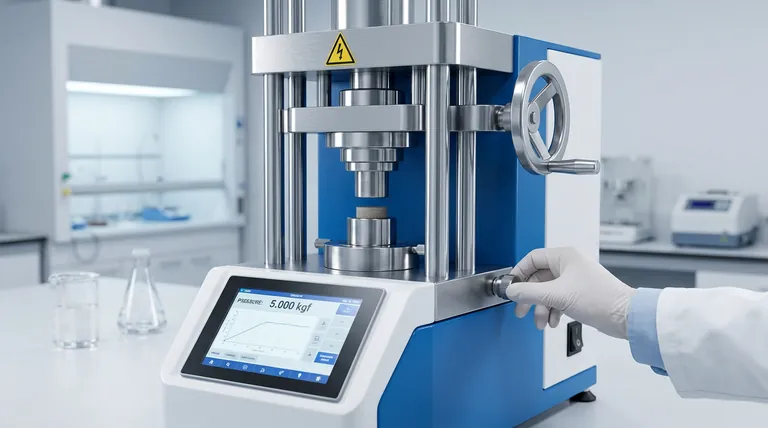
The Core Components of Precision Control
Understanding how each feature contributes to the final outcome is key to leveraging a pellet press effectively. These are not just quality-of-life improvements; they are fundamental to the machine's scientific and industrial value.
Adjustable Pressure Settings
The ability to precisely set and hold a specific pressure is the most critical function. Different materials require different levels of compaction to form a stable, non-friable pellet without cracking.
Fine-grained adjustable pressure controls allow you to dial in the exact force needed for your specific powder, ensuring optimal density and pellet integrity every time.
Digital Pressure Gauges and Displays
Modern presses have moved from analog dials to digital displays. This shift is crucial for precision. A digital gauge provides a clear, unambiguous reading of the applied force, eliminating the guesswork and parallax error associated with reading a needle on a dial.
This high-resolution feedback allows for much tighter control and makes it simple for different operators to apply the exact same force, dramatically improving run-to-run and operator-to-operator consistency.
Rapid and Precise Platen Adjustment
Before pressure is applied, the sample must be contained correctly. Features like threaded rods with locking nuts allow for the rapid and precise adjustment of the platen, which is the moving plate that applies force.
This ensures the press is set up correctly for a specific die set, guaranteeing that each pellet will have a uniform thickness and size. This dimensional consistency is just as important as density for many analytical techniques.
Why This Precision Matters
The focus on precision is not academic. It has a direct and significant impact on the quality and reliability of your results, whether in a research lab or on a production floor.
Ensuring Sample Uniformity
For analytical methods like X-Ray Fluorescence (XRF) or Fourier-Transform Infrared (FTIR) spectroscopy, the density and thickness of the pellet directly affect the results.
A press with precise control creates pellets of uniform density. This ensures the analytical beam interacts with the sample consistently, preventing variations in signal intensity that could be misinterpreted as changes in chemical composition.
Enhancing Reproducibility
Reproducibility is the cornerstone of valid science and effective quality control. If you cannot remake a sample and get the same analytical result, your data is unreliable.
By controlling the key variables of pressure and dimension, these features ensure that an experiment performed today can be accurately reproduced tomorrow, or by a colleague in another lab.
Understanding the Trade-offs and Limitations
Even the most precise press operates within a larger system. Understanding its limitations is critical for troubleshooting and achieving the best possible outcomes.
The Critical Role of the Die Set
The press applies the force, but the die set forms the pellet. A low-quality, scratched, or worn-out die will produce a poor-quality pellet regardless of how precise the press is. The surface finish and dimensional tolerances of your die are equally important.
The Influence of Material Properties
A press controls external force, but it cannot change the intrinsic properties of your sample powder. Factors like particle size, morphology, and moisture content have a profound impact on compaction and final pellet quality. A precise press helps compensate for minor material variations, but it cannot fix a poorly prepared sample.
Operator Skill Still Matters
Modern features reduce the potential for human error but do not eliminate it. Proper technique in loading the die, cleaning equipment, and releasing pressure slowly to prevent pellet cracking remains essential. The operator's knowledge is a key part of the system.
Making the Right Choice for Your Application
To select the right features, you must first define your primary goal.
- If your primary focus is high-stakes analytical testing (e.g., XRF, FTIR): Prioritize a press with a high-resolution digital gauge and extremely fine-grained pressure control to ensure maximum data reproducibility.
- If your primary focus is industrial quality control: Look for a balance of precision and durability, with features like rapid platen adjustment to maximize throughput without sacrificing consistency.
- If your primary focus is general research and development: Seek a versatile press with a wide, adjustable pressure range to accommodate experiments with a variety of novel materials.
Ultimately, mastering these features transforms the pellet press from a simple tool into a precision instrument that delivers reliable and trustworthy results.
Summary Table:
| Feature | Key Benefit | Impact on Precision |
|---|---|---|
| Adjustable Pressure Settings | Enables exact force application for optimal density | Ensures consistent pellet integrity and material-specific compaction |
| Digital Pressure Gauges | Provides clear, high-resolution force readings | Reduces operator error and improves run-to-run consistency |
| Rapid Platen Adjustment | Allows quick setup for uniform pellet dimensions | Guarantees consistent thickness and size for accurate analysis |
Ready to elevate your laboratory's precision and efficiency? KINTEK specializes in high-quality lab press machines, including automatic lab presses, isostatic presses, and heated lab presses, designed to deliver reliable, consistent results for your analytical and production needs. Our advanced features ensure superior control, enhancing reproducibility and sample uniformity in applications like XRF and FTIR. Don't settle for variability—contact us today to discover how KINTEK can support your specific requirements and drive your success!
Visual Guide
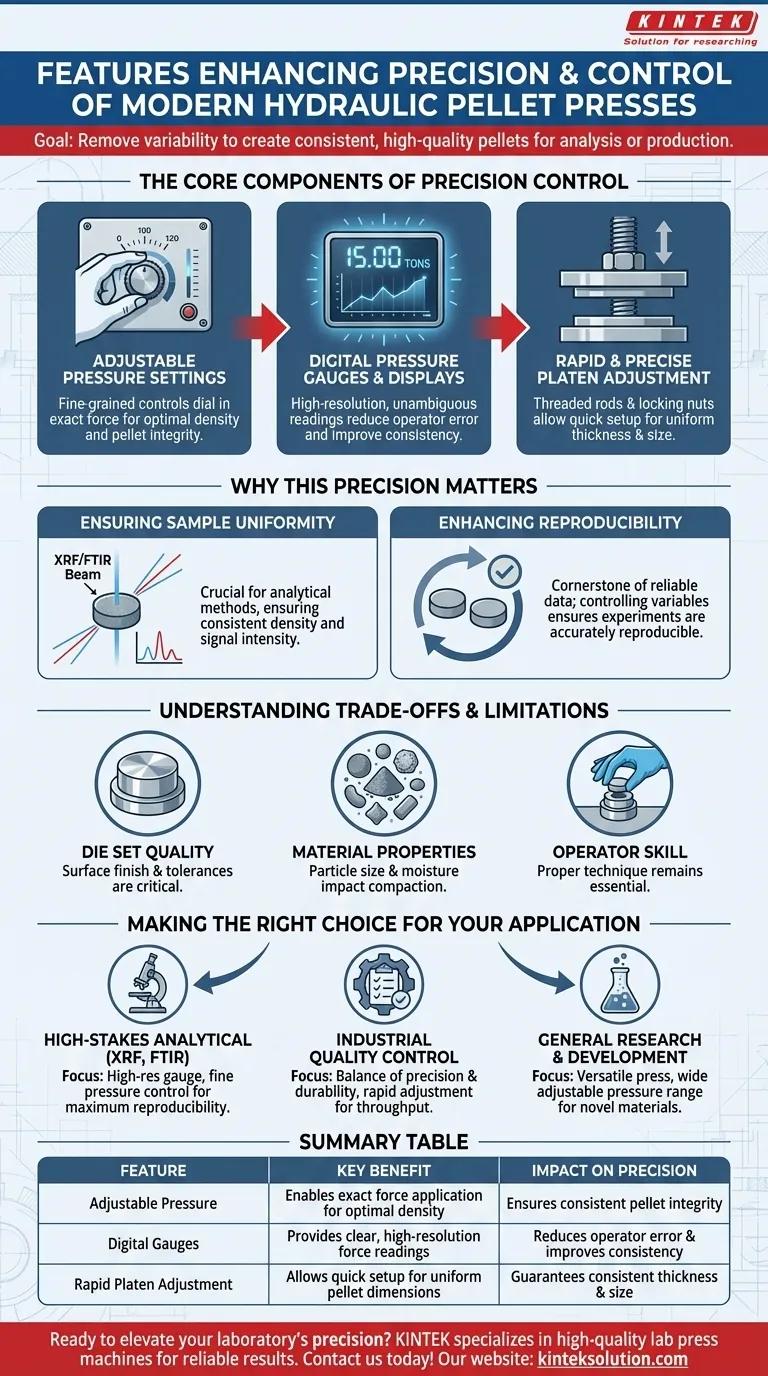
Related Products
- Laboratory Hydraulic Pellet Press for XRF KBR FTIR Lab Press
- Automatic Laboratory Hydraulic Press Lab Pellet Press Machine
- Manual Laboratory Hydraulic Pellet Press Lab Hydraulic Press
- Laboratory Hydraulic Press Lab Pellet Press Machine for Glove Box
- Automatic Laboratory Hydraulic Press for XRF and KBR Pellet Pressing
People Also Ask
- Laboratory Pellet Press for Solar PV Recycling: Ensuring High-Precision Material Analysis and Purity
- Why is a professional laboratory pellet press required for XRF of silica sand? Achieve +/- 0.10% Precision
- Why is precise pressure-holding control critical for biomass pellets? Master Your Densification Results
- What is the necessity of a laboratory pellet press for alcohol by-product fuels? Maximize Energy Density & Consistency
- What are the different types of pellet-making tools available for labs? Choose the Right Press for Your Sample



















