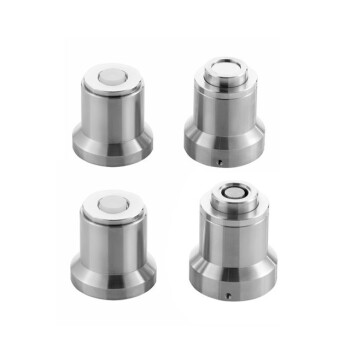
A chromium-doped magnesium oxide (MgO) octahedron serves three critical functions in high-pressure assemblies: it acts as the primary medium for uniformly transmitting pressure to the sample, provides essential thermal insulation, and acts as a robust structural foundation. By leveraging the refractory properties of MgO, this component maintains the geometric stability of the experiment even at extreme synthesis temperatures reaching 2100°C.
Core Takeaway This component acts as the physical and thermal bridge between the massive force of external anvils and the delicate internal sample. It converts directional force into uniform "quasi-hydrostatic" pressure while simultaneously shielding the sample from heat loss, creating the precise environment required for material synthesis.
The Mechanics of Pressure Transmission
Converting Anisotropic Force
The primary role of the MgO octahedron is to act as a pressure-transmitting medium (PTM). External anvils apply force from specific directions (anisotropic pressure), which would normally crush a sample unevenly.
Achieving Quasi-Hydrostatic Conditions
MgO possesses low shear strength, allowing it to undergo micro-plastic deformation under high pressure. This characteristic enables the octahedron to flow around the sample, converting the directional force of the anvils into quasi-hydrostatic pressure, ensuring the sample is compressed uniformly from all sides.
Thermal and Structural Integrity
The Role of Chromium Doping
While pure MgO is a strong refractory material, the addition of Chromium Oxide (Cr2O3) serves a specific enhancement purpose. Doping the MgO reduces the material's thermal conductivity, thereby improving its ability to insulate the sample chamber and concentrate heat where it is needed most.
Structural Support at High Temperatures
The octahedron functions as a rigid refractory container for the internal furnace components. It prevents electrical short circuits and supports the heater components, ensuring they can maintain constant temperatures.
Geometric Stability
Crucially, the assembly must not collapse or deform strictly under heat. The Cr-doped MgO retains its mechanical performance at synthesis temperatures as high as 2100°C, preserving the geometry of the experimental assembly throughout the process.
Understanding the Trade-offs
Quasi-Hydrostatic vs. True Hydrostatic
It is important to note the distinction between quasi-hydrostatic and truly hydrostatic environments. While MgO flows well due to low shear strength, it is still a solid medium.
Experimental Precision
For most solid-state synthesis (like stishovite growth), this quasi-hydrostatic environment is ideal. However, it may possess small non-uniformities (pressure gradients) compared to liquid pressure media, though it offers vastly superior containment at extreme temperatures.
Making the Right Choice for Your Goal
When designing a high-pressure assembly, the choice of a Cr-doped MgO octahedron depends on your specific experimental requirements.
- If your primary focus is Extreme Temperature Stability: Rely on this medium for experiments requiring temperatures up to 2100°C, as its refractory nature prevents assembly collapse where other media might fail.
- If your primary focus is Crystal Growth Quality: Leverage the micro-plastic deformation of MgO to minimize pressure gradients, creating the uniform environment necessary for annealing and growing single crystals.
By combining mechanical flow with thermal resistance, the Cr-doped MgO octahedron creates a stable, high-pressure crucible for advanced material synthesis.
Summary Table:
| Function | Description | Benefit |
|---|---|---|
| Pressure Transmission | Converts anisotropic force to quasi-hydrostatic pressure | Ensures uniform sample compression |
| Thermal Insulation | Cr-doping reduces thermal conductivity | Concentrates heat and protects external anvils |
| Refractory Support | Maintains structural integrity up to 2100°C | Prevents assembly collapse at extreme temperatures |
| Mechanical Stability | Resists deformation and prevents electrical shorts | Preserves geometry for precise material synthesis |
Elevate Your Material Research with KINTEK Precision
At KINTEK, we understand that successful high-pressure experiments depend on the quality of your assembly components. We specialize in comprehensive laboratory pressing solutions, providing high-performance tools from manual and automatic presses to cold and warm isostatic presses designed for battery research and advanced material synthesis.
Whether you are growing single crystals or synthesizing new materials at 2100°C, our equipment ensures the stability and precision your lab requires. Contact us today to discover how KINTEK can optimize your laboratory workflow with our multifunctional and glovebox-compatible pressing models.
References
- Narangoo Purevjav, Tomoo Katsura. Temperature Dependence of H<sub>2</sub>O Solubility in Al‐Free Stishovite. DOI: 10.1029/2023gl104029
This article is also based on technical information from Kintek Solution Knowledge Base .
Related Products
- Lab Cylindrical Press Mold for Laboratory Use
- Square Lab Press Mold for Laboratory Use
- Lab Infrared Press Mold for No Demolding
- Lab Round Bidirectional Press Mold
- Lab XRF Boric Acid Powder Pellet Pressing Mold for Laboratory Use
People Also Ask
- What is the purpose of incorporating cartridge heaters into a lab press mold for MLCC block compression? Optimize Results
- Why is precise cooling management of the lab press mold necessary? Protect Core Integrity in Thermoforming
- What is the function of a pressing tool in thermoplastic panels? Master Precision Shaping & Fusion Bonding
- Why is a high-performance laboratory molding press critical for in-situ electrolyte formation? Unlock Battery Success
- How does the geometry of laboratory molds influence mycelium-based composites? Optimize Density and Strength