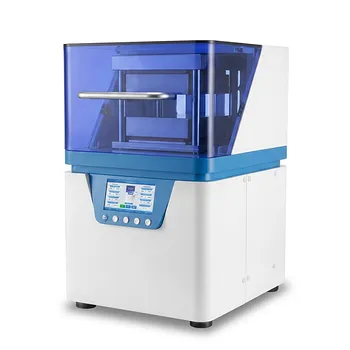
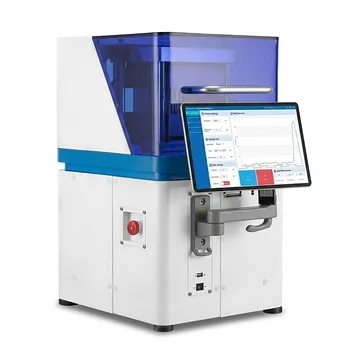
A hydraulic mini press is a compact, portable mechanical device designed to generate significant compressive force through a hand-held hydraulic system. While these units are exceptionally lightweight—typically weighing around 4 kilograms—they are engineered to apply approximately 2 tons of pressure, making them a powerful tool for specific, small-scale applications.
The hydraulic mini press democratizes high-pressure sample preparation. By focusing force onto a smaller surface area, it achieves the specific pressure required for laboratory standards without the immense footprint or cost of a full-sized industrial machine.
Understanding the Mechanics
To understand the value of a mini press, you must first understand how it defies its size. It operates on Pascal's principle, leveraging fluid dynamics to amplify force.
The Power Source
Unlike large, electrically driven industrial presses, a mini press is typically manually operated. By turning a handle, the user drives a pump that pressurizes oil within the system.
The Plunger Action
This hydraulic pressure moves an oil-filled plunger. The plunger then transfers this energy to compress fluids or gases, eventually exerting force on a solid object or sample.
Controlled Application
Despite its manual nature, the system is precise. Valves regulate the pressure, allowing the user to adjust the output to meet the specific requirements of the task.
Key Attributes and Advantages
The hydraulic mini press is defined by its ability to separate raw tonnage from physical bulk.
Extreme Portability
The defining feature of this tool is its weight. At approximately 4 kilograms, it is truly hand-held. This allows for easy transport between different workstations in a lab or even to field locations.
Cost-Effectiveness
Because it requires less material to build and lacks complex motorization, the mini press is significantly lower in cost than full-sized hydraulic counterparts. This makes it accessible for smaller academic labs or facilities with tight budgets.
Repeatable Precision
Top-tier mini presses include an integrated pressure gauge. This is critical for scientific rigor, as it allows the operator to apply the exact same load every time, ensuring that sample production is consistent and reliable.
The Physics of Efficiency: Why 2 Tons is Enough
A common misconception is that "lower tonnage" means "weaker results." This is not necessarily true in the context of sample preparation.
The Pellet Diameter Factor
Full-sized presses often create 13 mm pellets. A mini press typically produces smaller pellets, often 7 mm in diameter.
Equivalent Pressure
Pressure is Force divided by Area. Because the mini press applies its 2 tons of force to a much smaller surface area (the 7 mm pellet), the effective pressure applied to the material is comparable to that of a larger machine.
Industry Applications
This efficiency makes the mini press ideal for pharmaceutical, polymer testing, and academic laboratories, where creating small, high-density pellets is a frequent requirement.
Understanding the Trade-offs
While highly effective for specific tasks, the hydraulic mini press is not a universal solution.
Sample Size Limitations
The compact design restricts the size of the sample you can process. If you require large-diameter pellets (e.g., standard 13 mm or larger), the 2-ton limit may not provide sufficient pressure for proper compaction.
Manual Effort
These devices rely on manual operation (turning a handle). For high-volume production environments where speed and automation are critical, a motorized full-sized press is superior.
Making the Right Choice for Your Goal
To decide if a hydraulic mini press is the right tool for your specific application, consider your primary constraints.
- If your primary focus is field work or mobility: The 4kg weight allows you to bring laboratory-grade compression capabilities directly to the sample site.
- If your primary focus is budget optimization: This device offers the most cost-effective method for achieving 2 tons of force without investing in heavy infrastructure.
- If your primary focus is small-scale sample prep: The device provides equivalent pressure to larger machines by utilizing smaller (7 mm) die sets, ensuring quality results without waste.
The hydraulic mini press proves that in precision engineering, massive force does not always require a massive footprint.
Summary Table:
| Feature | Specification/Detail |
|---|---|
| Weight | Approximately 4 kg (Highly Portable) |
| Max Load | 2 Tons |
| Standard Pellet Size | 7 mm diameter |
| Operation | Manual (Hand-held) |
| Principle | Pascal's Law (Fluid Dynamics) |
| Best For | Academic labs, field work, and small-scale testing |
Maximize Your Lab Efficiency with KINTEK Press Solutions
Are you looking to optimize your sample preparation without sacrificing space or budget? KINTEK specializes in comprehensive laboratory pressing solutions tailored to your specific research needs.
Whether you need the ultra-portable Hydraulic Mini Press for field work, or require our advanced automatic, heated, or glovebox-compatible models, we provide the precision and durability your data demands. Our expertise extends to cold and warm isostatic presses, widely utilized in cutting-edge battery research and material science.
Ready to find the perfect fit for your laboratory? Contact KINTEK Today to Consult with an Expert
Related Products
- Automatic Hydraulic Hot Press with Large Plate and Precision Temperature Control for Advanced Material Sample Preparation and Industrial Research
- Automatic Laboratory Hydraulic Press Lab Pellet Press Machine
- Laboratory Hydraulic Press Lab Pellet Press Machine for Glove Box
- Automatic Hydraulic Heat Press Machine with Multi Stage Programmable Control and Integrated Water Cooling Plate Size 180x180mm
- Laboratory Hydraulic Press Lab Pellet Press Button Battery Press
People Also Ask
- What are the specific features and applications of hydraulic hot press machines? Precision Solutions for Modern Labs
- How does an automatic hydraulic press operate? Achieve Precision and Consistency in Lab Pelleting
- What are the advantages and common applications of an automatic hydraulic press? Elevate Your Lab's Precision
- What is the technical significance of setting a precise dwell time? Achieve Peak Material Density and Stability
- When is an automatic hydraulic press more suitable than a manual press? Scale Your Lab with Precision & Speed