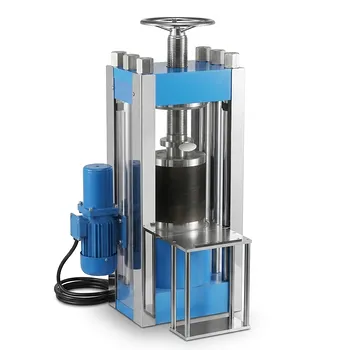
A KBr press is a specialized laboratory instrument designed to compress potassium bromide (KBr) powder into transparent pellets for use in infrared (IR) spectroscopy. By applying immense pressure to a mixture of KBr and a solid sample, the device creates a clear disc that allows infrared light to pass through with minimal interference, facilitating accurate molecular analysis.
Core Takeaway: The KBr press bridges the gap between solid samples and optical analysis. Its primary function is to transform a loose, opaque powder mixture into a solid, transparent window, ensuring that the resulting spectral data represents the sample's molecular structure rather than the matrix holding it.
The Science Behind the Device
Why Potassium Bromide (KBr)?
The effectiveness of this method relies heavily on the unique properties of potassium bromide.
Unlike many other solids, KBr becomes transparent to infrared radiation when compressed. This makes it the ideal "matrix" or carrier material for spectroscopy.
Solving the Solid Sample Problem
Analyzing solid samples in IR spectroscopy presents a challenge: solids often scatter light or block it entirely.
The KBr press solves this by suspending the sample within a clear medium. When the KBr and sample are pressed together, the result is a pellet that is optically clear, allowing the IR beam to interact directly with the sample molecules.
System Components and Mechanics
The Die Set
The die set is the component responsible for shaping the pellet.
It typically consists of a cylindrical die body and two plungers. This assembly holds the loose powder mixture in place and defines the final geometry of the disc.
The Hydraulic Press
The engine of the system is the hydraulic press.
To transform powder into a solid, fused pellet, significant force is required. The press typically applies between 8 to 10 tons of pressure to the die set to achieve the necessary compaction.
The Base Plate
The base plate serves as the foundation for the operation.
It provides a stable, rigid surface for the die set to rest on. This stability is critical to ensure that the massive force generated by the hydraulic press is distributed evenly across the sample.
Critical Operational Considerations
The Requirement for High Pressure
Creating a usable pellet is not merely about shaping powder; it requires fusing the material.
The system must be capable of delivering sustained pressure in the 8 to 10-ton range. Inadequate pressure results in opaque or fragile pellets that will scatter IR light and degrade data quality.
Material Transparency
The quality of the analysis is entirely dependent on the transparency of the pellet.
While the press provides the mechanical force, the success of the operation hinges on the KBr being free of impurities. The goal is to create a pellet where the matrix itself is invisible to the analysis equipment.
Making the Right Choice for Your Goal
To ensure accurate spectroscopic results, consider the following when evaluating or using a KBr press:
- If your primary focus is data accuracy: Ensure your press is calibrated to deliver the full 8-10 tons of pressure, as lower pressure yields cloudy pellets that interfere with spectral readings.
- If your primary focus is sample preparation workflow: Verify that your die set components are perfectly aligned and maintained, as the quality of the pellet shape dictates the ease of handling and insertion into the spectrometer.
Ultimately, the KBr press is the standard solution for converting difficult solid samples into high-quality optical windows for molecular identification.
Summary Table:
| Component | Function | Key Specification |
|---|---|---|
| Potassium Bromide (KBr) | Transparent matrix carrier | Must be high-purity and dry |
| Hydraulic Press | Applies compaction force | Requires 8 - 10 tons of pressure |
| Die Set | Shapes the powder mixture | Cylindrical body with dual plungers |
| Base Plate | Provides structural stability | Must be rigid for even force distribution |
Elevate Your Spectroscopic Accuracy with KBr Solutions
Precise molecular analysis starts with a perfect pellet. KINTEK specializes in comprehensive laboratory pressing solutions, offering manual, automatic, heated, and multifunctional models designed to meet the rigorous demands of battery research and material science.
Whether you need a compact manual KBr press or advanced isostatic equipment, our tools ensure the 8-10 ton pressure stability required for optically clear samples. Contact KINTEK today to discuss your lab's specific needs and let our experts help you choose the ideal pressing system for your research workflow.
Related Products
- Laboratory Hydraulic Press 2T Lab Pellet Press for KBR FTIR
- Laboratory Hydraulic Pellet Press for XRF KBR FTIR Lab Press
- Automatic Laboratory Hydraulic Press for XRF and KBR Pellet Pressing
- Lab Infrared Press Mold for No Demolding
- Button Battery Sealing Press Machine for Lab
People Also Ask
- What is the role of a laboratory pressure machine and KBr in FTIR? Master Sample Preparation for Flame Retardants
- What is the role of a laboratory hydraulic press in high-loading NCM811 cathode prep for solid-state batteries?
- What role does a laboratory hydraulic press play in reaction pellets? Optimizing Lunar Soil and Metal Fuel Density
- Why is a laboratory hydraulic press necessary for sample preparation? Precise Pelleting for Spiro Heterocyclic Analysis
- What is the role of a laboratory hydraulic press in denture preparation? Achieve High-Density Dental Prosthetics