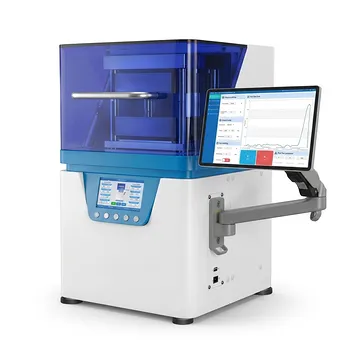
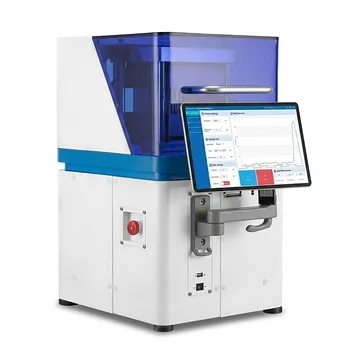
A laboratory hydraulic press is a high-precision machine designed to apply immense compressive force to materials using fluid pressure. Utilizing a hydraulic ram powered by either hand-operated levers or an electric motor, it condenses and molds substances for research, testing, and sample preparation.
Core Insight: A laboratory hydraulic press leverages the physics of fluid dynamics to amplify force significantly. While they are often compact and affordable compared to industrial counterparts, they provide the critical precision needed to create uniform samples for spectroscopy or to test the structural limits of new materials.
The Engineering Behind the Force
To understand how a laboratory press functions, you must look past the external levers and platens to the hydraulic system inside.
Pascal’s Law in Action
The fundamental operation relies on Pascal’s Law. This principle states that pressure applied to a confined fluid is transmitted equally in all directions throughout that fluid.
Force Amplification
The machine contains a hydraulic cylinder filled with oil. When a pump applies a modest mechanical force to a small area (the small piston), the pressure moves through the oil to a larger area (the main piston or ram).
The Resulting Output
Because the pressure remains constant but the surface area of the second piston is larger, the total mechanical force is multiplied. This allows a user to generate tons of compressive force with very little physical effort.
Primary Applications in the Lab
While the primary reference highlights the machine's ability to "condense and mold," the specific applications in a research setting are distinct.
Sample Preparation for Spectroscopy
One of the most common uses is creating pellets for analysis. Researchers compress powders into thin, flat discs (pellets) used in infrared (IR) spectroscopy or X-ray fluorescence (XRF).
Material Characterization
Scientists use these presses to investigate the strength and durability of materials. By subjecting substances to controlled high pressure, researchers can study deformation, stress-strain behavior, and structural integrity.
Specialized Environmental Testing
Modern lab presses are designed with a small footprint, making them portable. This design allows them to be placed inside vacuum glove boxes to process moisture-sensitive or hazardous samples in a controlled environment.
Thermal Processing
Advanced variations, such as the Hydraulic Heat Lab Press, include heated platens. This allows for simultaneous heating and pressing, which is essential for molding polymers or composite materials.
Understanding the Trade-offs
While laboratory hydraulic presses are versatile and often affordable, they have specific limitations you should recognize.
Manual vs. Electric Consistency
Manual presses are cost-effective but rely on hand levers. This can introduce human error or fatigue, potentially leading to slight inconsistencies in pressure application between different samples.
Electric Precision vs. Cost
Electric motor presses offer superior consistency and ease of use by automating the pressure application. However, this comes at a significantly higher financial cost compared to manual versions.
Scale Limitations
These are "laboratory" units for a reason. While they generate high pressure, their total force capacity and platen size are limited compared to industrial manufacturing presses. They are designed for samples, not mass production.
Making the Right Choice for Your Goal
Selecting the right press depends entirely on the volume of work and the sensitivity of your materials.
- If your primary focus is budget and low-volume sampling: A manual hydraulic press offers the best balance of affordability and utility for basic pelletizing or molding.
- If your primary focus is repeatability and high throughput: An electric, automated press eliminates operator fatigue and ensures every sample is subjected to the exact same pressure profile.
- If your primary focus is complex material synthesis: Look for a press compatible with glove boxes or equipped with heated platens to control environmental variables.
The laboratory hydraulic press is the bridge between raw material and analyzable data, transforming loose substances into testable forms through the power of fluid dynamics.
Summary Table:
| Feature | Manual Hydraulic Press | Electric Hydraulic Press | Heated/Advanced Press |
|---|---|---|---|
| Operation | Hand-operated levers | Automated electric motor | Specialized heating/vacuum control |
| Consistency | Variable (Operator-dependent) | High (Digital control) | High (Precision thermal control) |
| Best For | Low-volume, budget-conscious | High-throughput, repeatability | Polymers, composites, & glovebox use |
| Primary Use | IR/XRF Pellets | Stress-strain testing | Material synthesis & environmental testing |
Elevate Your Research Precision with KINTEK
At KINTEK, we understand that the quality of your research begins with the integrity of your samples. As specialists in comprehensive laboratory pressing solutions, we offer a versatile range of equipment tailored to your specific scientific needs—from manual and automatic models to advanced heated and glovebox-compatible presses.
Whether you are pioneering battery research using our cold and warm isostatic presses or preparing high-purity pellets for spectroscopy, our solutions provide the force amplification and precision you demand. Don't let inconsistent sample preparation compromise your data.
Contact KINTEK today to find the perfect press for your lab!
Related Products
- Laboratory Hydraulic Press Lab Pellet Press Button Battery Press
- Laboratory Hydraulic Press 2T Lab Pellet Press for KBR FTIR
- Laboratory Hydraulic Press Lab Pellet Press Machine for Glove Box
- 24T 30T 60T Heated Hydraulic Lab Press Machine with Hot Plates for Laboratory
- Automatic Laboratory Hydraulic Press Lab Pellet Press Machine
People Also Ask
- How is a laboratory hydraulic press used for HAP composite gels? Master Mineral Substrate Standardization
- What role does a laboratory hydraulic press play in the preparation of piezoelectric ceramic discs for DC-PG? | KINTEK
- What role does a laboratory hydraulic press play in reaction pellets? Optimizing Lunar Soil and Metal Fuel Density
- What role does a laboratory hydraulic press play in the assembly of all-solid-state battery test cells? Expert Guide
- Why is a laboratory hydraulic press required for PBAT and PLA sample preparation? Achieve Flawless Characterization