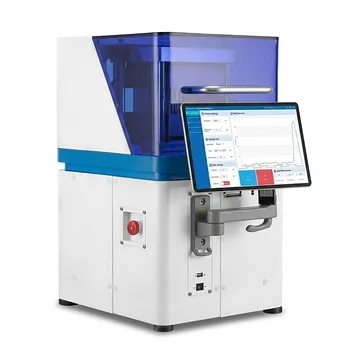
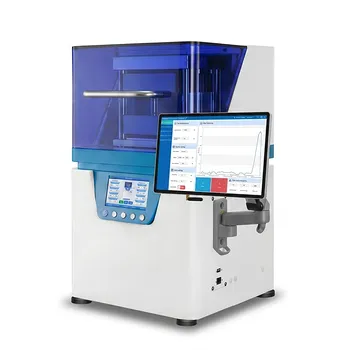
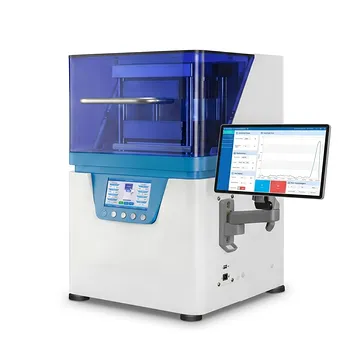
The primary advantage of a laboratory press compared to production machinery is its exceptional operational flexibility. Unlike industrial equipment, a laboratory press allows operators to rapidly change settings and switch between different material types with minimal downtime, making it the superior choice for experimental environments where parameters change frequently.
While production machinery is designed for volume and repetition, a laboratory press is engineered for iteration. Its core value lies in the ability to modify pressure, temperature, and dwell time instantly, enabling rapid prototyping without the logistical burden of heavy industrial equipment.
The Agility of the Laboratory Press
Rapid Parameter Adjustment
In a research setting, the ability to tweak variables is essential. A laboratory press allows you to quickly alter critical settings such as pressing pressure, temperature, and duration.
This stands in stark contrast to injection molding machines or large production presses. Those systems are often cumbersome to adjust, requiring significant time and effort to recalibrate for even minor process changes.
Seamless Material Switching
Production machines generally require extensive purging and cleaning when changing materials to prevent cross-contamination.
A laboratory press is designed to handle frequent changes in sample types. You can test a polymer blend, clean the platens, and switch to a composite material in a fraction of the time it would take to reset a production line.
Small Footprint Efficiency
Beyond operational speed, laboratory-scale equipment offers a significantly smaller physical footprint. This allows R&D facilities to install high-precision pressing capabilities without dedicating the floor space required by industrial machinery.
Strategic Value in Research & Development
Cost-Effective Exploration
Using production machinery for testing new concepts is often cost-prohibitive due to the high volume of material required for a standard run.
Laboratory presses enable cost-effective exploration of new material compositions. They allow researchers to validate complex reaction pathways using small sample sizes, saving both raw materials and financial resources.
Establishing Process Parameters
Before a product moves to mass manufacturing, the process must be perfected.
Laboratory presses allow you to optimize grinding speeds and pressing pressures on a small scale. This helps establish the foundational process parameters necessary for a successful transition to large-scale industrial production.
Understanding the Trade-offs
Volume Limitations
While highly flexible, laboratory presses are not designed for throughput.
They cannot match the cycle speeds or automated output capabilities of production machinery. Attempting to use a lab press for small-batch manufacturing can lead to bottlenecks and inconsistent cycle times compared to automated equipment.
Scalability Complexities
Data gathered from a laboratory press is critical, but it does not always scale linearly.
Thermal dynamics and pressure distribution can behave differently on a small platen compared to a massive industrial surface. Users must be careful when extrapolating lab results to factory settings, ensuring that the "foundational parameters" are adjusted for the realities of mass production.
Making the Right Choice for Your Goal
To maximize efficiency, align your equipment choice with your immediate objective:
- If your primary focus is Research & Development: Prioritize a laboratory press to enable rapid iteration of material formulas and frequent changes to pressure or temperature settings.
- If your primary focus is Mass Manufacturing: Rely on production machinery where the long setup times are justified by high-speed, automated repetition and consistent volume.
True efficiency in material science comes from using the lab press to define the process, and production machinery to execute it at scale.
Summary Table:
| Feature | Laboratory Press | Production Machinery |
|---|---|---|
| Primary Goal | Iteration & Research | Volume & Repetition |
| Setup Time | Rapid / Minimal | Extensive / Long |
| Sample Size | Small (Cost-effective) | Large (High-volume) |
| Flexibility | High (Instant changes) | Low (Static parameters) |
| Footprint | Compact Lab-friendly | Large Industrial Scale |
Optimize Your Research with KINTEK Pressing Solutions
Transitioning from experimentation to production requires precision tools that offer absolute control. KINTEK specializes in comprehensive laboratory pressing solutions, including manual, automatic, heated, multifunctional, and glovebox-compatible models, as well as cold and warm isostatic presses widely applied in battery research.
Our equipment empowers your R&D team to:
- Minimize Downtime: Switch between material types and adjust parameters instantly.
- Reduce Costs: Validate complex reactions using minimal sample sizes.
- Ensure Scalability: Establish foundational process parameters with high-precision data.
Ready to enhance your lab's efficiency? Contact KINTEK today to find the perfect press for your material science applications!
Related Products
- Laboratory Hydraulic Press Lab Pellet Press Button Battery Press
- Laboratory Hydraulic Press Lab Pellet Press Machine for Glove Box
- Laboratory Split Manual Heated Hydraulic Press Machine with Hot Plates
- Laboratory Hydraulic Pellet Press for XRF KBR FTIR Lab Press
- Laboratory Hydraulic Split Electric Lab Pellet Press
People Also Ask
- How is a laboratory hydraulic press used for HAP composite gels? Master Mineral Substrate Standardization
- What role does a laboratory hydraulic press play in reaction pellets? Optimizing Lunar Soil and Metal Fuel Density
- What role does a laboratory hydraulic press play in the preparation of piezoelectric ceramic discs for DC-PG? | KINTEK
- Why is a laboratory hydraulic press required for PBAT and PLA sample preparation? Achieve Flawless Characterization
- What role does a laboratory hydraulic press play in the assembly of all-solid-state battery test cells? Expert Guide