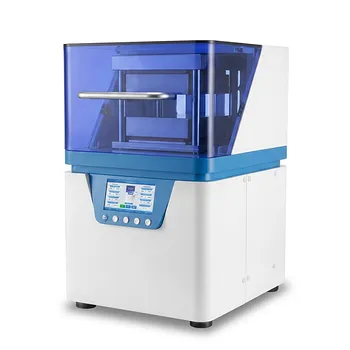
The primary application of a hydraulic mini press is the production of KBr (Potassium Bromide) discs for FTIR (Fourier Transform Infrared) analysis. These compact devices are specifically engineered to compress powders into solid pellets, a critical step in preparing samples within pharmaceutical, polymer testing, and academic chemistry laboratories.
Core Insight: While significantly smaller and lighter than full-sized laboratory presses, the hydraulic mini press achieves the necessary pressure for effective sample preparation by reducing the pellet surface area. This makes it an ideal, cost-effective solution for routine analytical tasks requiring portability and consistency.
Understanding the Operational Principle
The Force-to-Area Ratio
A standard concern with smaller equipment is a loss of power, but the mini press solves this through physics. While the device typically generates a lower total tonnage (around 2 tons) compared to full-sized units, it concentrates this force on a smaller surface area.
By producing pellets with a diameter of approximately 7mm—versus the standard 13mm—the press achieves an equivalent pressure on the sample. This ensures the KBr disc is compressed sufficiently for accurate spectroscopic analysis.
Hydraulic Mechanics
Despite its small footprint, the device utilizes a genuine hydraulic system. Users typically operate the press by turning a handle, which drives a pump to move an oil-filled plunger.
This plunger compresses fluids to exert high force on the die assembly, allowing for the precise compression of solid samples.
Key Advantages in Laboratory Settings
Reproducibility via Pressure Gauges
One of the most critical requirements in analytical chemistry is consistency. Many hydraulic mini presses are equipped with a pressure gauge.
This feature allows the operator to monitor the load applied to the sample. By applying the same load every time, researchers ensure that sample production is repeatable, minimizing variables in their data.
Portability and Accessibility
Weighing approximately 4 kilograms, the hydraulic mini press is distinctly portable. This makes it an excellent choice for undergraduate teaching labs where equipment must be moved frequently, or for labs with limited bench space.
Its lower cost relative to benchtop presses also makes it accessible for smaller operations that need high-pressure capabilities without the industrial footprint.
Understanding the Trade-offs
Sample Size Limitations
The compact design necessitates a compromise on pellet size. These presses are optimized for 7mm discs; they generally cannot produce the standard 13mm or larger pellets used in some specific protocols.
If your analysis requires a larger surface area for the beam path, the mini press will likely provide insufficient coverage or force.
Manual Operation and Throughput
Most mini presses rely on manual operation (turning a handle) rather than automated electric motors.
While this reduces complexity and cost, it can become physically tedious in high-throughput environments where dozens of samples must be prepared in rapid succession.
Making the Right Choice for Your Goal
To determine if a hydraulic mini press fits your laboratory's needs, consider your specific constraints:
- If your primary focus is routine FTIR analysis: The mini press is the ideal tool for efficiently creating high-quality 7mm KBr pellets.
- If your primary focus is portability or education: The lightweight 4kg design allows for easy transport between workstations or classrooms without sacrificing necessary pressure.
- If your primary focus is large-format sampling: You should opt for a full-sized benchtop press capable of handling 13mm dies or larger to ensure adequate pressure distribution.
The hydraulic mini press represents a smart utilization of physics to deliver industrial-grade pressure in a portable, cost-effective package for specific analytical needs.
Summary Table:
| Feature | Hydraulic Mini Press Specification |
|---|---|
| Primary Application | KBr Disc Production for FTIR Analysis |
| Typical Load Capacity | Approx. 2 Tons |
| Standard Pellet Size | 7mm Diameter |
| Weight | ~4 kg (Highly Portable) |
| Mechanism | Manual Hydraulic Pump with Pressure Gauge |
| Target Environments | Academic Labs, Pharmacy, Polymer Testing |
Elevate Your Sample Preparation with Kintek
Precision starts with the right equipment. KINTEK specializes in comprehensive laboratory pressing solutions, offering manual, automatic, heated, multifunctional, and glovebox-compatible models, as well as cold and warm isostatic presses widely applied in battery research. Whether you need a portable hydraulic mini press for routine FTIR analysis or a high-tonnage system for complex material science, our team is ready to provide the expertise and tools your research demands.
Ready to optimize your lab's workflow? Contact us today to find the perfect pressing solution for your specific application!
Related Products
- Automatic Hydraulic Hot Press with Large Plate and Precision Temperature Control for Advanced Material Sample Preparation and Industrial Research
- Automatic Laboratory Hydraulic Press Lab Pellet Press Machine
- Laboratory Hydraulic Press Lab Pellet Press Machine for Glove Box
- Automatic Hydraulic Heat Press Machine with Multi Stage Programmable Control and Integrated Water Cooling Plate Size 180x180mm
- Laboratory Hydraulic Press Lab Pellet Press Button Battery Press
People Also Ask
- What are the specific features and applications of hydraulic hot press machines? Precision Solutions for Modern Labs
- How does an automatic hydraulic press operate? Achieve Precision and Consistency in Lab Pelleting
- What are the advantages and common applications of an automatic hydraulic press? Elevate Your Lab's Precision
- What is the technical significance of setting a precise dwell time? Achieve Peak Material Density and Stability
- When is an automatic hydraulic press more suitable than a manual press? Scale Your Lab with Precision & Speed