
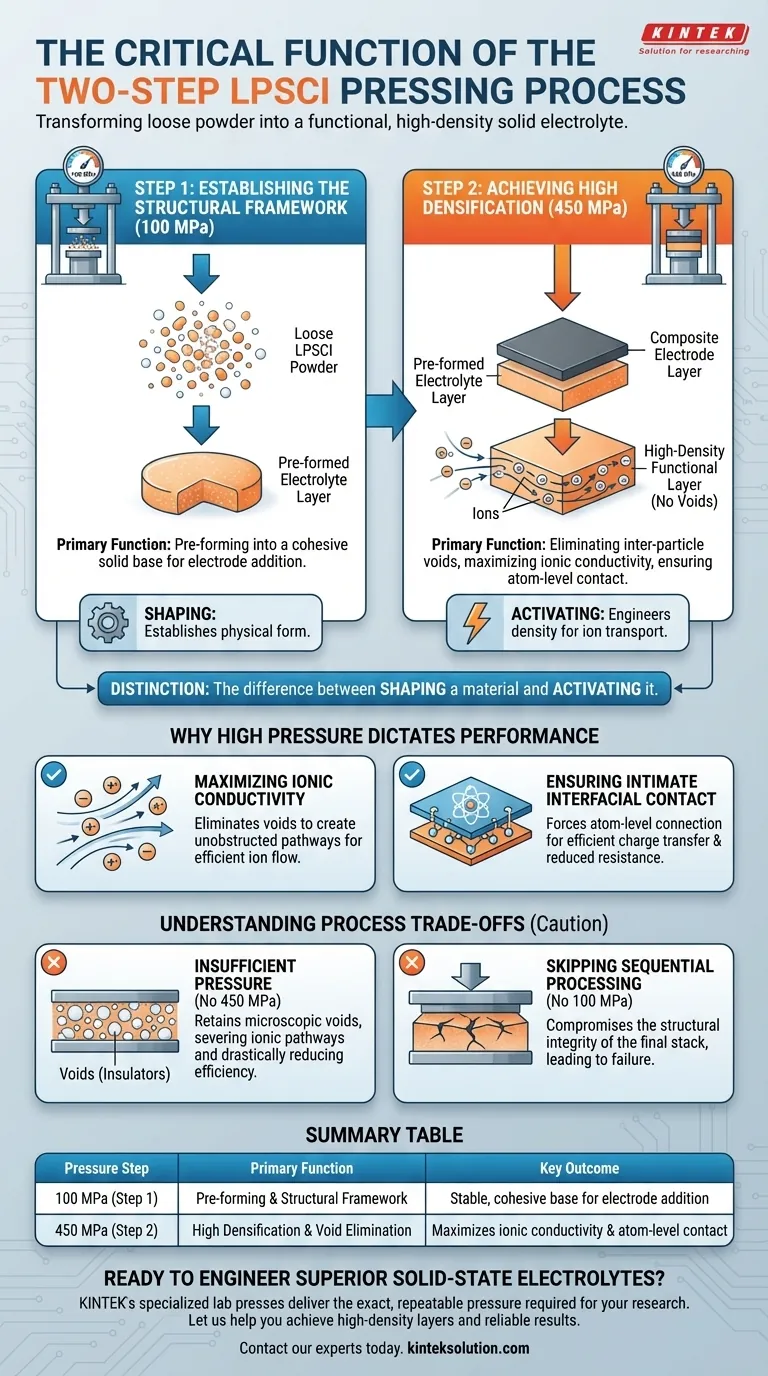
The two-step pressing process acts as the defining mechanism for transforming loose LPSCl powder into a functional, high-density solid electrolyte. The initial 100 MPa application creates a preliminary structural framework to shape the material, while the subsequent 450 MPa application provides the critical force required to eliminate inter-particle voids, maximize ionic conductivity, and ensure intimate, atom-level contact between the electrode and electrolyte.
The distinction between these two steps is the difference between shaping a material and activating it. While the first step establishes physical form, the second step engineers the density required for efficient ion transport.
The Mechanics of the Two-Step Protocol
Step 1: Establishing the Structural Framework
The initial phase utilizes a relatively low pressure of 100 MPa.
The primary function here is pre-forming the LPSCl sulfide electrolyte powder. This step converts loose powder into a cohesive solid layer, establishing a preliminary structural framework. This stable base is necessary before introducing the composite electrode layer.
Step 2: Achieving High Densification
Once the composite electrode layer is added to the pre-formed electrolyte, the system undergoes ultra-high pressure application at 450 MPa.
This stage is the driver of performance. The extreme pressure forces the material to compact significantly, effectively eliminating inter-particle voids that would otherwise interrupt the path of ions.
Why High Pressure Dictates Performance
Maximizing Ionic Conductivity
The performance of a solid electrolyte depends heavily on its density.
By removing voids through the 450 MPa press, the process creates a continuous material phase. This high densification creates an unobstructed pathway for ions, thereby maximizing the ionic conductivity of the LPSCl layer.
Ensuring Intimate Interfacial Contact
Solid-state batteries often fail due to poor connection between layers.
The 450 MPa step forces the electrolyte and electrode into intimate, atom-level contact. This physical connection is essential for facilitating efficient charge transfer across the interface and reducing resistance.
Understanding the Process Trade-offs
The Consequence of Insufficient Pressure
It is a common error to assume that merely shaping the pellet is sufficient.
Without the secondary 450 MPa application, the electrolyte layer retains microscopic voids. These voids act as insulators, severing ionic pathways and drastically reducing the overall efficiency of the cell.
The Necessity of Sequential Processing
Attempting to apply ultra-high pressure in a single step can lead to structural issues.
The 100 MPa pre-forming step is not merely a warm-up; it establishes the geometry required for the final layer to accept the electrode uniformly. Skipping this preliminary framework can compromise the integrity of the final stack.
Making the Right Choice for Your Goal
To ensure the success of your LPSCl electrolyte preparation, align your pressing strategy with these functional priorities:
- If your primary focus is Handling and Assembly: Ensure you utilize the 100 MPa step to create a stable, pre-formed framework that allows for the safe addition of the electrode layer.
- If your primary focus is Electrochemical Performance: You must rigorously apply the 450 MPa step to drive out voids and guarantee the atom-level contact required for high ionic conductivity.
Successful solid-state electrolyte fabrication is less about the material itself and more about the mechanical history you impose upon it.
Summary Table:
| Pressure Step | Primary Function | Key Outcome |
|---|---|---|
| 100 MPa | Pre-forming & Structural Framework | Creates a stable, cohesive base for electrode addition |
| 450 MPa | High Densification & Void Elimination | Maximizes ionic conductivity and ensures atom-level interfacial contact |
Ready to Engineer Superior Solid-State Electrolytes?
The precise mechanical history you impose on your materials is critical for performance. KINTEK's specialized lab press machines, including automatic and heated lab presses, are engineered to deliver the exact, repeatable pressure required for your research and development.
Let us help you achieve:
- High-Density Layers: Eliminate voids and maximize ionic conductivity.
- Reliable Results: Ensure consistent, intimate interfacial contact for your solid-state batteries.
- Process Optimization: Perfect your two-step or custom pressing protocols.
Contact our experts today to discuss how our laboratory presses can advance your solid-state battery development. #Contact Us for a consultation.
Visual Guide
Related Products
- Laboratory Hydraulic Press Lab Pellet Press Button Battery Press
- Laboratory Hydraulic Press 2T Lab Pellet Press for KBR FTIR
- Laboratory Hydraulic Press Lab Pellet Press Machine for Glove Box
- 24T 30T 60T Heated Hydraulic Lab Press Machine with Hot Plates for Laboratory
- Automatic Laboratory Hydraulic Press Lab Pellet Press Machine
People Also Ask
- How is a laboratory hydraulic press used for HAP composite gels? Master Mineral Substrate Standardization
- What role does a laboratory hydraulic press play in the preparation of piezoelectric ceramic discs for DC-PG? | KINTEK
- What role does a laboratory hydraulic press play in reaction pellets? Optimizing Lunar Soil and Metal Fuel Density
- Why is a laboratory hydraulic press required for PBAT and PLA sample preparation? Achieve Flawless Characterization
- What role does a laboratory hydraulic press play in the assembly of all-solid-state battery test cells? Expert Guide



















