
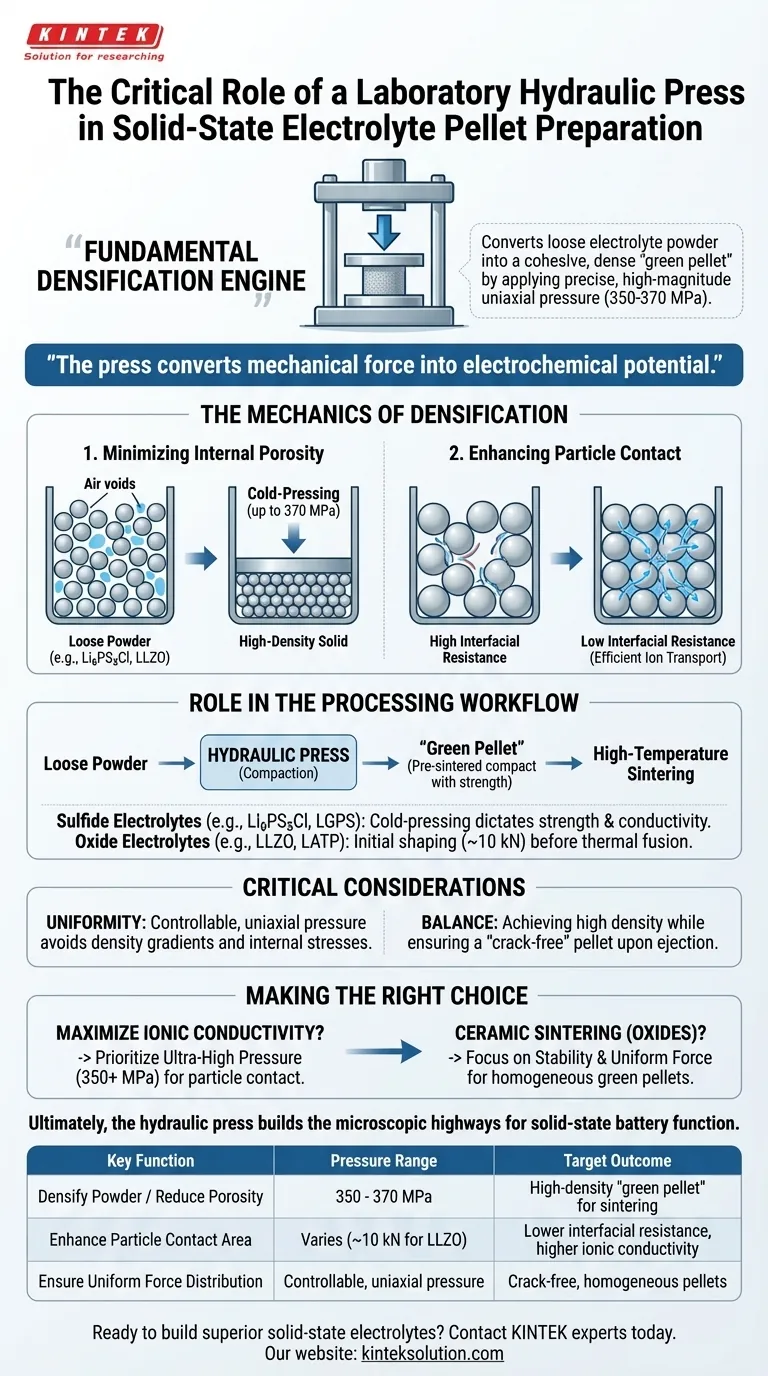
The laboratory hydraulic press acts as the fundamental densification engine in the fabrication of solid-state batteries. Its primary function is to apply precise, high-magnitude uniaxial pressure—often reaching 350 to 370 MPa—to transform loose electrolyte powder into a cohesive, dense solid known as a "green pellet."
The press converts mechanical force into electrochemical potential. By forcing electrolyte particles into intimate contact and eliminating air voids, the hydraulic press creates the continuous physical pathways required for lithium ions to move efficiently, directly dictating the final ionic conductivity of the material.
The Mechanics of Densification
The transition from a loose powder to a functional electrolyte relies entirely on the reduction of empty space.
Minimizing Internal Porosity
Loose powders, such as Li6PS5Cl or LLZO, naturally contain significant volume comprised of air voids. A laboratory press applies cold-pressing force to mechanically collapse these voids.
References indicate that pressures up to 370 MPa are necessary to achieve the required density. This process effectively squeezes out porosity, resulting in a tightly packed solid structure that is essential for high-performance applications.
Enhancing Particle Contact
For a solid-state battery to function, lithium ions must hop from one particle to the next.
If particles are loosely packed, the resistance at the interface between them blocks ion flow. The hydraulic press forces these particles together, significantly increasing the contact area.
This mechanical bridging reduces interfacial resistance, establishing the efficient ion transport channels that define a superior electrolyte.
The Role in the Processing Workflow
Beyond immediate density, the press serves as a critical preparation step for subsequent manufacturing phases.
Forming the "Green Pellet"
Before a ceramic electrolyte (like LATP or LLZO) acts as a conductor, it must first exist as a stable shape.
The press compacts powder into a green pellet—a pre-sintered compact with sufficient mechanical strength to be handled without crumbling.
This step is a prerequisite for high-temperature sintering. Without a uniform, high-density green pellet, the final sintered ceramic is likely to suffer from cracks or poor structural integrity.
Material-Specific Requirements
Different materials require this densification for different reasons.
For sulfide electrolytes like Li6PS5Cl or LGPS, the cold-pressing stage often dictates the final mechanical strength and conductivity directly.
For oxide electrolytes like LLZO or LATP, the press provides the initial shaping (often around 10 kN of force) to prepare the material for the thermal treatment that ultimately fuses the ceramics.
Critical Considerations and Trade-offs
While pressure is vital, the application of that pressure requires precision.
The Necessity of Uniformity
Simply applying force is insufficient; the pressure must be uniaxial and uniform.
References highlight that controllable pressure is essential to avoid density gradients within the pellet.
If pressure is applied unevenly, the resulting pellet may develop internal stresses. This can lead to warping during sintering or inconsistent ionic conductivity across the surface of the electrolyte.
Balancing Pressure and Integrity
There is a delicate balance between achieving high density and maintaining structural integrity.
The goal is a "crack-free" pellet. While high pressure increases density, the press must offer stability to ensure the pellet does not fracture upon ejection or subsequent handling.
Making the Right Choice for Your Goal
The role of the hydraulic press changes slightly depending on the specific electrolyte chemistry you are developing.
- If your primary focus is maximizing Ionic Conductivity: Prioritize a press capable of delivering ultra-high pressures (350+ MPa) to maximize particle contact and minimize interfacial resistance.
- If your primary focus is Ceramic Sintering (Oxides): Focus on a press that offers exceptional stability and uniform force distribution to create a homogeneous green pellet that will not crack during heating.
Ultimately, the laboratory hydraulic press is not just a shaping tool; it is the device responsible for building the microscopic highways that allow a solid-state battery to function.
Summary Table:
| Key Function | Pressure Range | Target Outcome |
|---|---|---|
| Densify Powder / Reduce Porosity | 350 - 370 MPa | High-density 'green pellet' for sintering |
| Enhance Particle Contact Area | Varies by material (e.g., ~10 kN for LLZO) | Lower interfacial resistance, higher ionic conductivity |
| Ensure Uniform Force Distribution | Controllable, uniaxial pressure | Crack-free, homogeneous pellets for reliable performance |
Ready to build superior solid-state electrolytes? The precise, high-pressure densification provided by a KINTEK lab press is the critical first step in developing high-performance battery materials like LLZO, LATP, or Li6PS5Cl. Our automatic lab presses, isostatic presses, and heated lab presses deliver the uniform force and stability required to create crack-free pellets with optimal ionic conductivity. Let's discuss your specific electrolyte development goals – contact our experts today to find the perfect press for your laboratory.
Visual Guide
Related Products
- Laboratory Hydraulic Press Lab Pellet Press Machine for Glove Box
- Laboratory Hydraulic Press 2T Lab Pellet Press for KBR FTIR
- 24T 30T 60T Heated Hydraulic Lab Press Machine with Hot Plates for Laboratory
- Laboratory Hydraulic Press Lab Pellet Press Button Battery Press
- Laboratory Hydraulic Pellet Press for XRF KBR FTIR Lab Press
People Also Ask
- How does a laboratory hydraulic press contribute to the preparation of Li3-3xScxSb samples? Optimize Ionic Conductivity
- What is the function of a laboratory hydraulic press in FT-IR of curcumin-coated MWCNTs? Achieve Optical Clarity.
- Why is a laboratory hydraulic press required for compression molding boron-siloxane? Solve High-Loading Density Challenges
- What role does a laboratory hydraulic press play in reaction pellets? Optimizing Lunar Soil and Metal Fuel Density
- What role does a laboratory hydraulic press play in the preparation of piezoelectric ceramic discs for DC-PG? | KINTEK



















