
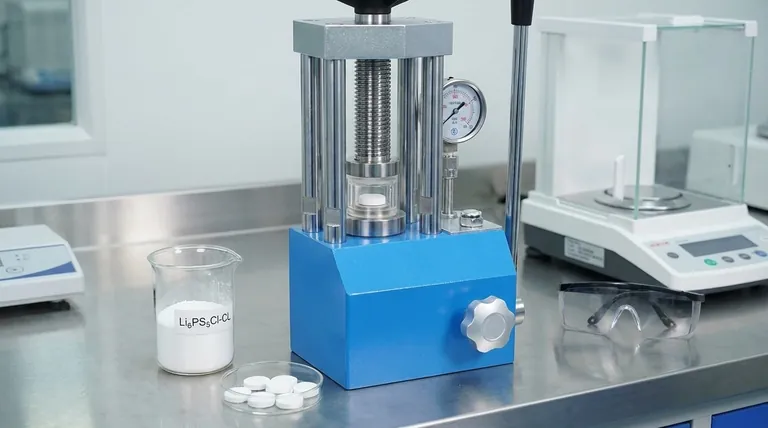
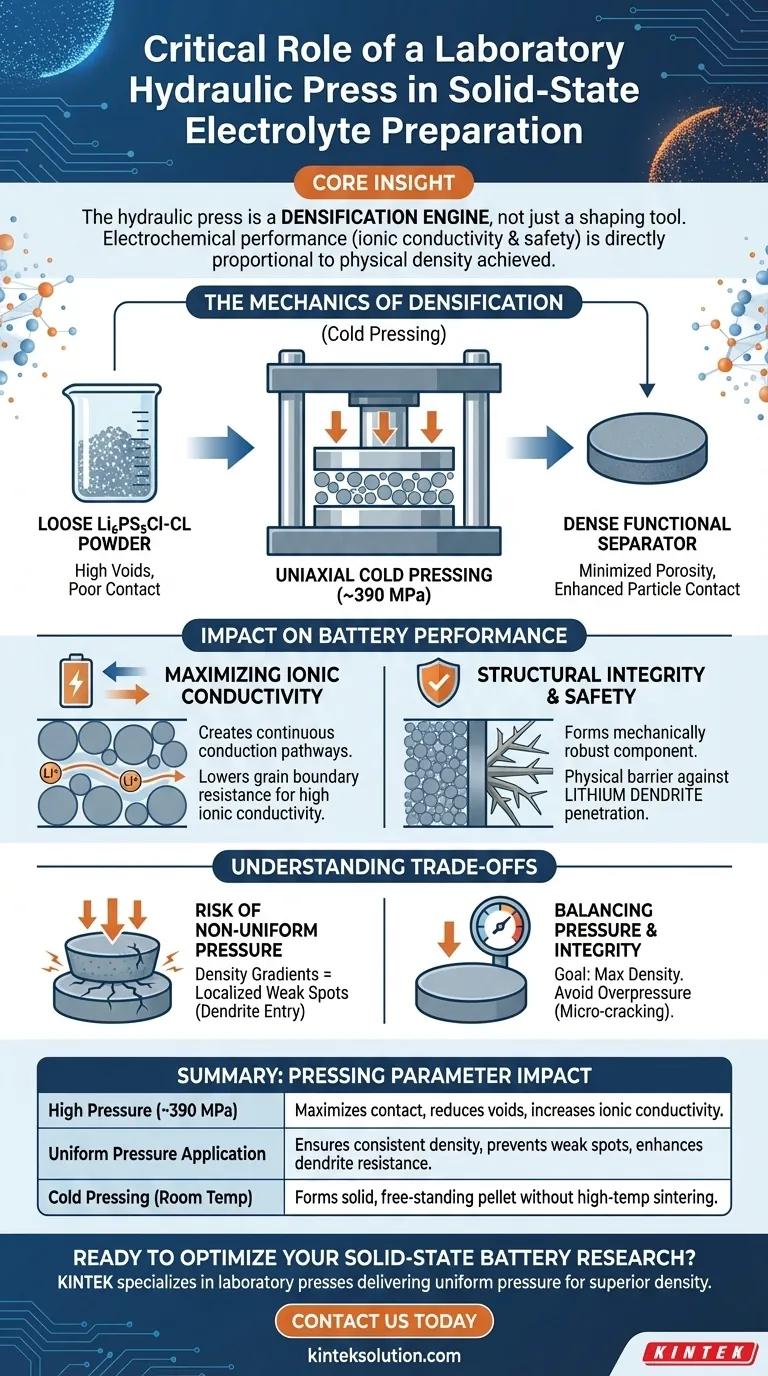
The primary role of the laboratory hydraulic press is to transform loose Li₆PS₅Cl-CL powder into a dense, functional separator through a process called cold pressing. By applying high uniaxial pressure (often around 390 MPa), the press eliminates inter-particle voids to create continuous lithium-ion conduction pathways and provides the mechanical structural integrity necessary to resist lithium dendrite penetration.
Core Insight: The hydraulic press is not merely a shaping tool; it is a densification engine. In solid-state battery fabrication, the electrochemical performance of the electrolyte is directly proportional to the physical density achieved during pressing, as this dictates both ionic conductivity and mechanical safety.
The Mechanics of Densification
Uniaxial Cold Pressing
The process begins with loose Li₆PS₅Cl-CL powder, which inherently lacks structural cohesion.
The hydraulic press applies uniaxial high pressure to the material at room temperature (cold pressing). This forces the powder particles to rearrange and deform, creating a solid, free-standing pellet without the immediate need for high-temperature sintering.
Minimizing Porosity
The most critical physical change driven by the press is the reduction of voids (pores) between particles.
Loose powder contains significant air gaps that act as insulators against ion flow. High-pressure compaction collapses these voids, maximizing the ratio of active material per unit volume.
Enhancing Particle Contact
Densification is useless without connection.
The press forces individual powder grains into tight contact with one another. This increases the effective contact area, which is essential for reducing interfacial resistance and ensuring a smooth path for lithium ions to travel across grain boundaries.
Impact on Battery Performance
Maximizing Ionic Conductivity
Conductivity in solid electrolytes is strictly physical; ions must "hop" from particle to particle.
By reducing the voids and increasing contact area, the hydraulic press establishes continuous conduction pathways. This directly lowers grain boundary resistance, allowing the Li₆PS₅Cl-CL separator to achieve the high ionic conductivity required for high-performance batteries.
Structural Integrity and Safety
A separator must physically separate the anode from the cathode.
The pressure applied by the press fuses the powder into a mechanically robust component. This density is the primary defense mechanism against lithium dendrites—metallic filaments that grow during charging and can cause short circuits. A highly densified separator acts as a physical barrier to block this penetration.
Understanding the Trade-offs
The Risk of Non-Uniform Pressure
While high pressure is necessary, the application must be perfectly uniform.
If the hydraulic press applies pressure unevenly, it creates density gradients within the pellet. These inconsistencies lead to localized weak spots where dendrites can easily penetrate, or areas of high resistance that throttle battery performance.
Balancing Pressure and Integrity
There is a mechanical limit to the material.
While specifically for Li₆PS₅Cl-CL, pressures around 390 MPa are cited as effective, applying pressure beyond the equipment or material limits can cause micro-cracking. The goal is maximum density, but not at the expense of fracturing the pellet structure.
Making the Right Choice for Your Goal
To optimize your solid-state electrolyte preparation, focus on the specific outcome you need to achieve with your press.
- If your primary focus is Maximizing Conductivity: Ensure your press can sustain high pressures (e.g., 390 MPa) to minimize grain boundary resistance and maximize particle contact.
- If your primary focus is Safety and Durability: Prioritize a press with exceptional pressure uniformity to create a defect-free, dense barrier that resists dendrite propagation.
The laboratory hydraulic press is the defining instrument that bridges the gap between raw chemical potential and a viable, safe energy storage component.
Summary Table:
| Pressing Parameter | Impact on Li₆PS₅Cl-CL Separator |
|---|---|
| High Pressure (~390 MPa) | Maximizes particle contact, reduces voids, and increases ionic conductivity. |
| Uniform Pressure Application | Ensures consistent density, prevents weak spots, and enhances dendrite resistance. |
| Cold Pressing (Room Temp) | Forms a solid, free-standing pellet without immediate high-temperature sintering. |
Ready to Optimize Your Solid-State Battery Research?
The precise, high-pressure densification described is critical for developing safe, high-performance solid-state electrolytes. KINTEK specializes in laboratory press machines, including automatic lab presses and heated lab presses, designed to deliver the uniform pressure and control your R&D demands.
Contact us today using the form below to discuss how our presses can help you achieve superior density and performance in your Li₆PS₅Cl-CL separators.
Visual Guide
Related Products
- 24T 30T 60T Heated Hydraulic Lab Press Machine with Hot Plates for Laboratory
- Automatic Heated Hydraulic Press Machine with Heated Plates for Laboratory
- Automatic Heated Hydraulic Press Machine with Hot Plates for Laboratory
- Manual Laboratory Hydraulic Press Lab Pellet Press
- Automatic High Temperature Heated Hydraulic Press Machine with Heated Plates for Lab
People Also Ask
- Function of a Laboratory Hydraulic Press with Heated Platens in SSE? Enhance Battery Density & Conductivity
- Why is a laboratory hydraulic press with heating plates required for PLA/TEC films? Achieve Precise Sample Integrity
- What role does a laboratory heated hydraulic press play in LTCC? Essential for High-Density Ceramic Lamination
- What is the primary function of a laboratory heated hydraulic press? Mastering Thermoplastic Carbon Fiber Composites
- What is the critical role of a laboratory heated hydraulic press? Mastering PVC Sample Prep for Testing



















