
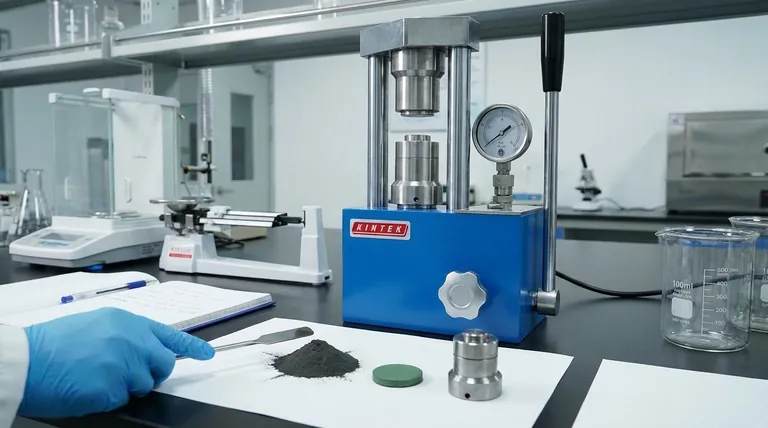
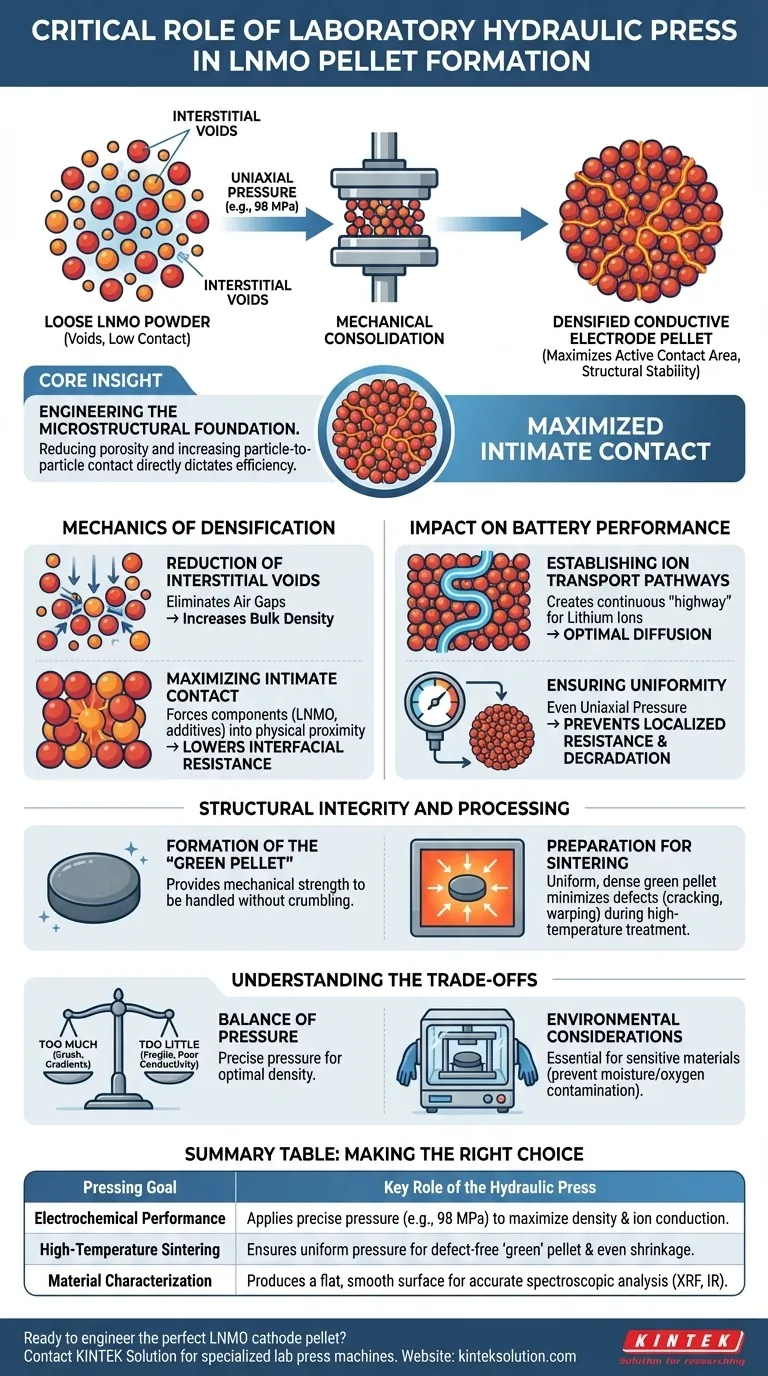
The primary function of a laboratory hydraulic press in processing LNMO composite cathode powder is to transform loose particles into a densified, conductive electrode pellet through the application of precise, uniform uniaxial pressure.
This mechanical consolidation is the critical first step in establishing the electrode's physical architecture. It eliminates interstitial voids between the LNMO particles, maximizing the active contact area necessary for efficient electrochemical performance and ensuring the structural stability of the "green" (unfired) pellet.
Core Insight: The hydraulic press does not merely shape the powder; it engineering the microstructural foundation of the battery. By reducing porosity and increasing particle-to-particle contact, the press directly dictates the efficiency of lithium-ion conduction pathways and the mechanical viability of the final electrode.
The Mechanics of Densification
Reduction of Interstitial Voids
Loose LNMO powder inherently contains significant air gaps, or voids, between particles. These voids act as insulators, blocking the flow of ions and electrons.
The hydraulic press applies force (often up to 98 MPa or higher) to mechanically collapse these gaps. This process dramatically increases the bulk density of the material, moving it closer to its theoretical density.
Maximizing Intimate Contact
For a composite cathode to function, the active material (LNMO) must have continuous contact with conductive additives and electrolytes.
The press forces these distinct components into intimate contact. This physical proximity is required to lower interfacial resistance, allowing for efficient charge transfer across particle boundaries.
Impact on Battery Performance
Establishing Ion Transport Pathways
The primary goal of densification is to create a continuous "highway" for lithium ions.
By minimizing porosity, the press establishes a connected network of solid material. This creates the optimal physical pathway required for efficient ion diffusion through the cathode structure.
Ensuring Uniformity
A laboratory hydraulic press is designed to apply uniaxial pressure evenly across the sample surface.
This uniformity ensures that the density is consistent throughout the pellet. Uniform density prevents localized areas of high resistance, which can lead to uneven current distribution and premature battery degradation.
Structural Integrity and Processing
Formation of the "Green Pellet"
Before any thermal treatment, the loose powder must be formed into a cohesive solid, often called a green pellet.
The press provides the mechanical force necessary to interlock the particles. This yields a pellet with sufficient mechanical strength to be handled, moved, or stacked without crumbling or deforming.
Preparation for Sintering
If the LNMO pellet is destined for high-temperature sintering, the quality of the pressing stage is the determining factor for success.
A uniform, dense green pellet minimizes defects during heating. It effectively reduces the risk of uneven shrinkage, cracking, or warping that can occur when a poorly compacted sample is fired.
Understanding the Trade-offs
The Balance of Pressure
While high pressure is necessary for density, excessive force can be detrimental.
Applying too much pressure may crush the internal structure of the LNMO particles or cause density gradients (where the surface is denser than the core). Conversely, insufficient pressure results in a fragile pellet with poor conductivity.
Environmental Considerations
The pressing process exposes the material to the surrounding atmosphere.
Many hydraulic presses are compact enough to be operated within a vacuum glove box. For sensitive materials, this capability is essential to prevent moisture or oxygen contamination during the compaction phase.
Making the Right Choice for Your Goal
To maximize the utility of your laboratory hydraulic press for LNMO preparation, consider your specific experimental objectives:
- If your primary focus is Electrochemical Performance: Prioritize reaching a specific target density (e.g., via 98 MPa pressure) to ensure low internal resistance and optimal ion conduction.
- If your primary focus is High-Temperature Sintering: Focus on the uniformity of the applied pressure to produce a defect-free green body that will shrink evenly without cracking.
- If your primary focus is Material Characterization (e.g., XRF/IR): Focus on achieving a perfectly flat, smooth surface finish to ensure accurate spectroscopic readings.
Success in battery fabrication relies not just on the chemistry of the powder, but on the precision of the pressure used to bind it.
Summary Table:
| Pressing Goal | Key Role of the Hydraulic Press |
|---|---|
| Electrochemical Performance | Applies precise pressure (e.g., 98 MPa) to maximize density, reduce internal resistance, and create optimal ion conduction pathways. |
| High-Temperature Sintering | Ensures uniform pressure for a defect-free 'green' pellet that shrinks evenly without cracking during thermal treatment. |
| Material Characterization | Produces a flat, smooth pellet surface for accurate spectroscopic analysis (e.g., XRF, IR). |
Ready to engineer the perfect LNMO cathode pellet for your research?
The precise, uniform pressure from a KINTEK lab press is the critical first step in building a high-performance battery electrode. Our automatic lab presses, isostatic presses, and heated lab presses are engineered to deliver the consistency and control your laboratory needs for reliable densification and microstructural development.
Contact us today to discuss how our specialized lab press machines can enhance your battery development process. Let's build the foundation for your success together.
Visual Guide
Related Products
- Laboratory Hydraulic Press Lab Pellet Press Machine for Glove Box
- Laboratory Hydraulic Press 2T Lab Pellet Press for KBR FTIR
- 24T 30T 60T Heated Hydraulic Lab Press Machine with Hot Plates for Laboratory
- Laboratory Hydraulic Press Lab Pellet Press Button Battery Press
- Laboratory Hydraulic Pellet Press for XRF KBR FTIR Lab Press
People Also Ask
- How does a laboratory hydraulic press contribute to the preparation of Li3-3xScxSb samples? Optimize Ionic Conductivity
- What is the function of a laboratory hydraulic press in FT-IR of curcumin-coated MWCNTs? Achieve Optical Clarity.
- Why is a laboratory hydraulic press required for compression molding boron-siloxane? Solve High-Loading Density Challenges
- What role does a laboratory hydraulic press play in reaction pellets? Optimizing Lunar Soil and Metal Fuel Density
- What role does a laboratory hydraulic press play in the preparation of piezoelectric ceramic discs for DC-PG? | KINTEK



















