
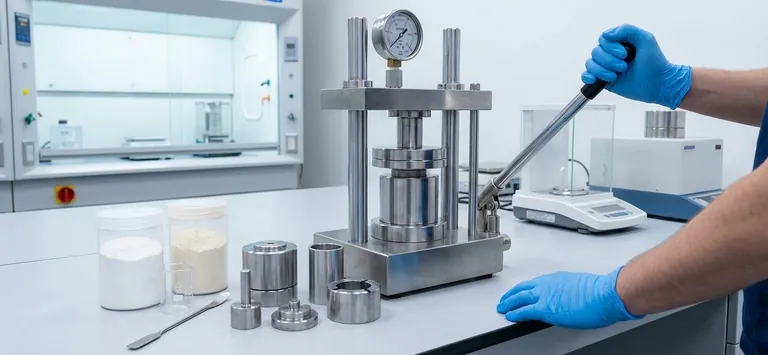
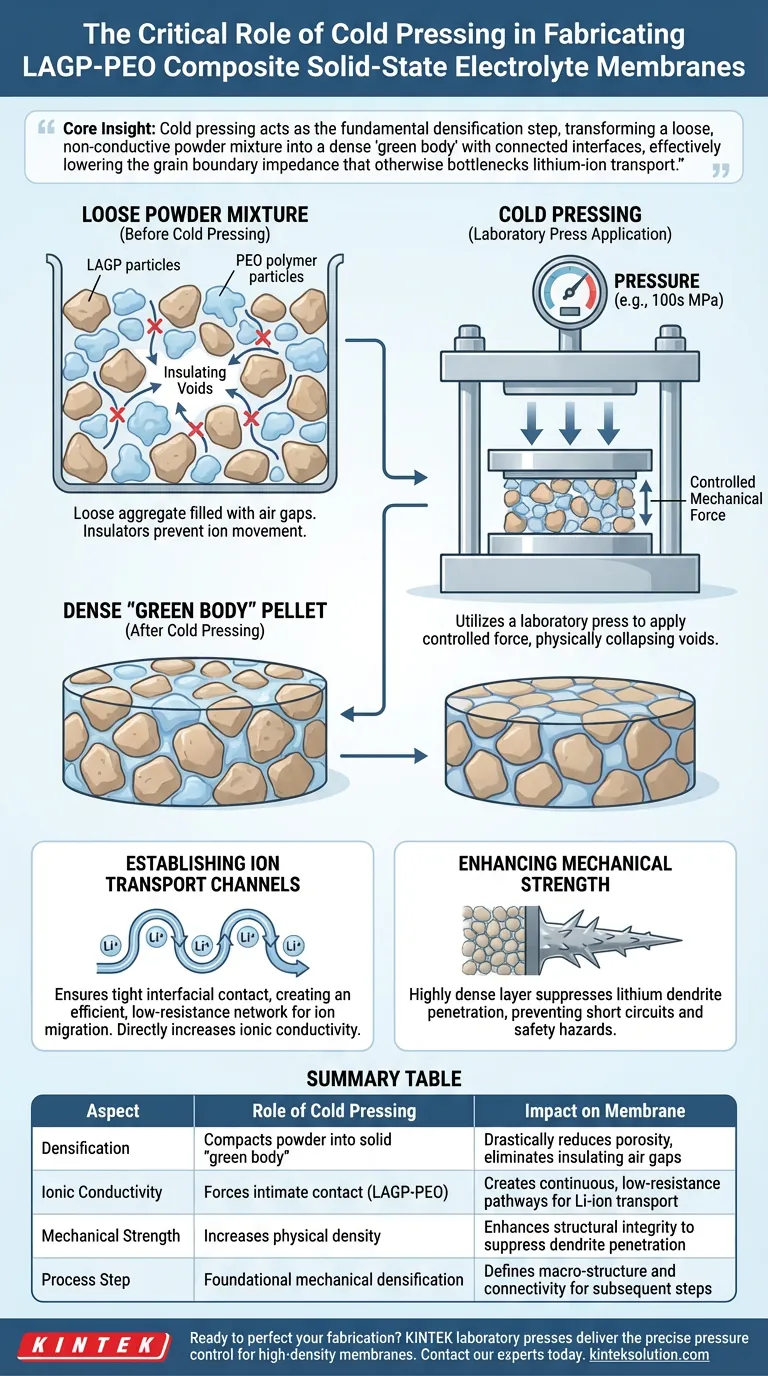
Cold pressing acts as the fundamental densification step in the fabrication of LAGP-PEO composite solid-state electrolyte membranes. This process utilizes a laboratory press to apply controlled mechanical force to the mixed precursor powders, physically collapsing the voids between particles to form a solid, cohesive structure. By reducing porosity, cold pressing forces the LAGP (ceramic) filler and PEO (polymer) matrix into intimate physical contact, which is the physical prerequisite for ionic conduction.
Core Insight: The effectiveness of a solid-state battery relies entirely on the continuity of its internal pathways. Cold pressing transforms a loose, non-conductive powder mixture into a dense "green body" with connected interfaces, effectively lowering the grain boundary impedance that otherwise bottlenecks lithium-ion transport.
The Physics of Densification
Creating the Green Body
The primary function of cold pressing is to compact the mixed LAGP and PEO powders into a dense pellet, often referred to as a green body.
Without this high-pressure compaction, the material remains a loose aggregate of particles filled with air gaps. These gaps act as insulators, preventing the movement of ions across the membrane.
Eliminating Inter-particle Voids
Applying high pressure (often ranging from MPa to hundreds of MPa depending on the specific protocol) drastically reduces the material's internal porosity.
The laboratory press mechanically forces the softer PEO polymer to deform around the harder LAGP ceramic particles. This minimizes the "dead space" within the composite, ensuring that the volume is occupied by active electrolyte material rather than air.
Impact on Electrochemical Performance
Establishing Ion Transport Channels
Lithium ions cannot "jump" across air gaps; they require a continuous material path to travel from anode to cathode.
Cold pressing ensures tight interfacial contact between the ceramic filler and the polymer matrix. This physical continuity creates an efficient, low-resistance network for ion migration, directly increasing the final ionic conductivity of the membrane.
Enhancing Mechanical Strength
Beyond conductivity, the densification provided by cold pressing is critical for the membrane's structural integrity.
A highly dense, low-porosity layer is mechanically robust. This density is essential for suppressing lithium dendrite penetration, a phenomenon where metallic lithium grows through pores in the electrolyte, potentially causing short circuits and safety hazards.
Understanding the Trade-offs
The Necessity of Precision
While high pressure is beneficial, it must be precise. The goal is to maximize density without degrading the materials.
Insufficient pressure leaves residual porosity, leading to high grain boundary impedance and poor connectivity. Conversely, while not explicitly detailed in every protocol, excessive pressure in some ceramic contexts can lead to stress fractures; therefore, finding the optimal pressure window is key to a uniform, defect-free membrane.
Cold vs. Hot Pressing Distinction
It is important to distinguish cold pressing from hot pressing. Cold pressing relies solely on mechanical force to reduce voids and is often used to form the initial shape or "green body."
Hot pressing, by contrast, introduces heat to melt the polymer (like PEO) for even deeper encapsulation. However, cold pressing remains the critical first step in defining the macro-structure and density of the pellet before any thermal treatment occurs.
Making the Right Choice for Your Goal
When configuring your fabrication protocol for LAGP-PEO membranes, consider your specific performance targets:
- If your primary focus is Ionic Conductivity: Prioritize pressures that maximize the density of the green body to minimize interfacial resistance between the LAGP and PEO.
- If your primary focus is Safety (Dendrite Suppression): Ensure your pressing protocol achieves near-zero porosity, as physical density is the primary barrier against lithium metal penetration.
Achieving a high-performance solid-state electrolyte is impossible without the foundational density and particle interconnectivity established during the cold pressing stage.
Summary Table:
| Aspect | Role of Cold Pressing | Impact on Membrane |
|---|---|---|
| Densification | Compacts powder mixture into a solid 'green body' | Drastically reduces porosity, eliminates insulating air gaps |
| Ionic Conductivity | Forces intimate contact between LAGP filler and PEO matrix | Creates continuous, low-resistance pathways for lithium-ion transport |
| Mechanical Strength | Increases physical density of the composite layer | Enhances structural integrity to suppress lithium dendrite penetration |
| Process Step | Foundational mechanical densification before thermal treatment | Defines the macro-structure and particle connectivity for subsequent steps |
Ready to perfect your solid-state electrolyte fabrication? The precise pressure control of a KINTEK laboratory press is fundamental to achieving the high-density, low-porosity membranes required for superior ionic conductivity and dendrite suppression. Our automatic lab presses, isostatic presses, and heated lab presses are engineered to deliver the repeatable performance your research demands.
Contact our experts today to find the ideal press for developing your LAGP-PEO and other composite electrolyte materials.
Visual Guide
Related Products
- Electric Lab Cold Isostatic Press CIP Machine
- Automatic Lab Cold Isostatic Pressing CIP Machine
- Electric Split Lab Cold Isostatic Pressing CIP Machine
- Manual Cold Isostatic Pressing CIP Machine Pellet Press
- Laboratory Hydraulic Press Lab Pellet Press Machine for Glove Box
People Also Ask
- What role do electric lab cold isostatic presses play in industrial contexts? Bridge R&D and Manufacturing with Precision
- What are the applications of electric lab cold isostatic presses in research settings? Advance Material R&D with High-Pressure CIPs
- How does electrical Cold Isostatic Pressing (CIP) contribute to cost savings? Unlock Efficiency and Reduce Expenses
- What are some research applications of electric lab CIPs? Unlock Uniform Powder Densification for Advanced Materials
- What are the characteristics of standard off-the-shelf electric lab CIP solutions? Achieve Immediate, Cost-Effective Processing



















