
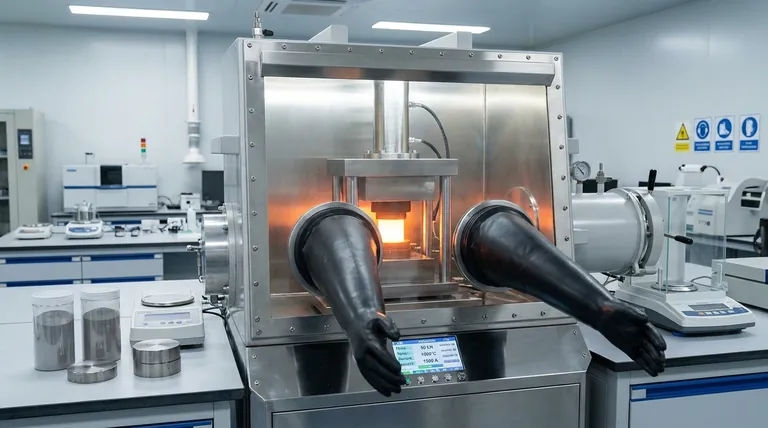
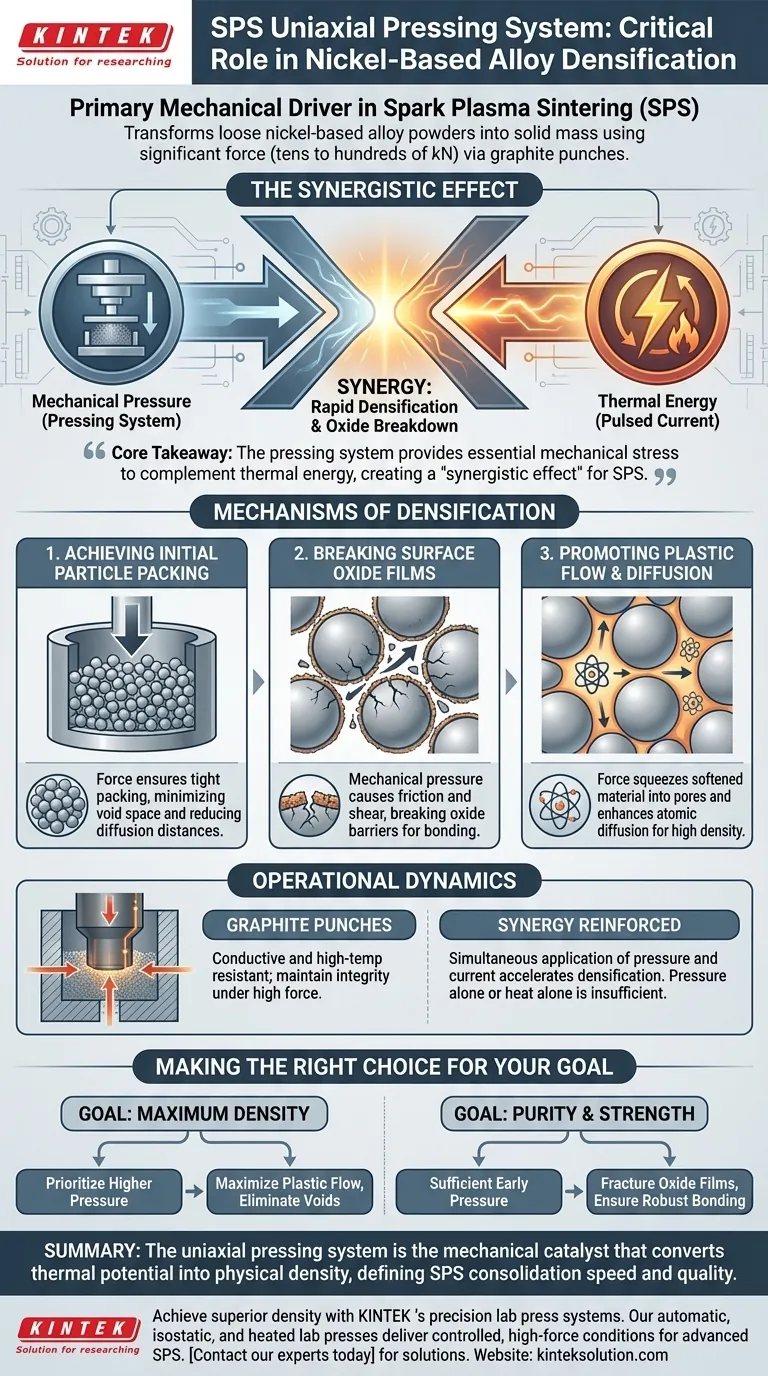
The uniaxial pressing system acts as the primary mechanical driver in Spark Plasma Sintering (SPS) equipment. By utilizing graphite punches to apply significant force—ranging from tens to hundreds of kilonewtons—directly to nickel-based alloy powders, it transforms loose particles into a solid mass. This system is not merely a clamp; it is an active variable that dictates the microstructure and density of the final material.
Core Takeaway The pressing system provides the mechanical stress necessary to complement thermal energy, creating a "synergistic effect" that is essential for SPS. Without this applied pressure, the thermal energy alone would be insufficient to rapidly densify nickel-based alloys or break down the stubborn oxide layers that inhibit bonding.
The Mechanisms of Densification
To understand the critical role of the pressing system, one must look beyond simple compression. The applied force activates three specific physical mechanisms that drive the material toward full density.
Achieving Initial Particle Packing
The first function of the uniaxial system is geometric. The force ensures the tight packing of powder particles within the die.
By minimizing the void space between particles before sintering begins, the system reduces the distance atoms must diffuse, setting the stage for efficient consolidation.
Breaking Surface Oxide Films
Nickel-based alloys are prone to forming surface oxides, which act as a barrier to inter-particle bonding.
The mechanical pressure applied by the punches causes friction and shear stresses that break up these surface oxide films. This exposes the clean metal underneath, allowing for true metallurgical bonding between particles.
Promoting Plastic Flow and Diffusion
As the pulsed current generates heat, the nickel alloy softens. The uniaxial pressure exploits this thermal softening.
The force promotes plastic flow, effectively squeezing the material into remaining pores. Simultaneously, it enhances atomic diffusion at high temperatures, which is the fundamental transport mechanism for closing gaps and achieving high density.
Understanding the Operational Dynamics
The effectiveness of the uniaxial pressing system relies on the interplay between mechanical limits and thermal energy.
The Role of Graphite Punches
The force is transmitted to the powder through graphite punches.
Graphite is chosen because it is conductive (necessary for the pulsed current) and can withstand high temperatures. However, the system relies on these punches to maintain structural integrity while delivering up to hundreds of kilonewtons of force.
The Synergistic Effect
The pressing system does not operate in a vacuum. Its critical role is defined by its synergy with the thermal energy from the pulsed current.
Pressure alone cannot sinter the material, and heat alone often results in porous components. It is the simultaneous application of pressure and current that significantly accelerates the densification process.
Making the Right Choice for Your Goal
When configuring the uniaxial pressing parameters for nickel-based alloys, align your approach with your specific material objectives.
- If your primary focus is Maximum Density: Prioritize higher pressure settings to maximize plastic flow and eliminate microscopic voids as the material softens.
- If your primary focus is Material Purity and Strength: Ensure sufficient pressure is applied early in the process to effectively fracture surface oxide films, guaranteeing robust inter-particle bonding.
In summary, the uniaxial pressing system is the mechanical catalyst that converts thermal potential into physical density, making it the defining factor in the speed and quality of SPS consolidation.
Summary Table:
| Role of Uniaxial Pressing System | Key Function |
|---|---|
| Initial Particle Packing | Ensures tight powder packing to reduce diffusion distances. |
| Breaking Surface Oxide Films | Applies shear stress to fracture oxide barriers for bonding. |
| Promoting Plastic Flow & Diffusion | Enhances material flow and atomic diffusion to eliminate pores. |
Achieve superior material density and performance with KINTEK's precision lab press systems. Our automatic lab presses, isostatic presses, and heated lab presses are engineered to deliver the controlled, high-force conditions essential for advanced processes like Spark Plasma Sintering. Whether you are working with nickel-based alloys or other challenging materials, our equipment ensures the reliable mechanical driving force your research demands. Contact our experts today to discuss how our pressing solutions can optimize your laboratory's sintering outcomes.
Visual Guide
Related Products
- Automatic Laboratory Hydraulic Press for XRF and KBR Pellet Pressing
- Split Automatic Heated Hydraulic Press Machine with Heated Plates
- Lab Cylindrical Press Mold with Scale
- Automatic Heated Hydraulic Press Machine with Heated Plates for Laboratory
- Automatic Lab Cold Isostatic Pressing CIP Machine
People Also Ask
- Why is pressing powder into a pellet critical before sintering? Ensure Dense, Conductive Solid-State Electrolytes
- What is the role of a laboratory pressure machine and KBr in FTIR? Master Sample Preparation for Flame Retardants
- What are the advantages of using a laboratory automatic hydraulic press for HEA green compact forming?
- What are the advantages of using a lab automatic hydraulic press for HEA green body molding? Ensure Material Integrity
- Why are high-precision automatic hydraulic presses required for Martian ISRU? Ensure Reliable Regolith Forming



















