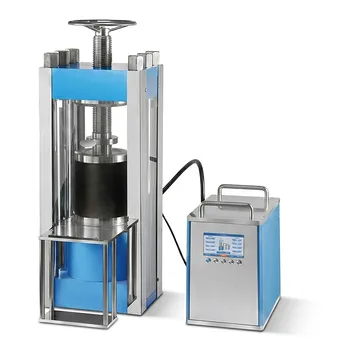
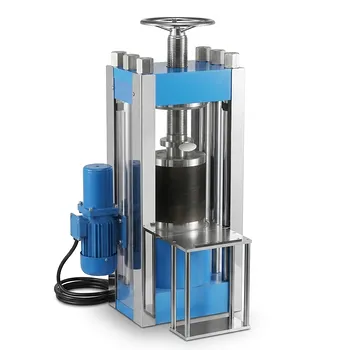
A heated lab press is a precision instrument designed to simultaneously apply controlled heat and pressure to a material. Its primary function is to mold, compact, or laminate samples, facilitating critical processes ranging from material testing and polymer film production to pharmaceutical manufacturing. By integrating thermal energy with mechanical force, it transforms bulk materials into standardized, solid forms for analysis or production.
By combining thermal energy with mechanical force, the heated lab press eliminates voids and ensures uniformity in sample structure. This dual action is essential for creating standardized, dense materials required for accurate scientific analysis and high-quality industrial prototyping.
The Core Mechanisms of Action
To understand the function of a heated lab press, you must look beyond the simple application of force. The synergy between heat and pressure drives specific physical changes in the material.
Densification and Void Removal
The application of heat softens organic precursors or polymers, allowing them to flow. Simultaneous pressure forces these materials into voids and gaps.
For example, in epoxy resin mixtures or ceramic powder processes, this action expels residual air. The result is a dense, non-porous structure with uniform distribution of particles.
Stress Relief and Dimensional Stability
Compression molding at specific temperatures allows for controlled heating and cooling cycles.
This process helps eliminate residual stresses within a composite sheet. The outcome is a sample that maintains its shape and physical properties, ensuring valid mechanical testing results later.
Critical Applications in Research and Industry
The heated lab press is a versatile tool used across various disciplines to solve specific material challenges.
Enhancing Interfacial Adhesion
In the creation of multilayer devices, such as piezoelectric nanogenerators or printed circuit boards (PCBs), distinct layers must bond perfectly.
The press provides the uniform pressure required to minimize contact resistance between layers like graphene electrodes and flexible substrates. This ensures strong physical contact and efficient stress transfer between components.
Standardization for Accurate Analysis
In research fields like food science, variation between samples can ruin data integrity.
Researchers use heated presses to prepare food samples with identical thickness and density. This standardization allows texture analyzers to generate comparable data regarding hardness and brittleness, eliminating human error from the production process.
Battery and Polymer Development
For energy storage technologies, such as solid-state batteries, the press is used for thermo-compression and sintering.
This creates dense, homogenous solid polymer electrolyte films. Optimizing the interfacial contact in these films is vital for improving ionic conductivity and overall battery performance.
Operational Trade-offs and Safety Protocols
While the heated lab press is invaluable for material preparation, it introduces specific operational risks that must be managed.
The Safety Imperative
The combination of high temperatures and crushing force creates a hazardous environment.
Operators must keep hands and fingers away from the platens during compression to prevent severe injury. The use of appropriate Personal Protective Equipment (PPE), including high-temperature gloves and safety glasses, is non-negotiable.
Requirement for Strict Protocols
The quality of the output is heavily dependent on the operator's adherence to procedure.
Materials must be compatible with the press's temperature ranges, and the machine requires regular inspection. An effective training procedure is crucial to ensure users understand both the operational nuances and the emergency procedures.
Making the Right Choice for Your Goal
Whether you are synthesizing new materials or conducting quality control, the heated lab press serves different functions based on your objective.
- If your primary focus is Material Characterization: The press functions as a standardization tool, ensuring every sample has identical density and thickness to validate your test data.
- If your primary focus is Prototyping/Manufacturing: The press functions as a bonding agent, ensuring distinct layers or particles fuse into a single, mechanically stable unit without voids.
The heated lab press acts as the bridge between raw, bulk ingredients and the standardized, high-performance materials necessary for scientific advancement.
Summary Table:
| Core Function | Description | Key Research Benefit |
|---|---|---|
| Densification | Simultaneous heat and pressure removes air voids. | Achieves non-porous, uniform structures. |
| Lamination | Bonds multi-layer materials like PCBs or battery films. | Minimizes contact resistance and improves adhesion. |
| Standardization | Creates samples with identical thickness and density. | Ensures data integrity and repeatable analysis. |
| Stress Relief | Controlled heating/cooling cycles during molding. | Enhances dimensional stability of composites. |
Elevate Your Material Research with KINTEK Precision
At KINTEK, we specialize in comprehensive laboratory pressing solutions designed to meet the rigorous demands of modern science. Whether you are developing next-generation solid-state batteries or advanced polymers, our equipment provides the precision and reliability you need.
Our Versatile Range Includes:
- Manual and Automatic Heated Presses for seamless sample preparation.
- Multifunctional and Glovebox-Compatible models for sensitive environments.
- Cold and Warm Isostatic Presses (CIP/WIP) for high-density battery research.
Why Choose KINTEK? We help you eliminate sample variability, ensuring your research is backed by standardized, high-quality materials.
Contact KINTEK Today to Find Your Perfect Pressing Solution
Related Products
- 24T 30T 60T Heated Hydraulic Lab Press Machine with Hot Plates for Laboratory
- Automatic Heated Hydraulic Lab Press 120x120mm Plate Fully Automated Material Research Press
- Automatic Heated Hydraulic Lab Press with Programmable Touch Screen Controls and Precision Temperature Regulation
- Automatic Heated Hydraulic Lab Press Machine 200x200 Plate Size for Battery Research and Materials Science
- Manual Heated Hydraulic Lab Press with Integrated Hot Plates Hydraulic Press Machine
People Also Ask
- Function of a Laboratory Hydraulic Press with Heated Platens in SSE? Enhance Battery Density & Conductivity
- Why is a laboratory hydraulic press with heating plates required for PLA/TEC films? Achieve Precise Sample Integrity
- What role does a laboratory heated hydraulic press play in LTCC? Essential for High-Density Ceramic Lamination
- What is the primary function of a laboratory heated hydraulic press? Mastering Thermoplastic Carbon Fiber Composites
- What is the critical role of a laboratory heated hydraulic press? Mastering PVC Sample Prep for Testing