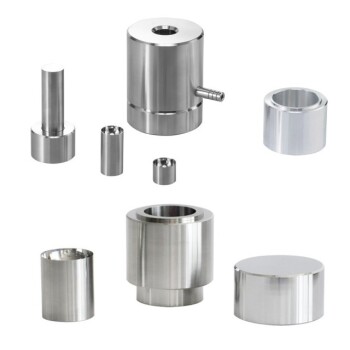
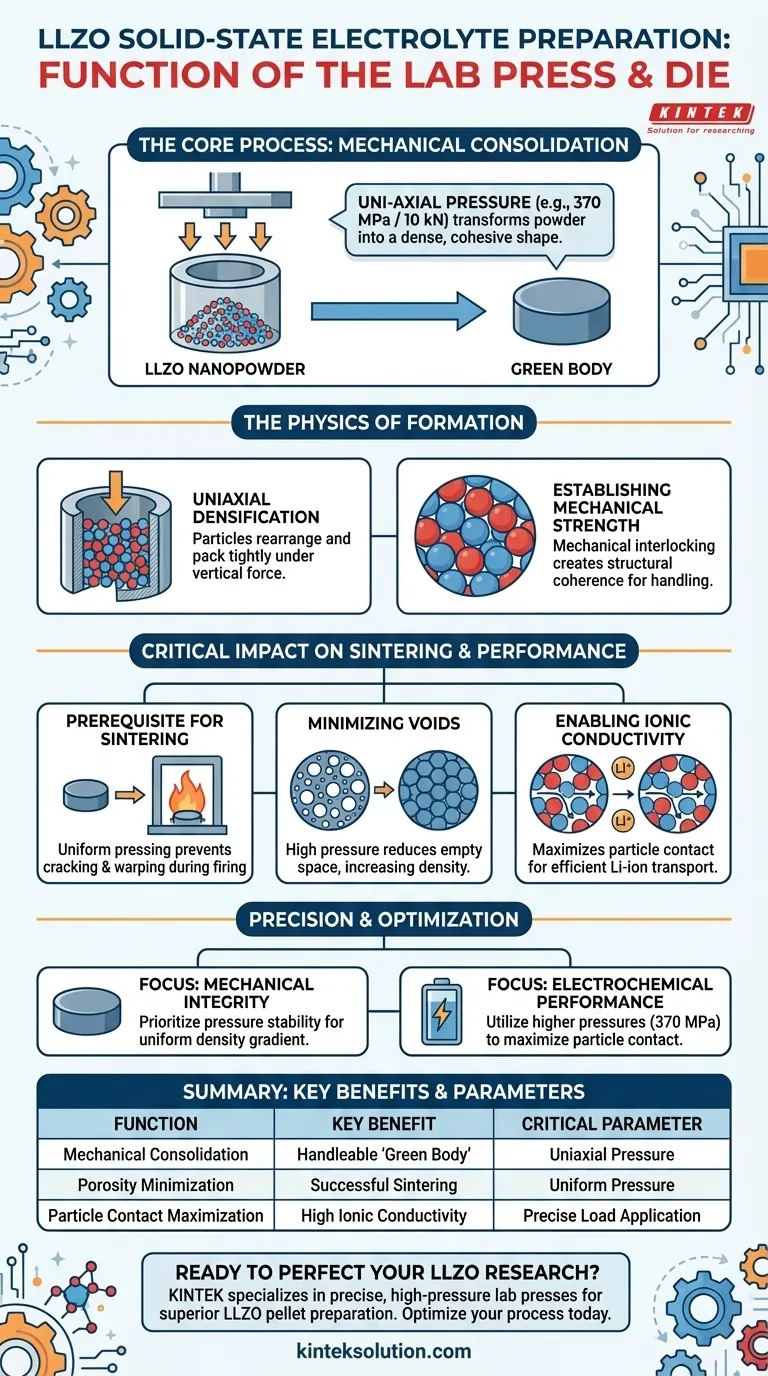
The primary function of a lab press and die in LLZO preparation is to mechanically consolidate loose Al-doped LLZO nanopowder into a cohesive, geometric shape known as a "green body." By applying precise uniaxial pressure—often reaching 370 MPa or approximately 10 kilonewtons—the equipment transforms the powder into a dense, circular pellet that possesses sufficient structural integrity to be handled before heat treatment.
The Core Engineering Goal While the visible result is a shaped pellet, the critical objective is the minimization of internal porosity. This cold-pressing stage establishes the intimate particle-to-particle contact necessary to prevent cracking during high-temperature sintering and to create continuous pathways for lithium-ion transport.
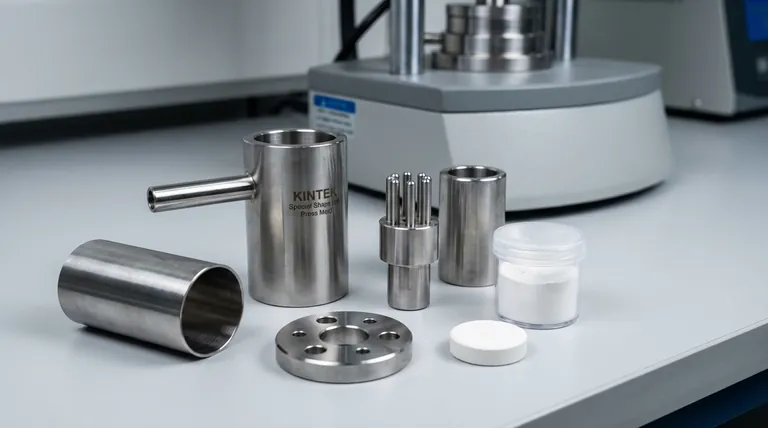
The Physics of Pellet Formation
Creating the Green Body
The immediate output of the press and die is the creation of a "green pellet" or "green body." This is an unsintered compact that holds its shape solely through mechanical interlocking and adhesion between particles.
Uniaxial Densification
The specialized die contains the powder laterally, while the press applies force vertically. This uniaxial compression forces the LLZO particles to rearrange and pack tightly together.
Establishing Mechanical Strength
Without this compression, the loose powder would have no structural coherence. The pressure ensures the pellet has enough initial mechanical strength to be removed from the die and transferred to a furnace without disintegrating.
Critical Impact on Sintering and Performance
Prerequisite for Sintering
The quality of the pressed green pellet dictates the success of the final firing process. A uniformly pressed pellet prevents common failure modes such as cracking, warping, or deformation during high-temperature sintering.
Minimizing Voids
The press plays a vital role in reducing the volume of empty space (voids) between powder particles. High-pressure compaction forces particles into a tighter configuration, significantly increasing the density of the material before it is ever heated.
Enabling Ionic Conductivity
For a solid-state electrolyte to function, lithium ions must move freely through the material. The press increases the contact area between particles, reducing interfacial resistance. This creates the continuous physical pathways required for high ionic conductivity in the final battery cell.
Understanding the Precision Variables
The Necessity of Uniformity
It is not enough to simply apply force; the pressure must be uniform. The lab press must deliver a stable load to ensure a uniform density gradient throughout the pellet.
Risks of Improper Compression
If the pressure is uncontrolled or uneven, the green body will contain internal stress points. These inconsistencies inevitably lead to structural failure or poor electrochemical performance after the sintering phase.
Making the Right Choice for Your Goal
To maximize the effectiveness of your LLZO pellet preparation, align your pressing parameters with your specific research objectives:
- If your primary focus is mechanical integrity: Prioritize pressure stability to ensure the green body creates a uniform density gradient, preventing cracks during handling and sintering.
- If your primary focus is electrochemical performance: Utilize higher pressures (up to 370 MPa) to maximize particle contact area and minimize porosity, which directly correlates to higher ionic conductivity.
The lab press is not merely a shaping tool; it is the foundational step that defines the ultimate density and efficiency of the solid-state electrolyte.
Summary Table:
| Function | Key Benefit | Critical Parameter |
|---|---|---|
| Mechanical Consolidation | Creates a handleable "green body" pellet | Uniaxial Pressure (e.g., 370 MPa) |
| Porosity Minimization | Enables successful sintering and prevents cracking | Uniform Pressure Distribution |
| Particle Contact Maximization | Establishes pathways for high ionic conductivity | Precise, Stable Load Application |
Ready to perfect your LLZO solid-state electrolyte research?
The precise, high-pressure compaction described is critical for achieving the density and uniformity required for high-performance batteries. KINTEK specializes in lab press machines (including automatic, isostatic, and heated lab presses) designed specifically for demanding applications like LLZO pellet preparation.
Our equipment delivers the uniform pressure and stability you need to ensure your green pellets have the ideal foundation for sintering, leading to superior mechanical integrity and electrochemical performance.
Contact our experts today to discuss how our lab presses can optimize your solid-state battery development process.
Visual Guide
References
- Matthias Klimpel, Maksym V. Kovalenko. Dual-Layer Li Metal All-Solid-State Battery Based on an Argyrodite-type Li <sub>6</sub> PS <sub>5</sub> Cl Catholyte and a Garnet-type Li <sub>7</sub> La <sub>3</sub> Zr <sub>2</sub> O <sub>12</sub> Separator. DOI: 10.1021/acsaem.5c02435
This article is also based on technical information from Kintek Solution Knowledge Base .
Related Products
- Laboratory Hydraulic Split Electric Lab Pellet Press
- Lab Ring Press Mold for Sample Preparation
- Lab Infrared Press Mold for No Demolding
- Lab XRF Boric Acid Powder Pellet Pressing Mold for Laboratory Use
- XRF KBR Steel Ring Lab Powder Pellet Pressing Mold for FTIR
People Also Ask
- What are the emerging trends in the design and materials of lab pellet presses? Modernize Your Lab Efficiency
- How do lab pellet presses support customization and flexibility? Optimize Your Sample Prep for Any Material
- What are common lab pellet press issues? Expert Troubleshooting Guide for Reliable Material Research
- What are the common operational types of lab pellet presses? Choosing the Right Manual, Automatic, or Hydraulic System
- Why use a laboratory pellet press for solid-state battery evaluation? Ensure Accuracy in Interface Stability Testing