
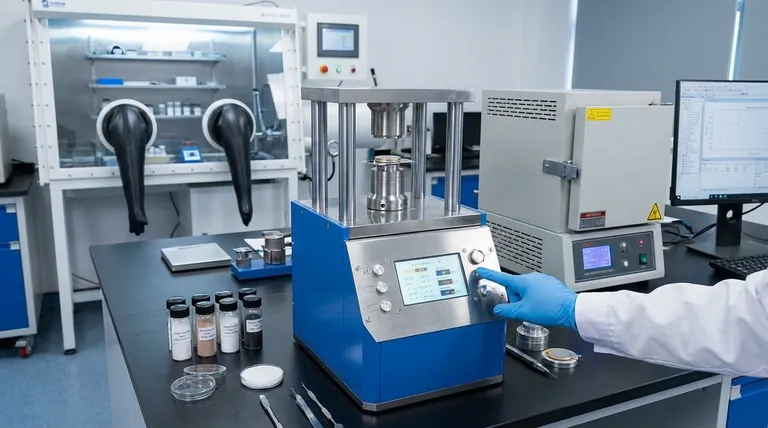
The primary function of a laboratory hydraulic or isostatic press in assembling Li/LLZO/Li symmetric cells is to apply precise, uniform force to bridge the physical gap between solid components. Specifically, it forces the soft metallic lithium anode to conform to the hard, microscopic topography of the LLZO (solid-state electrolyte) surface.
Core Takeaway In solid-state batteries, the lack of liquid electrolytes means ions cannot flow through physical gaps. The laboratory press serves as the critical tool to mechanically eliminate these voids, creating a seamless interface that minimizes resistance, suppresses dendrite growth, and enables stable long-term cycling.
The Challenge of the Solid-Solid Interface
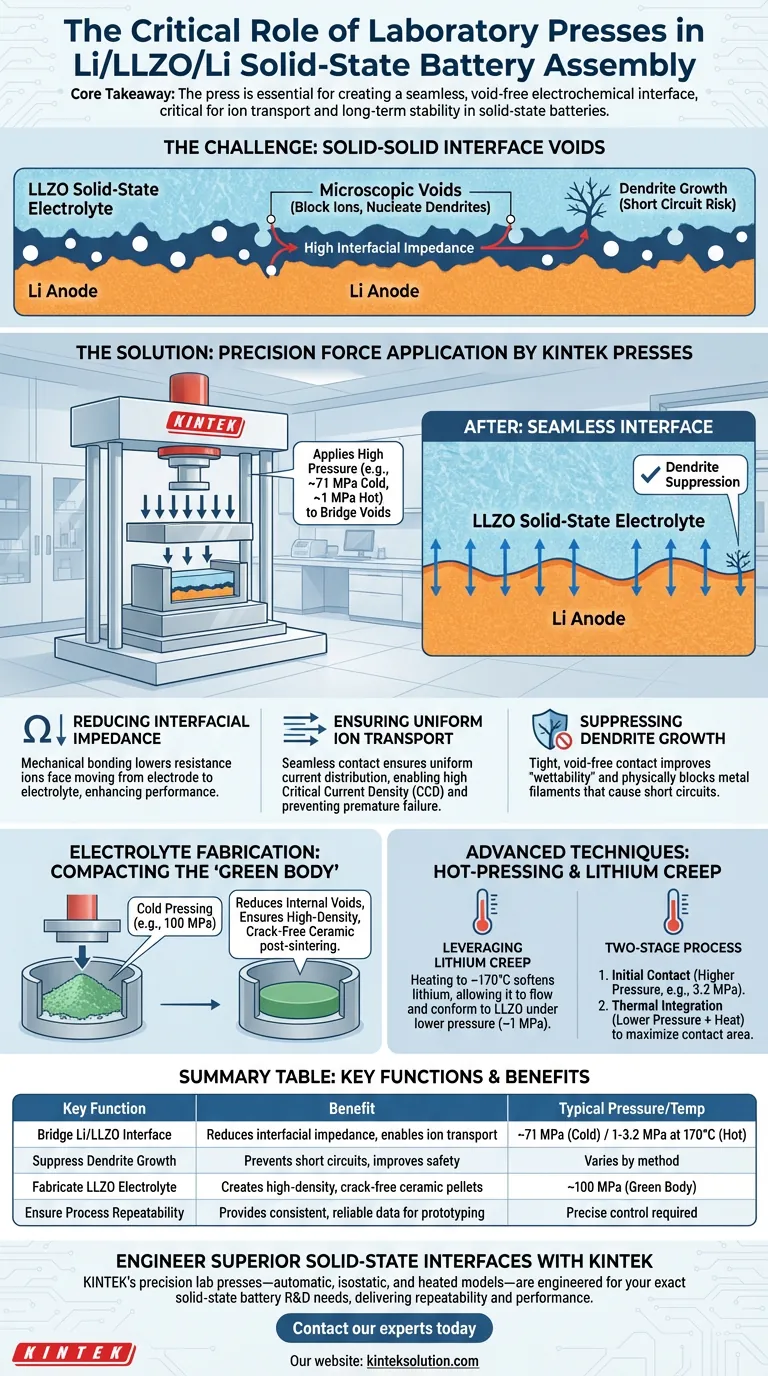
The fundamental hurdle in assembling Li/LLZO/Li cells is ensuring the two solid materials touch at a microscopic level. Without external intervention, surface roughness creates voids that block ion transport.
Reducing Interfacial Impedance
The press applies high pressure (often around 71 MPa) to create "intimate" contact.
This mechanical bonding significantly lowers the interfacial impedance, which is the resistance ions face when moving from the electrode into the electrolyte.
Ensuring Uniform Ion Transport
By creating a seamless interface, the press ensures lithium ions move uniformly across the entire contact area.
Uniform transport is essential for achieving a high Critical Current Density (CCD). If contact is uneven, current concentrates in specific spots, leading to premature cell failure.
Suppressing Dendrite Growth
Tight, void-free contact improves the "wettability" of the lithium on the ceramic electrolyte.
This physical intimacy is a critical factor in suppressing lithium dendrites—metal filaments that grow through voids and short-circuit the battery.
The Role of Pressure in Electrolyte Fabrication
Before the final cell is even assembled, the press plays a vital role in preparing the LLZO ceramic itself.
Compacting the "Green Body"
Prior to high-temperature sintering, the press is used to cold-press synthesized LLZO powder into a green pellet.
Operating at pressures such as 100 MPa, the press compacts the loose powder to reduce internal voids.
Ensuring Structural Integrity
This step determines the quality of the final ceramic. A high-quality green body is a prerequisite for obtaining a high-density, crack-free electrolyte after sintering.
Advanced Techniques: Integrating Heat and Pressure
While cold pressing is standard, using a hydraulic press with heating capabilities allows for a more sophisticated assembly process known as hot-pressing.
Leveraging Lithium Creep
Heated presses utilize the creep properties of lithium metal.
By heating the assembly (e.g., to 170°C), the lithium softens. This allows it to flow and conform perfectly to the electrolyte's surface topography under significantly lower pressures (e.g., 1 MPa).
The Two-Stage Process
Effective hot-pressing often involves two stages:
- Initial Contact: Applying higher pressure (e.g., 3.2 MPa) to establish physical touch.
- Thermal Integration: Heating under lower pressure to maximize contact area and minimize resistance.
Understanding the Process Variables
Achieving a high-performance cell requires balancing pressure magnitude with material limitations.
Precision and Repeatability
A laboratory press provides the repeatable mechanical pressure necessary for prototyping.
Inconsistent pressure leads to variable data; the press ensures that structural integrity and sealing are identical across different test cells.
The Risk of Voids
If the applied pressure is insufficient during assembly, microscopic voids remain at the interface.
These voids increase resistance and act as nucleation sites for dendrites, severely compromising long-term cycling stability.
Making the Right Choice for Your Goal
Ideally, your pressing strategy should be tailored to the specific stage of cell development you are addressing.
- If your primary focus is synthesizing high-quality LLZO pellets: Prioritize high-pressure cold pressing (approx. 100 MPa) to minimize voids in the green body before sintering.
- If your primary focus is minimizing interfacial resistance in the final cell: Utilize a heated press to leverage lithium creep (approx. 170°C at 1 MPa), ensuring the anode conforms to the electrolyte surface.
Ultimately, the laboratory press is not just a tool for compaction, but the primary instrument for engineering the electrochemical interface that defines the battery's performance.
Summary Table:
| Key Function | Benefit | Typical Pressure/Temp |
|---|---|---|
| Bridge Li/LLZO Interface | Reduces interfacial impedance, enables ion transport | ~71 MPa (Cold) / 1-3.2 MPa at 170°C (Hot) |
| Suppress Dendrite Growth | Prevents short circuits, improves safety | Varies by method |
| Fabricate LLZO Electrolyte | Creates high-density, crack-free ceramic pellets | ~100 MPa (Green Body) |
| Ensure Process Repeatability | Provides consistent, reliable data for prototyping | Precise control required |
Ready to Engineer Superior Solid-State Battery Interfaces?
KINTEK's precision lab presses—including automatic, isostatic, and heated models—are engineered to meet the exact demands of solid-state battery R&D. Whether you need high-pressure compaction for LLZO pellets or controlled heat and pressure for flawless Li/LLZO assembly, our equipment delivers the repeatability and performance your laboratory requires.
Let KINTEK be your partner in innovation. Contact our experts today to discuss how our lab press solutions can accelerate your battery development.
Visual Guide
Related Products
- Warm Isostatic Press for Solid State Battery Research Warm Isostatic Press
- Lab Button Battery Tablet Press Sealing Mold
- Button Battery Sealing Press Machine for Lab
- Laboratory Hydraulic Press Lab Pellet Press Button Battery Press
- Lab Infrared Press Mold for Laboratory Applications
People Also Ask
- Why must composite cathodes be sealed in vacuum lamination bags for WIP? Ensure Battery Stability and Density
- What is the function of elastic molds in warm isostatic pressing? Achieve Uniform Density in Composite Particles
- How do sacrificial volume materials (SVM) maintain microchannels in isostatic pressing? Ensure Structural Integrity
- What are the advantages of using a Warm Isostatic Press (WIP) for batteries? Achieve Superior Interface Contact
- What is the role of the flexible material in warm isostatic pressing? Key to Uniform Density & Precision









