
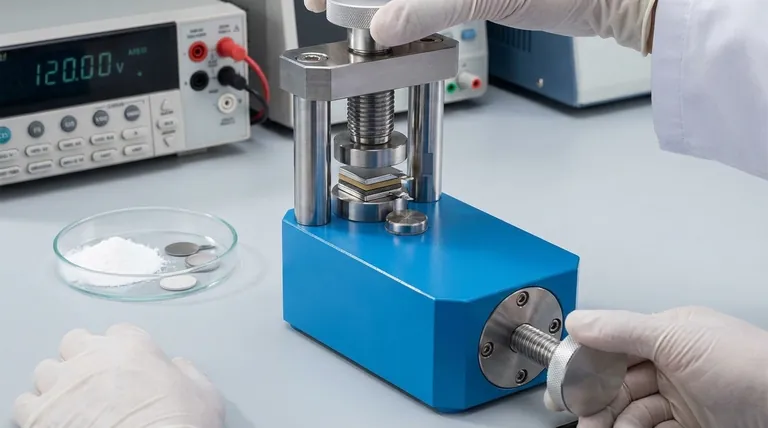
The primary function of a laboratory hydraulic press in the assembly of all-solid-state battery (ASSB) cells is to apply high-intensity, precise mechanical pressure to powdered and solid components. This process compacts electrolytes into dense membranes and eliminates microscopic voids between layers, facilitating the "solid-solid contact" required for the battery to function.
Core Takeaway Unlike traditional batteries that use liquid electrolytes to wet surfaces, ASSBs rely entirely on physical contact to move ions. The hydraulic press is the critical enabler of this mechanism, converting loose powders and stacked layers into a unified, low-resistance electrochemical system.
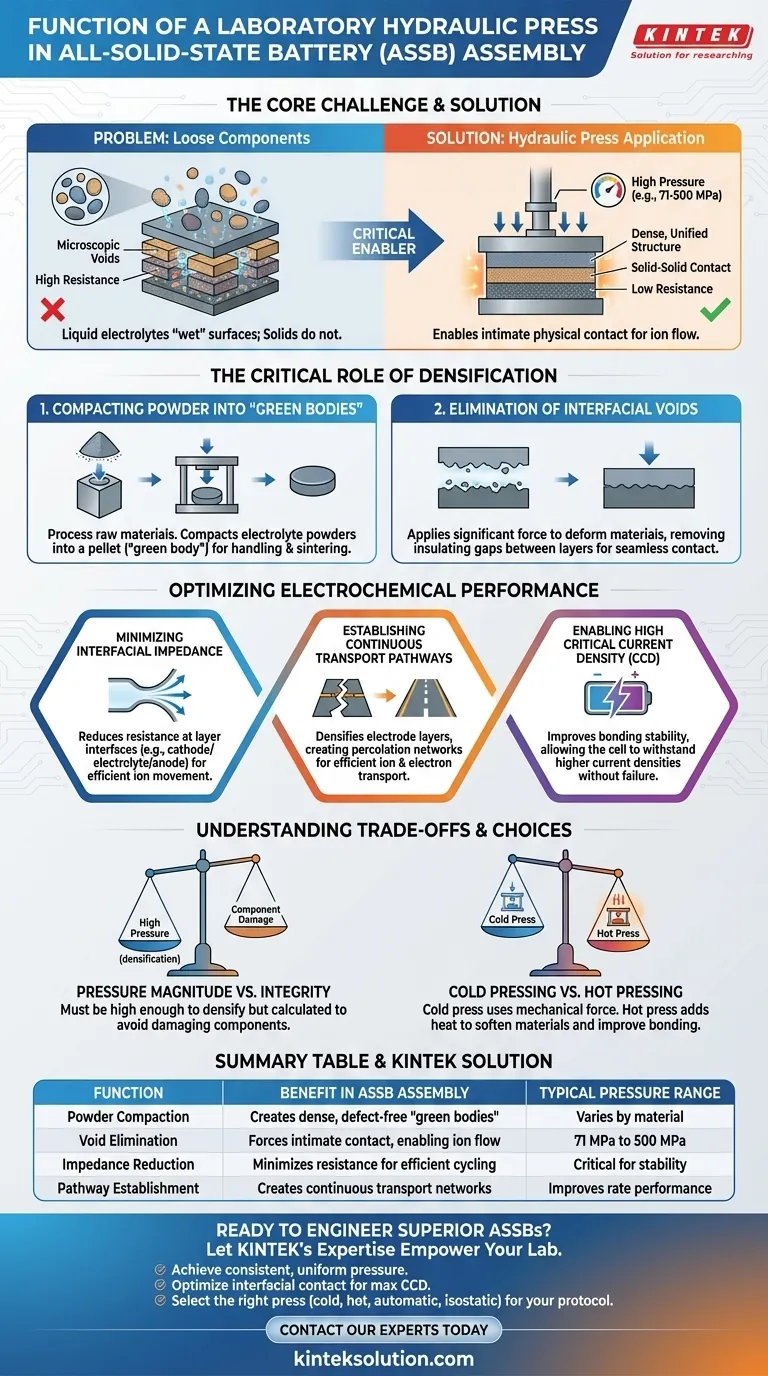
The Critical Role of Densification
The fundamental challenge in ASSB assembly is creating a cohesive structure from solid materials. The hydraulic press addresses this through two distinct physical mechanisms.
Compacting Powder into "Green Bodies"
Before a cell is fully assembled, the press is often used to process raw materials. It compacts synthesized electrolyte powders into a die to form a pellet, often called a "green body."
The magnitude of pressure and the duration of the hold time determine the density and mechanical strength of this pellet. This step is a prerequisite for creating a defect-free ceramic separator that can withstand subsequent handling or sintering.
Elimination of Interfacial Voids
On a microscopic level, placing two solid surfaces together leaves gaps filled with air or vacuum. These voids act as insulators, blocking the flow of ions.
The press applies significant force—ranging from 71 MPa to as high as 500 MPa depending on the chemistry—to mechanically deform these materials. This eliminates voids and forces the active materials, conductive additives, and electrolytes into intimate, seamless contact.
Optimizing Electrochemical Performance
The mechanical action of the press directly translates to the electrochemical capabilities of the battery.
Minimizing Interfacial Impedance
High impedance (resistance) at the interface between layers is a major bottleneck for ASSBs. By ensuring tight contact between the cathode, solid electrolyte, and anode, the press significantly reduces this interfacial impedance.
This is particularly vital in setups like Li/LLZO/Li symmetric cells. Uniform pressure creates a seamless interface that ensures ions can move freely between the lithium metal anode and the ceramic electrolyte.
Establishing Continuous Transport Pathways
For a battery to discharge, ions and electrons must travel through the material. A porous or loosely packed electrode interrupts these pathways.
By densifying the electrode layer, the hydraulic press establishes continuous percolation networks. This allows for efficient ion and electron transport, directly improving the battery’s rate performance and capacity.
Enabling High Critical Current Density (CCD)
The stability of the battery during cycling depends on how well the layers bond. High-quality interfaces formed under pressure help the cell withstand higher current densities without failing.
Proper pressing ensures uniform lithium-ion transport, which is fundamental for achieving stable long-term cycling and preventing rapid degradation.
Understanding the Trade-offs
While pressure is essential, the application of force is a nuanced variable that must be calibrated to the specific materials used.
Pressure Magnitude vs. Material Integrity
The pressure must be high enough to densify the cell but calculated carefully to avoid damaging components. For example, some processes use 200 MPa for pre-forming but increase to 500 MPa for final consolidation.
Applying the correct pressure is critical; too little leaves voids and high resistance, while variations in pressure can lead to non-uniform current distribution.
Cold Pressing vs. Hot Pressing
Most standard hydraulic presses perform "cold pressing," relying solely on mechanical force. However, some advanced protocols require a hot press.
Hot pressing applies heat and pressure simultaneously to soften materials and improve bonding. This is particularly useful for eliminating stubborn interfacial gaps that mechanical force alone cannot resolve.
Making the Right Choice for Your Assembly
The way you utilize a hydraulic press should be dictated by the specific requirements of your cell chemistry and research goals.
- If your primary focus is material synthesis: Prioritize the press's ability to hold specific pressures over time to create dense, uniform "green bodies" for sintering.
- If your primary focus is cycling stability: Ensure your assembly process uses sufficient pressure (e.g., 71+ MPa for LLZO) to minimize interfacial impedance and support high critical current densities.
- If your primary focus is complex multi-layer cells: Adopt a multi-step pressing protocol, utilizing lower pressure for pre-forming separators and higher pressure for final cell consolidation.
Success in ASSB assembly is not just about stacking layers; it is about using precise force to engineer a unified, high-density electrochemical device.
Summary Table:
| Function | Benefit in ASSB Assembly | Typical Pressure Range |
|---|---|---|
| Powder Compaction | Creates dense, defect-free electrolyte pellets ("green bodies") | Varies by material |
| Void Elimination | Forces intimate contact between layers, enabling ion flow | 71 MPa to 500 MPa |
| Impedance Reduction | Minimizes resistance at solid-solid interfaces for efficient cycling | Critical for stability |
| Pathway Establishment | Creates continuous networks for ion/electron transport | Improves rate performance |
Ready to Engineer Superior All-Solid-State Batteries?
The precise, high-pressure compaction provided by a laboratory hydraulic press is fundamental to achieving the low impedance and high density required for functional ASSBs. KINTEK specializes in lab press machines—including automatic, isostatic, and heated lab presses—designed to meet the exacting demands of battery research and development.
Let KINTEK's expertise empower your lab:
- Achieve consistent, uniform pressure for reliable cell assembly.
- Optimize interfacial contact to maximize critical current density and cycling stability.
- Select the right press for your specific protocol, from cold pressing to advanced hot pressing.
Don't let interfacial resistance limit your battery's performance. Contact our experts today to find the perfect hydraulic press solution for your laboratory's needs.
Visual Guide
Related Products
- Laboratory Hydraulic Press Lab Pellet Press Machine for Glove Box
- Laboratory Hydraulic Press 2T Lab Pellet Press for KBR FTIR
- 24T 30T 60T Heated Hydraulic Lab Press Machine with Hot Plates for Laboratory
- Laboratory Hydraulic Press Lab Pellet Press Button Battery Press
- Laboratory Hydraulic Pellet Press for XRF KBR FTIR Lab Press
People Also Ask
- How does a laboratory hydraulic press contribute to the preparation of Li3-3xScxSb samples? Optimize Ionic Conductivity
- What is the function of a laboratory hydraulic press in FT-IR of curcumin-coated MWCNTs? Achieve Optical Clarity.
- Why is a laboratory hydraulic press required for compression molding boron-siloxane? Solve High-Loading Density Challenges
- What role does a laboratory hydraulic press play in the preparation of piezoelectric ceramic discs for DC-PG? | KINTEK
- What role does a laboratory hydraulic press play in reaction pellets? Optimizing Lunar Soil and Metal Fuel Density



















