
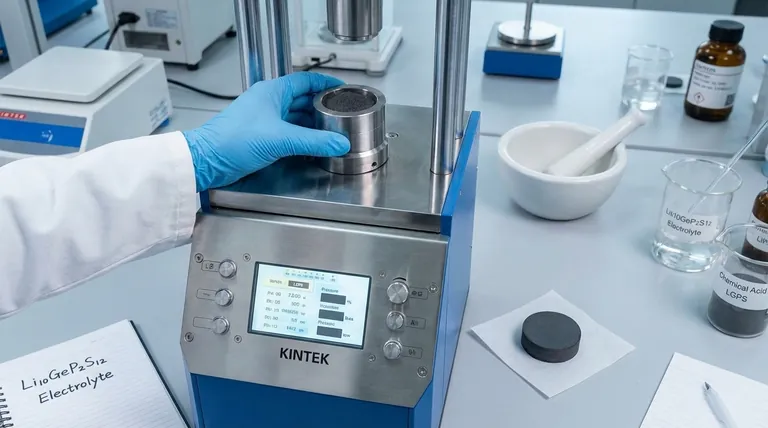
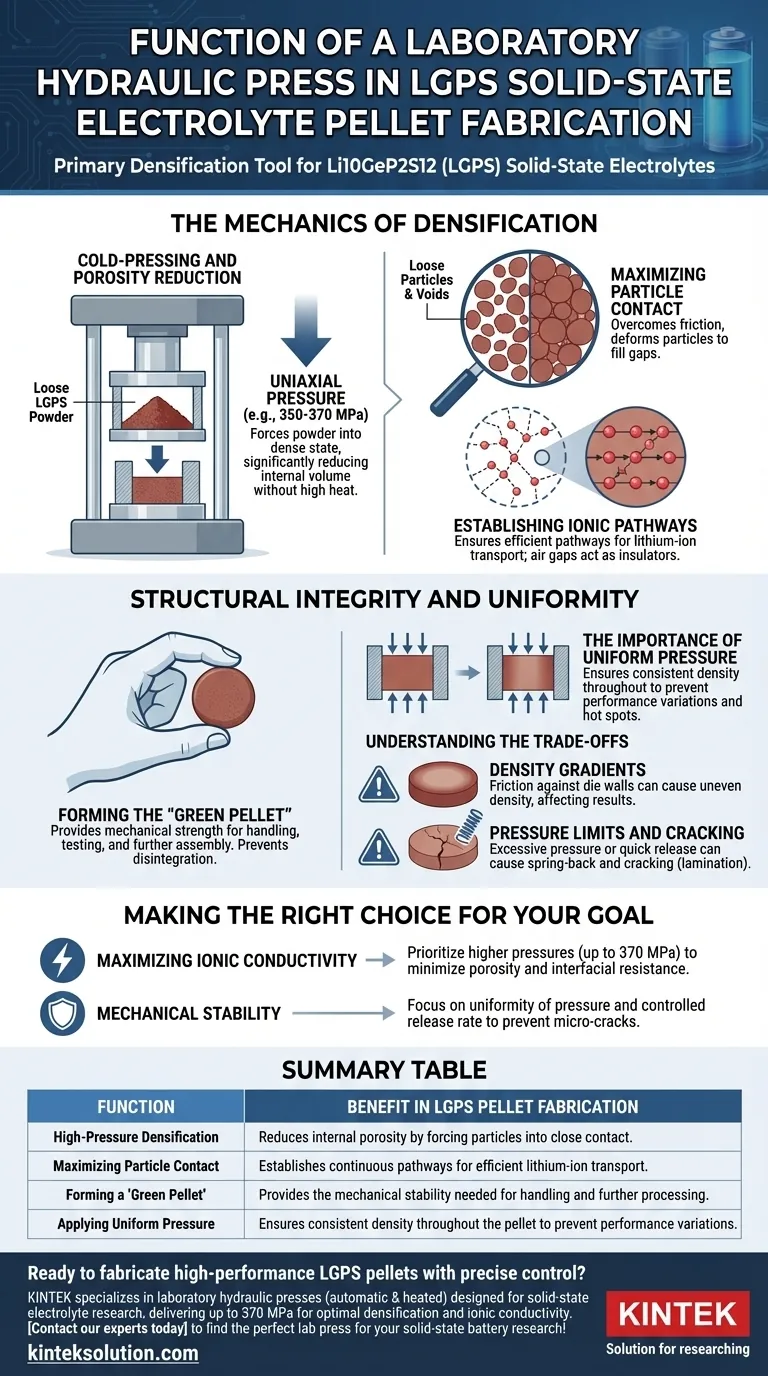
A laboratory hydraulic press functions as the primary densification tool in the fabrication of Li10GeP2S12 (LGPS) solid-state electrolytes. Its immediate role is to apply high, uniform uniaxial pressure—often reaching ranges between 350 and 370 MPa—to cold-press loose LGPS powder into a cohesive, mechanically stable pellet.
The hydraulic press is not merely a shaping device; it is a critical instrument for minimizing internal porosity. By forcing particles into close contact, the press establishes the continuous conductive pathways necessary for the high ionic conductivity that defines LGPS performance.
The Mechanics of Densification
Cold-Pressing and Porosity Reduction
The primary challenge with LGPS powder is the presence of voids between loose particles. A laboratory hydraulic press addresses this by applying uniaxial pressure to the powder within a specialized die.
This "cold-pressing" action significantly reduces internal volume, forcing the material into a denser state without the immediate need for high-temperature treatment.
Maximizing Particle Contact
High pressure is required to overcome the friction between particles and deform them slightly to fill gaps.
By compacting the powder, the press maximizes the contact area between individual LGPS grains. This is chemically significant because lithium ions require a continuous material medium to move effectively; air gaps act as insulators that block this movement.
Establishing Ionic Pathways
The ultimate goal of this densification is electrochemical performance.
The dense network created by the hydraulic press ensures efficient pathways for lithium-ion transport. References indicate that achieving high pressures (up to 370 MPa) is fundamental to reducing interfacial resistance and unlocking the superior ionic conductivity inherent to LGPS materials.
Structural Integrity and Uniformity
Forming the "Green Pellet"
Beyond electrochemical properties, the press is responsible for the physical creation of a "green pellet."
This compacted form provides the necessary mechanical strength for the electrolyte to be handled, tested, or subjected to further assembly steps without disintegrating. Without sufficient pressure, the pellet would remain too fragile for practical application in a battery cell.
The Importance of Uniform Pressure
The hydraulic press must apply pressure evenly across the surface of the die.
Uniform application ensures that the density is consistent throughout the entire volume of the pellet. Variations in pressure can lead to density gradients, creating "hot spots" of high resistance or weak structural points liable to crack.
Understanding the Trade-offs
Density Gradients
While a hydraulic press applies uniaxial pressure (from the top or bottom), friction against the die walls can cause uneven density. The edges of the pellet may be denser than the center, or the top denser than the bottom, potentially affecting test results.
Pressure Limits and Cracking
Applying higher pressure generally improves density, but there is a point of diminishing returns. Excessive pressure, or pressure released too quickly, can cause the pellet to spring back elastically, leading to lamination or cracking of the fragile LGPS structure.
Making the Right Choice for Your Goal
The use of a hydraulic press is a balance between achieving maximum density and maintaining structural integrity.
- If your primary focus is maximizing ionic conductivity: Prioritize higher pressures (up to 370 MPa) to minimize porosity and reduce interfacial resistance between particles.
- If your primary focus is mechanical stability: Focus on the uniformity of the pressure application and a controlled release rate to prevent micro-cracks and lamination in the pellet.
The laboratory hydraulic press serves as the bridge between raw chemical potential and functional reality, transforming loose powder into a high-performance solid electrolyte.
Summary Table:
| Function | Benefit in LGPS Pellet Fabrication |
|---|---|
| High-Pressure Densification | Reduces internal porosity by forcing particles into close contact. |
| Maximizing Particle Contact | Establishes continuous pathways for efficient lithium-ion transport. |
| Forming a 'Green Pellet' | Provides the mechanical stability needed for handling and further processing. |
| Applying Uniform Pressure | Ensures consistent density throughout the pellet to prevent performance variations. |
Ready to fabricate high-performance LGPS pellets with precise control?
KINTEK specializes in laboratory hydraulic presses, including automatic and heated models, designed to meet the exacting demands of solid-state electrolyte research. Our presses deliver the high, uniform pressure (up to 370 MPa) required to achieve optimal densification and ionic conductivity in your LGPS samples, ensuring reliable and reproducible results for your battery development.
Contact our experts today to find the perfect lab press for your solid-state battery research!
Visual Guide
Related Products
- Laboratory Hydraulic Split Electric Lab Pellet Press
- Automatic Laboratory Hydraulic Press for XRF and KBR Pellet Pressing
- Manual Laboratory Hydraulic Pellet Press Lab Hydraulic Press
- Automatic Laboratory Hydraulic Press Lab Pellet Press Machine
- Laboratory Hydraulic Pellet Press for XRF KBR FTIR Lab Press
People Also Ask
- What are the emerging trends in the design and materials of lab pellet presses? Modernize Your Lab Efficiency
- What are common lab pellet press issues? Expert Troubleshooting Guide for Reliable Material Research
- How do lab pellet presses support customization and flexibility? Optimize Your Sample Prep for Any Material
- What are the common operational types of lab pellet presses? Choosing the Right Manual, Automatic, or Hydraulic System
- Why use a laboratory pellet press for solid-state battery evaluation? Ensure Accuracy in Interface Stability Testing



















