
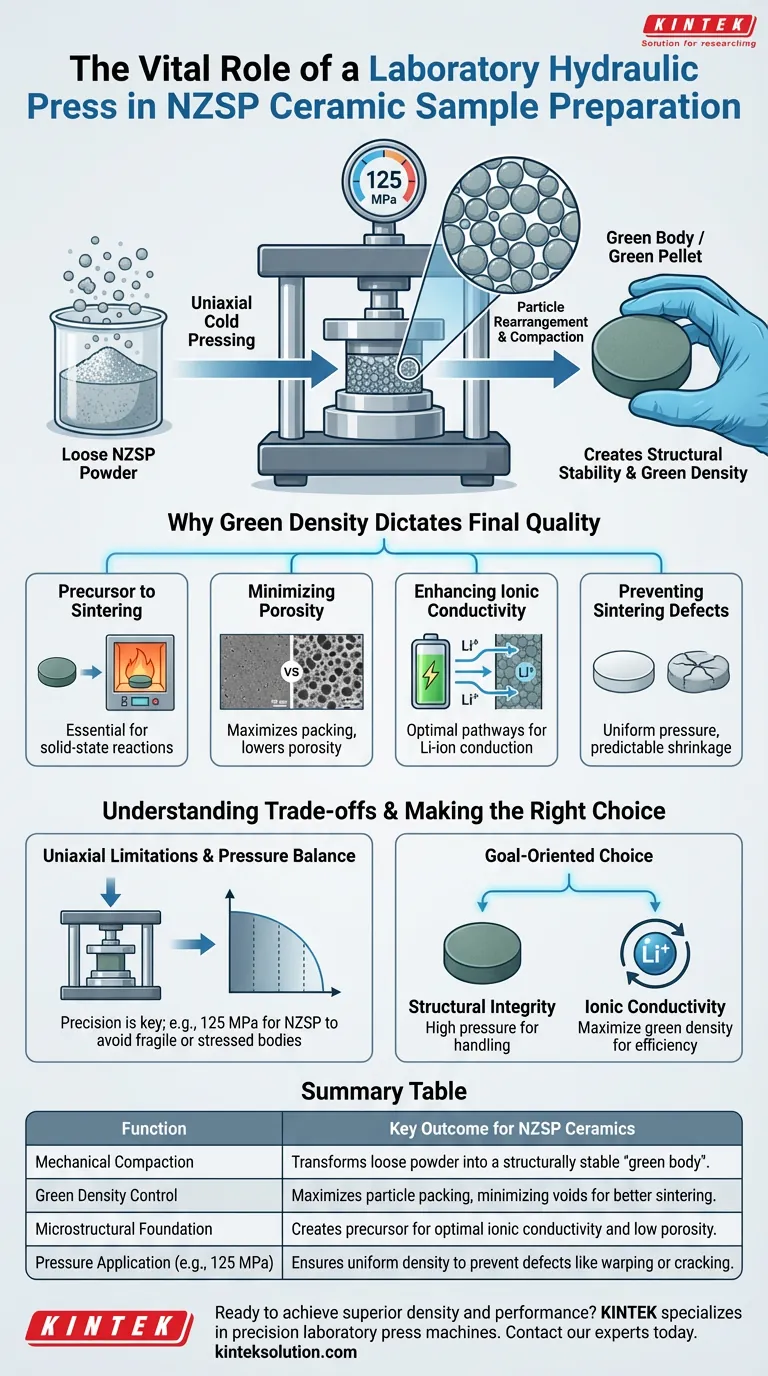
The primary function of a laboratory hydraulic press is to mechanically compact loose NZSP powder into a solid, cohesive geometric shape known as a "green body." By applying high uniaxial pressure—specifically up to 125 MPa for NZSP samples—the press transforms the powder into a dense pellet that is structurally stable enough to be handled and processed during subsequent heating stages.
The press does more than simply shape the material; it establishes the "green density" of the sample. By minimizing inter-particle voids at this stage, the press creates the necessary microstructural foundation required for successful high-temperature sintering and optimal ionic conductivity.
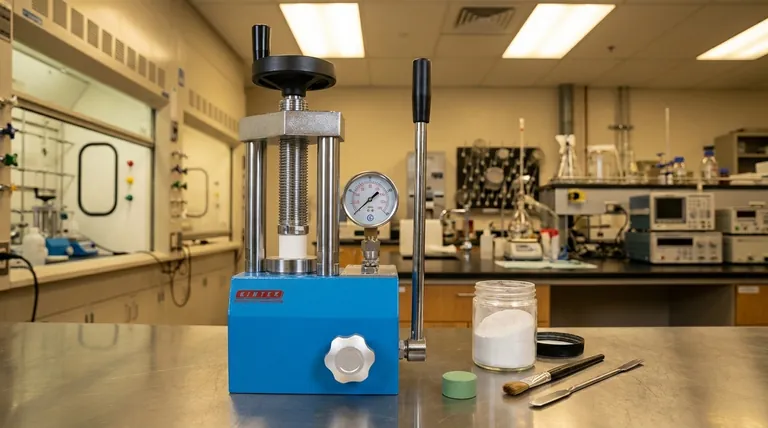
The Mechanics of Green Body Formation
Uniaxial Cold Pressing
The process employed is known as cold pressing. The hydraulic press drives a ram to apply force to the NZSP powder contained within a rigid die.
Particle Rearrangement and Compaction
As pressure increases, the loose powder particles are forced to rearrange and pack tightly together. This mechanical action drastically reduces the volume of air voids between particles.
Creating Structural Stability
The result of this compaction is a "green pellet" or "green body." While this pellet has not yet been fired, it possesses sufficient mechanical strength to be removed from the die and handled without crumbling.
Why Green Density Dictates Final Quality
The Precursor to Sintering
The green body serves as the essential precursor for the sintering phase. You cannot effectively sinter loose dust into a high-performance ceramic; the particles must be in close physical contact to facilitate the solid-state reactions.
Minimizing Porosity
A key objective of the hydraulic press is to maximize the packing density of the powder. A denser green body leads to a final ceramic product with lower porosity.
Enhancing Ionic Conductivity
For ceramic electrolytes like NZSP, low porosity is critical. High-density compaction ensures optimal pathways for lithium-ion conduction, directly influencing the electrical performance of the material.
Preventing Sintering Defects
Uniform application of pressure helps prevent common firing defects. A well-pressed green body undergoes more predictable shrinkage, reducing the likelihood of warping, uneven deformation, or cracking during the high-temperature cycle.
Understanding the Trade-offs
Uniaxial Limitations
While laboratory hydraulic presses are versatile and precise, they typically apply pressure uniaxially (from one direction). This can sometimes lead to slight density gradients within the pellet, where the edges may be denser than the center.
The Balance of Pressure
Applying pressure requires precision. In various ceramic contexts, pressures range widely (e.g., from 10 MPa to 400 MPa depending on the material). For NZSP, adhering to specific pressure parameters (like 125 MPa) is vital; insufficient pressure results in a fragile green body, while uncontrolled pressure could introduce stress fractures.
Making the Right Choice for Your Goal
To maximize the utility of your hydraulic press for NZSP preparation, consider your specific experimental objectives:
- If your primary focus is Structural Integrity: Ensure the pressure is high enough (e.g., 125 MPa) to produce a pellet that can be handled and transferred to the furnace without breakage.
- If your primary focus is Ionic Conductivity: Prioritize maximizing green density to minimize voids, as this directly correlates to the final relative density and efficiency of ion conduction.
The laboratory hydraulic press is not merely a shaping tool; it is the gatekeeper of your ceramic's final microstructural integrity.
Summary Table:
| Function | Key Outcome for NZSP Ceramics |
|---|---|
| Mechanical Compaction | Transforms loose powder into a structurally stable "green body". |
| Green Density Control | Maximizes particle packing, minimizing voids for better sintering. |
| Microstructural Foundation | Creates precursor for optimal ionic conductivity and low porosity. |
| Pressure Application (e.g., 125 MPa) | Ensures uniform density to prevent defects like warping or cracking. |
Ready to achieve superior density and performance in your NZSP ceramic samples?
KINTEK specializes in precision laboratory press machines, including automatic lab presses and heated lab presses, designed to meet the exacting demands of materials research. Our equipment delivers the consistent, high-pressure compaction your laboratory needs to create flawless green bodies for sintering.
Contact our experts today to discuss how our hydraulic presses can enhance your ceramic preparation process and ensure optimal results for your specific application.
Visual Guide
Related Products
- Laboratory Hydraulic Split Electric Lab Pellet Press
- Manual Laboratory Hydraulic Pellet Press Lab Hydraulic Press
- Automatic Laboratory Hydraulic Press Lab Pellet Press Machine
- Split Automatic Heated Hydraulic Press Machine with Heated Plates
- Automatic High Temperature Heated Hydraulic Press Machine with Heated Plates for Lab
People Also Ask
- What are the emerging trends in the design and materials of lab pellet presses? Modernize Your Lab Efficiency
- How do lab pellet presses support customization and flexibility? Optimize Your Sample Prep for Any Material
- What are common lab pellet press issues? Expert Troubleshooting Guide for Reliable Material Research
- What are the common operational types of lab pellet presses? Choosing the Right Manual, Automatic, or Hydraulic System
- Why use a laboratory pellet press for solid-state battery evaluation? Ensure Accuracy in Interface Stability Testing



















