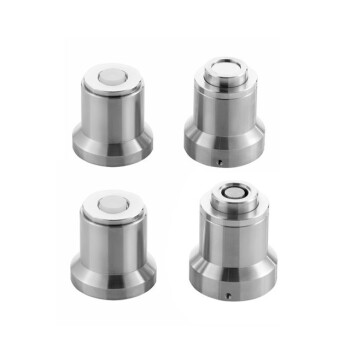
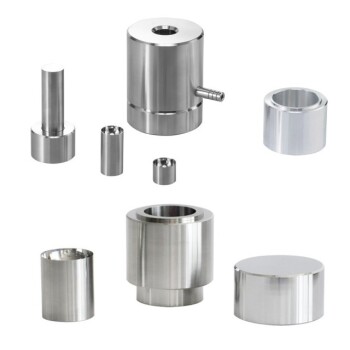
The molybdenum cup functions as the primary structural containment vessel. During the high-pressure densification of Cu2X powders, it holds the sample and provides the essential mechanical constraint required for the process. Its main purpose is to ensure that the extreme pressure applied is transmitted accurately and uniformly to the powder mixture, allowing for the successful synthesis of dense bulk materials.
Molybdenum’s specific combination of high mechanical strength and chemical stability allows it to withstand GPa-level pressures without fracturing, ensuring the integrity of the synthesis process.
The Role of Structural Constraint
Withstanding Extreme Pressure
The densification process operates at pressures in the GPa range.
The molybdenum cup acts as a robust barrier that contains the Cu2X powders. It must maintain its structural integrity under these extreme loads to prevent the assembly from fracturing.
Ensuring Uniform Force Transmission
Simply applying pressure is not enough; the force must be distributed correctly.
The cup provides a rigid constraint that ensures the applied force is transmitted uniformly to the powder mixture. This accuracy is critical for transforming loose powder into a cohesive solid.
Why Molybdenum is the Standard
Exceptional Mechanical Strength
Molybdenum is utilized because standard metals cannot survive the process conditions.
Its exceptional mechanical strength ensures the cup does not deform excessively or shatter. This durability allows the system to reach and maintain the necessary high pressures.
Chemical Stability
Physical strength is only half the equation.
Molybdenum possesses high chemical stability. This property ensures that the container does not degrade or react adversely with the Cu2X powders during the intense processing environment.
Impact on Final Material Properties
Facilitating High Density
The ultimate goal of using the cup is to produce a high-quality end product.
By effectively transmitting pressure and maintaining containment, the cup enables the synthesis of bulk materials with highly dense microstructures.
Operational Considerations and Constraints
The Risk of Material Failure
You cannot substitute molybdenum with materials of lower yield strength.
If the container material lacks the specific mechanical resilience of molybdenum, the cup will fracture under GPa loads. This results in a loss of pressure and a failure to densify the sample.
Constraint vs. Flexibility
The cup provides a rigid boundary, which is necessary for densification.
However, this rigidity means the system relies entirely on the applied force for compaction. Any flaw in the cup's construction can lead to stress concentrations and immediate failure.
Making the Right Choice for Your Goal
To ensure successful high-pressure synthesis of Cu2X, consider the following based on your specific objectives:
- If your primary focus is Structural Integrity: Rely on the molybdenum cup's mechanical strength to prevent containment failure during GPa-level pressurization.
- If your primary focus is Microstructural Quality: Utilize the cup's ability to provide uniform force transmission to achieve maximum density in the synthesized bulk material.
The molybdenum cup is not just a container; it is an active mechanical component that enables the transformation of powder into high-density bulk material.
Summary Table:
| Feature | Role of Molybdenum Cup in Densification |
|---|---|
| Primary Function | Structural containment and mechanical constraint for Cu2X powders |
| Pressure Handling | Withstands GPa-level loads without fracturing or excessive deformation |
| Force Distribution | Ensures uniform transmission of pressure for cohesive material synthesis |
| Material Stability | High chemical resistance prevents reactions with powder samples |
| Key Outcome | Facilitates the production of bulk materials with high-density microstructures |
Maximize Your Material Synthesis Success with KINTEK
Precision in high-pressure densification starts with the right equipment. KINTEK specializes in comprehensive laboratory pressing solutions, offering a versatile range of manual, automatic, heated, multifunctional, and glovebox-compatible models, alongside advanced cold and warm isostatic presses widely applied in battery and semiconductor research.
Whether you are synthesizing Cu2X powders or developing next-generation energy materials, our robust pressing technology ensures the structural integrity and uniform density your research demands.
Ready to elevate your lab's performance? Contact us today to find the perfect pressing solution!
References
- Dongwang Yang, Xinfeng Tang. Mechanochemical synthesis of high thermoelectric performance bulk Cu2X (X = S, Se) materials. DOI: 10.1063/1.4968521
This article is also based on technical information from Kintek Solution Knowledge Base .
Related Products
- Lab Cylindrical Press Mold for Laboratory Use
- Lab Double Plate Heating Mold for Laboratory Use
- Square Lab Press Mold for Laboratory Use
- Lab Round Bidirectional Press Mold
- Lab Infrared Press Mold for No Demolding
People Also Ask
- What is the purpose of incorporating cartridge heaters into a lab press mold for MLCC block compression? Optimize Results
- What is the function of a pressing tool in thermoplastic panels? Master Precision Shaping & Fusion Bonding
- Why is precise cooling management of the lab press mold necessary? Protect Core Integrity in Thermoforming
- Why is a high-performance laboratory molding press critical for in-situ electrolyte formation? Unlock Battery Success
- How does the geometry of laboratory molds influence mycelium-based composites? Optimize Density and Strength