
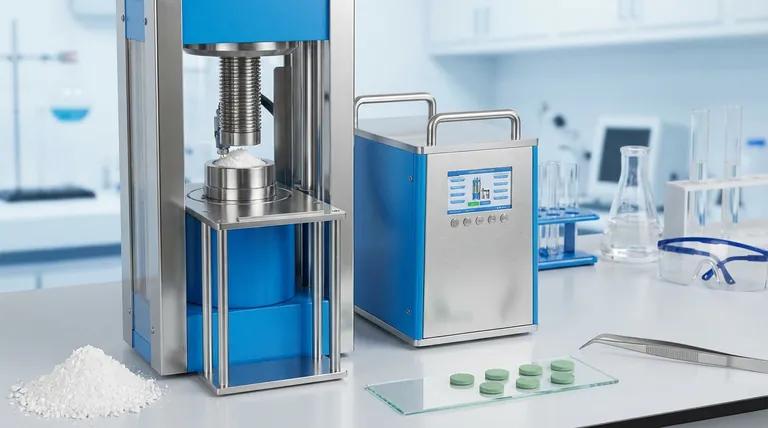
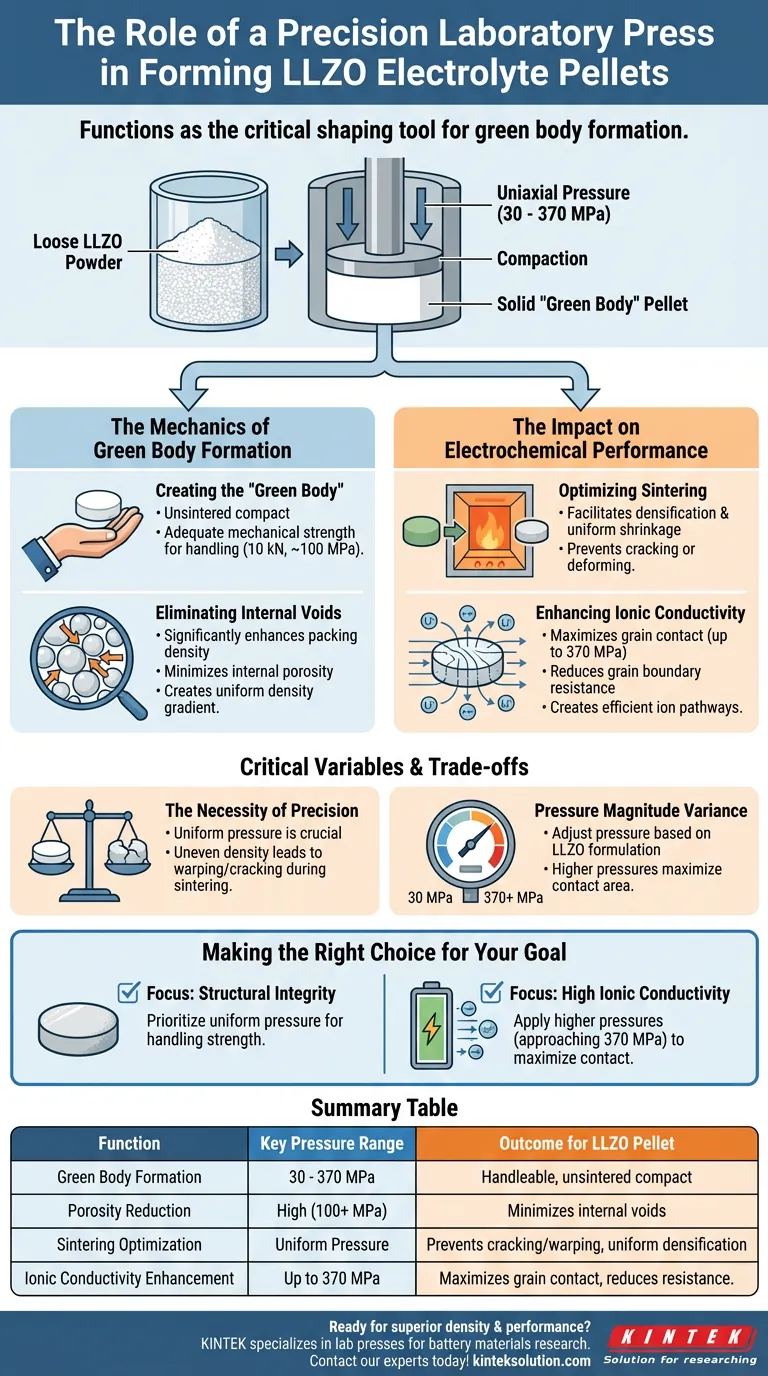
A precision laboratory press functions as the critical shaping tool used to convert loose Li7La3Zr2O12 (LLZO) powder into a solid, manageable form known as a "green body." By applying specific uniaxial pressure—ranging from 30 MPa to as high as 370 MPa—the press compacts the powder to establish the initial density and structural integrity required for subsequent high-temperature sintering.
While the immediate function of the press is to shape powder into a pellet, its deeper purpose is to minimize internal porosity before heat treatment. This pre-compaction step establishes the particle-to-particle contact necessary to prevent cracking during sintering and ensures the final electrolyte achieves high ionic conductivity.
The Mechanics of Green Body Formation
Creating the "Green Body"
The primary output of the laboratory press is a "green body," which is technically defined as an unsintered compact.
The press applies force (often around 10 kilonewtons or specifically calculated pressures like 100 MPa) to create a circular pellet.
This process gives the loose nanopowder adequate mechanical strength, allowing it to be handled and moved without crumbling.
Eliminating Internal Voids
The press is responsible for significantly enhancing the packing density of the powder.
By applying precise pressure, the machine forces particles closer together, minimizing inter-particle voids and internal porosity.
This tight packing creates a uniform density gradient throughout the pellet, which is a fundamental requirement for a stable structure.
The Impact on Electrochemical Performance
Optimizing the Sintering Process
The quality of the pressing stage directly dictates the success of the high-temperature sintering phase.
A high-quality green body facilitates better densification and promotes uniform shrinkage when heated.
By increasing the contact points between powder particles now, the press enhances material transport during sintering, which helps prevent the final ceramic from cracking or deforming.
Enhancing Ionic Conductivity
For solid-state batteries, the ultimate goal is efficient lithium-ion transport.
High-pressure compaction (up to 370 MPa) ensures intimate physical contact between grains.
This reduces grain boundary resistance, creating efficient pathways for ions to move through the material. Without this density, the material's intrinsic ionic conductivity cannot be accurately measured or utilized.
Critical Variables and Trade-offs
The Necessity of Precision
Pressure must be applied uniformly. If the pressure environment is not stable, the green body will suffer from uneven density.
Uneven density leads to warping or cracking during the sintering process, rendering the pellet useless for battery applications.
Pressure Magnitude Variance
References indicate a wide range of pressures depending on the specific LLZO formulation (e.g., Al-doped vs. Ga-LLZO).
While 30 MPa may establish a structural foundation, significantly higher pressures (hundreds of megapascals) are often required to maximize contact area and minimize resistance.
Making the Right Choice for Your Goal
To maximize the utility of your laboratory press for LLZO fabrication, align your pressing parameters with your specific research outcomes.
- If your primary focus is structural integrity: Prioritize uniform pressure distribution to ensure the green body has sufficient mechanical strength for handling without introducing stress fractures.
- If your primary focus is high ionic conductivity: Apply higher pressures (approaching 370 MPa) to maximize grain contact and minimize grain boundary resistance prior to sintering.
The laboratory press is not just a shaping device; it is the instrument that defines the potential density and efficiency of the final solid-state electrolyte.
Summary Table:
| Function | Key Pressure Range | Outcome for LLZO Pellet |
|---|---|---|
| Green Body Formation | 30 - 370 MPa | Creates a handleable, unsintered compact from powder |
| Porosity Reduction | High pressures (e.g., 100+ MPa) | Minimizes internal voids for better sintering |
| Sintering Optimization | Uniform pressure application | Prevents cracking/warping, ensures uniform densification |
| Ionic Conductivity Enhancement | Up to 370 MPa | Maximizes grain contact, reduces grain boundary resistance |
Ready to achieve superior density and performance in your LLZO electrolyte pellets? The right precision laboratory press is the foundational step. KINTEK specializes in lab press machines (including automatic, isostatic, and heated lab presses) designed specifically for the demanding needs of battery materials research. Our presses deliver the uniform, high-pressure compaction required to form flawless green bodies, setting the stage for successful sintering and high ionic conductivity. Contact our experts today to find the perfect press for your solid-state battery development.
Visual Guide
Related Products
- Laboratory Hydraulic Split Electric Lab Pellet Press
- Manual Laboratory Hydraulic Pellet Press Lab Hydraulic Press
- Automatic Laboratory Hydraulic Press for XRF and KBR Pellet Pressing
- Laboratory Hydraulic Press Lab Pellet Press Machine for Glove Box
- Laboratory Hydraulic Pellet Press for XRF KBR FTIR Lab Press
People Also Ask
- What are the emerging trends in the design and materials of lab pellet presses? Modernize Your Lab Efficiency
- What are common lab pellet press issues? Expert Troubleshooting Guide for Reliable Material Research
- How do lab pellet presses support customization and flexibility? Optimize Your Sample Prep for Any Material
- What are the common operational types of lab pellet presses? Choosing the Right Manual, Automatic, or Hydraulic System
- Why use a laboratory pellet press for solid-state battery evaluation? Ensure Accuracy in Interface Stability Testing



















