
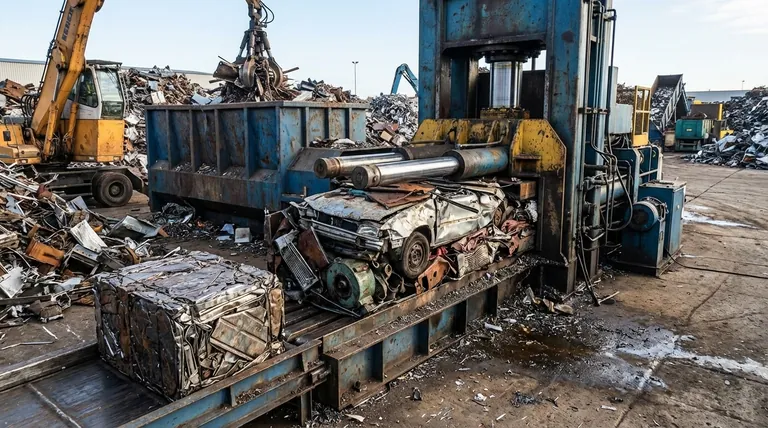
A scrap baling hydraulic press is a critical industrial machine designed to compress voluminous metal waste into dense, manageable blocks.
It primarily utilizes a "cold pressing" method to crush items ranging from dismantled automobiles to industrial machinery and equipment. By applying immense pressure, the press transforms loose, irregular scrap into uniform bales, significantly optimizing storage, transportation, and the recycling process.
Core Insight: The scrap baler is not just a crushing tool; it is a logistics enabler. By maximizing density through cold compression, it converts hazardous, space-consuming waste into a streamlined commodity ready for the furnace.
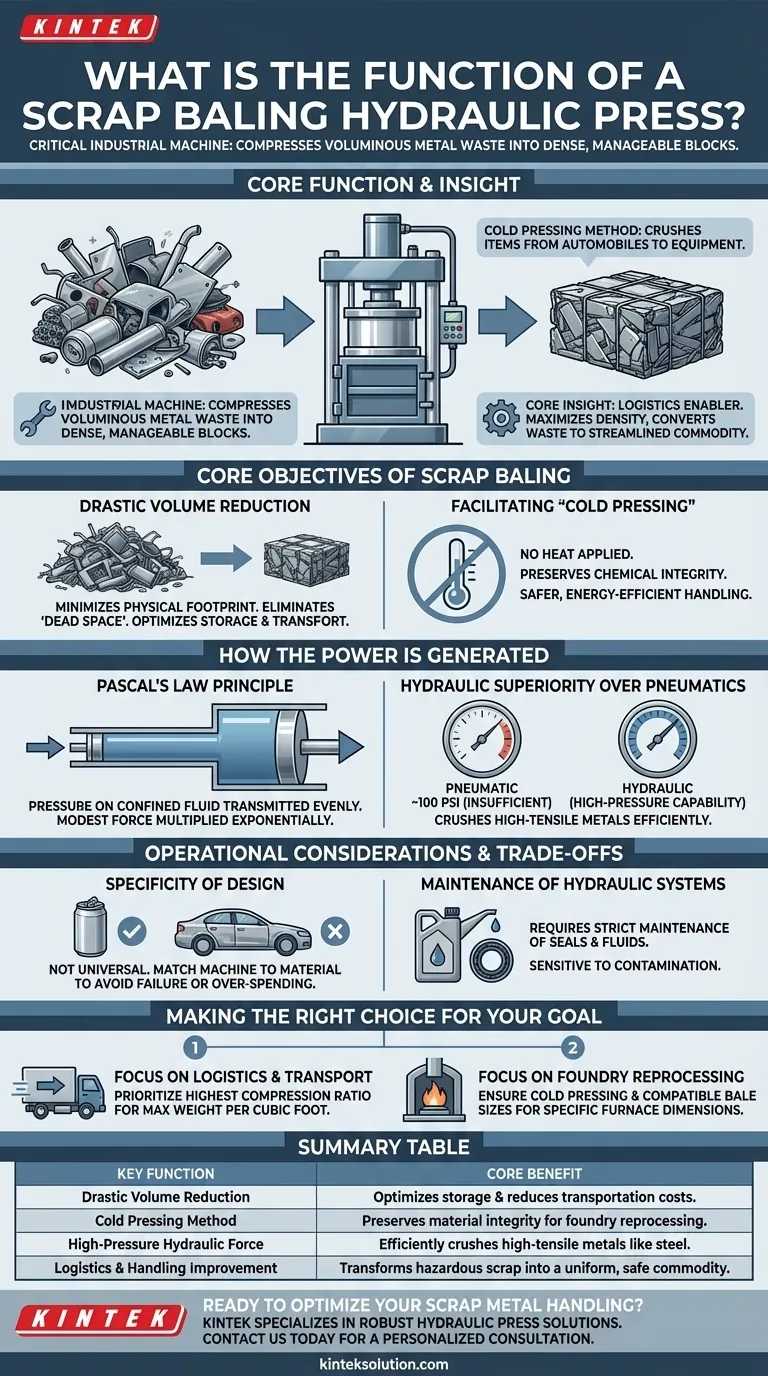
The Core Objectives of Scrap Baling
Drastic Volume Reduction
The most immediate function of the press is to minimize the physical footprint of scrap metal.
Loose scrap, such as car bodies or machining offcuts, contains a significant amount of air or "dead space."
The press eliminates this space, making the material easier to stockpile in yards and cheaper to transport via truck or rail.
Facilitating "Cold Pressing"
These machines operate using a cold pressing method, meaning no heat is applied to melt the metal during compaction.
This preserves the chemical integrity of the raw material before it is sent to a foundry or mill.
It ensures that the metal is compacted in its solid state, making it safer and more energy-efficient to handle prior to smelting.
How the Power is Generated
The Principle of Pascal’s Law
The immense force required to crush steel comes from hydraulic systems based on Pascal's Law.
This principle states that pressure exerted on a confined fluid is transmitted evenly throughout that fluid.
The machine uses a pump to apply modest force to a small piston, which transmits pressure through oil to a larger piston, multiplying the force exponentially.
Hydraulic Superiority Over Pneumatics
For heavy-duty scrap baling, pneumatic (air-based) systems are insufficient.
Pneumatic systems typically operate around 100 psi, whereas hydraulic systems can efficiently apply pressures in the range of 10,000 psi.
This high-pressure capability allows the machine to crush high-tensile metals that other systems could not deform.
Operational Considerations and Trade-offs
Specificity of Design
Not all balers are universal; different types are designed to compact specific materials.
A machine optimized for crushing aluminum cans may not have the shear force required to bale an automobile chassis.
Selecting a press that is under-powered for your material type leads to equipment failure, while an over-powered press results in unnecessary capital expenditure.
Maintenance of Hydraulic Systems
While powerful, hydraulic presses rely on oil-filled cylinders and pistons to generate compressive force.
This requires strict maintenance of seals and fluids to prevent leaks and maintain pressure.
Unlike simple mechanical crushers, the reliance on fluid dynamics means the system is sensitive to contamination and seal degradation.
Making the Right Choice for Your Goal
When evaluating a scrap baling hydraulic press for your operation, consider your end-game for the material.
- If your primary focus is Logistics and Transport: Prioritize a press with the highest compression ratio to maximize the weight per cubic foot, reducing shipping costs.
- If your primary focus is Foundry Reprocessing: Ensure the machine utilizes a cold pressing method that produces bale sizes compatible with the specific furnace dimensions of your buyers.
Ultimately, the value of a hydraulic press lies in its ability to turn chaotic metal waste into a uniform, tradable asset through the precise application of force.
Summary Table:
| Key Function | Core Benefit |
|---|---|
| Drastic Volume Reduction | Optimizes storage and reduces transportation costs. |
| Cold Pressing Method | Preserves material integrity for foundry reprocessing. |
| High-Pressure Hydraulic Force | Efficiently crushes high-tensile metals like steel. |
| Logistics & Handling Improvement | Transforms hazardous scrap into a uniform, safe commodity. |
Ready to optimize your scrap metal handling and boost your bottom line?
KINTEK specializes in robust hydraulic press solutions, including lab presses and industrial balers, designed to meet the specific needs of laboratories and recycling facilities. Our expertise ensures you get a machine perfectly matched to your material type and operational goals, maximizing efficiency and ROI.
Contact KINTEK today for a personalized consultation and discover how our presses can transform your scrap into a streamlined, profitable asset.
Visual Guide
Related Products
- Manual Laboratory Hydraulic Press Lab Pellet Press
- Laboratory Hydraulic Press Lab Pellet Press Machine for Glove Box
- Automatic Laboratory Hydraulic Press Lab Pellet Press Machine
- Manual Laboratory Hydraulic Pellet Press Lab Hydraulic Press
- Laboratory Hydraulic Pellet Press for XRF KBR FTIR Lab Press
People Also Ask
- How does a laboratory manual hydraulic press assist in powder canning? Maximize Density and Structural Integrity
- What is the primary objective of using a laboratory manual hydraulic press at 20 MPa? Achieve Perfect Green Body Shaping
- What is the primary purpose of manual lab hydraulic pellet presses? Achieve High-Precision Sample Preparation for Spectroscopy
- What is the primary purpose of a manual lab hydraulic pellet press? Ensure Accurate Sample Prep for XRF and FTIR
- How do lab pellet presses support customization and flexibility? Optimize Your Sample Prep for Any Material


















