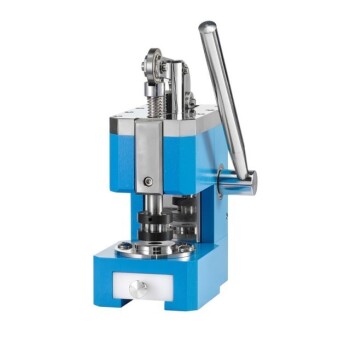
A triaxial tester is the definitive instrument for characterizing the failure behavior of powder materials under complex, multi-axial stress states. It functions by applying a confining pressure to a cylindrical sample while simultaneously subjecting it to axial loads, effectively simulating the multi-directional pressures found in actual powder molding environments. This allows for the precise measurement of material responses across various stress paths, rather than just a single direction.
To predict how a powder will behave during compaction, you cannot rely on simple compression tests alone. The triaxial tester provides the essential map of material behavior—specifically the yield surface and compression cap surface—required to feed accurate data into Finite Element Analysis (FEA) models.
The Mechanics of Powder Characterization
Simulating Real-World Stress States
In a molding die, powder is never compressed in just one direction; it experiences pressure from the die walls as well as the punch.
A triaxial tester replicates this by creating a multi-axial stress state. It applies a surrounding "confining pressure" to the sample while adding axial load, mimicking the realistic conditions of the manufacturing process.
Defining the Yield Surface
One of the primary functions of this device is to define the yield surface of the material.
This surface represents the boundary where the powder transitions from a stable state to a state of failure or flow. Understanding this boundary is critical for predicting when and how the powder will deform during the molding process.
Establishing the Compression Cap
Beyond simple failure, the tester characterizes the compression cap surface.
This metric describes how the material behaves under high hydrostatic pressure, which is essential for understanding density changes during compaction. It completes the mechanical profile of the powder.
Extracting Critical Parameters
For engineers performing simulations, raw test data must be converted into usable constants.
The triaxial tester provides the physical property parameters necessary for mathematical modeling, specifically the internal friction angle and cohesion force. These values quantify how particles interact, stick, and slide against one another.
Understanding the Necessity for Simulation
The Limitation of Uniaxial Testing
Simple compression tests only provide data on how a material fails when pushed from one direction.
While useful for basic comparisons, these tests fail to capture the complex interaction between confining pressure and vertical load. Relying on them for process design can lead to inaccurate assumptions about density and structural integrity.
The Link to Finite Element Analysis (FEA)
The ultimate functional value of the triaxial tester is its role as a data generator for Finite Element Analysis.
FEA software requires precise definitions of the yield and compression cap surfaces to simulate the molding process accurately. Without the multi-axial data provided by a triaxial tester, computer simulations cannot reliably predict the final component properties.
Making the Right Choice for Your Goal
To determine if triaxial testing is required for your specific application, consider your end goals:
- If your primary focus is accurate process simulation: You must use triaxial testing to derive the internal friction angle and cohesion force required for valid Finite Element Analysis.
- If your primary focus is characterizing failure boundaries: Rely on the device to define the yield surface and compression cap surface, giving you a complete map of the material's limits.
By bridging the gap between physical testing and digital simulation, the triaxial tester transforms raw powder into predictable engineering data.
Summary Table:
| Feature | Function in Powder Characterization | Value for Engineering |
|---|---|---|
| Multi-Axial Stress State | Simulates simultaneous axial and confining pressures. | Replicates realistic molding die conditions. |
| Yield Surface Mapping | Defines the boundary where powder flows or fails. | Predicts deformation limits during compaction. |
| Compression Cap Surface | Measures material behavior under high hydrostatic pressure. | Essential for understanding density distribution. |
| Data Parameters | Extracts internal friction angle and cohesion force. | Provides critical inputs for FEA simulation models. |
Elevate Your Powder Research with KINTEK Precision Solutions
At KINTEK, we specialize in comprehensive laboratory pressing solutions designed to turn complex material behavior into predictable engineering data. Whether you are conducting fundamental battery research or optimizing industrial compaction processes, our extensive range of manual, automatic, heated, multifunctional, and glovebox-compatible models, alongside advanced cold and warm isostatic presses, ensures you have the right tools for the job.
Don't settle for incomplete data from simple uniaxial tests. Our equipment provides the accuracy needed for reliable Finite Element Analysis (FEA), helping you master internal friction angles and yield surfaces.
Ready to optimize your powder molding process? Contact KINTEK today to find the perfect pressing solution for your lab!
References
- Csaba Sinka. Modelling Powder Compaction. DOI: 10.14356/kona.2007005
This article is also based on technical information from Kintek Solution Knowledge Base .
Related Products
- Lab Double Plate Heating Mold for Laboratory Use
- Lab Anti-Cracking Press Mold
- Lab Cylindrical Press Mold for Laboratory Use
- Laboratory Hydraulic Split Electric Lab Pellet Press
- Laboratory Hydraulic Pellet Press for XRF KBR FTIR Lab Press
People Also Ask
- How does the geometry of laboratory molds influence mycelium-based composites? Optimize Density and Strength
- Why are precision laboratory molds essential for forming basalt-reinforced lightweight concrete specimens?
- Why are high-precision laboratory molds and specific compaction processes required? Ensure Data Integrity in Soil Research
- Why is low-temperature pre-drying on a laboratory hot plate necessary? Stabilize Silver Ink for Better Conductivity
- How is a laboratory hot plate utilized in Li-Si alloy electrode preparation? Achieve High-Activity Battery Materials