
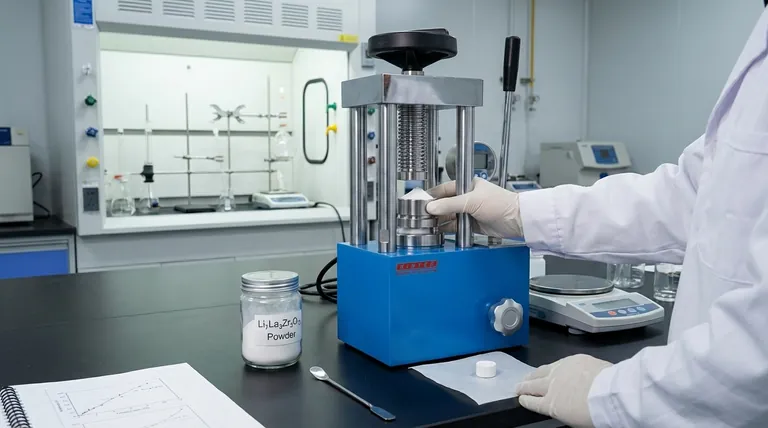
The primary function of a uniaxial press in the preparation of Li₇La₃Zr₂O₁₂ (LLZO) is to transform loose, synthesized powder into a coherent solid known as a "green pellet."
By applying mechanical force along a single vertical axis, the press compacts the powder into a specific geometric shape (typically a disc) with sufficient structural integrity to be handled. This process is the critical bridge between raw material synthesis and the high-temperature treatment required to create a functional ceramic electrolyte.
Core Takeaway While uniaxial pressing creates the physical shape of the electrolyte, its deeper purpose is to establish a uniform density gradient and intimate particle contact. This initial compaction is the defining prerequisite for successful sintering; without a high-quality green body, the final ceramic will lack the ionic conductivity and mechanical strength required for solid-state batteries.
The Mechanics of Green Body Formation
Compaction and Particle Contact
The press forces the loose LLZO or LLZTO powder particles into intimate contact with one another. This mechanical interlocking is what turns a pile of dust into a standalone component.
This contact creates the physical pathways necessary for ion diffusion. By minimizing the distance between particles now, you enable the formation of continuous ion-conductive channels during the later heating stages.
Reduction of Internal Porosity
The application of precise pressure (often ranging significantly depending on protocol) drives air out of the powder bulk. This drastically reduces the void space, or porosity, within the material.
Achieving this low-porosity state at the "green" stage is vital. If the starting porosity is too high, the material will struggle to densify fully during sintering, leading to a brittle and resistive final product.
Critical Impact on Final Performance
Prerequisite for Sintering
The green pellet serves as the foundation for the high-temperature sintering process. The press ensures the pellet has the "green strength" to survive transfer to a furnace without crumbling.
More importantly, a well-pressed pellet minimizes the risk of macroscopic defects. If the initial pressing is flawed, the pellet is highly likely to crack, warp, or deform as it shrinks during sintering.
Enabling High Ionic Conductivity
The ultimate goal of LLZO is to transport lithium ions. The uniaxial press sets the stage for this by creating a dense, packed structure.
A dense green body facilitates the grain growth and densification required to maximize ionic conductivity. It allows the final ceramic to achieve the mechanical robustness needed to suppress lithium dendrite growth in an operating battery.
Understanding the Trade-offs
The Density Gradient Limitation
While effective, uniaxial pressing applies force from only one direction (top and bottom). This can create a density gradient where the edges and faces are denser than the center of the pellet due to friction against the die walls.
The Role as a Pre-Step
Because of the density gradient issue, uniaxial pressing is often used as a preliminary step rather than the final shaping step.
In high-performance workflows, the uniaxial press creates a "pre-form." This pre-form is subsequently subjected to Cold Isostatic Pressing (CIP), which applies pressure from all directions to ensure perfectly uniform density before sintering.
Making the Right Choice for Your Goal
To get the most out of your uniaxial pressing stage, align your process with your specific experimental needs:
- If your primary focus is rapid material screening: Use the uniaxial press to create standalone pellets at high pressure (e.g., 600 MPa) to quickly evaluate electrochemical performance without complex multi-step processing.
- If your primary focus is maximizing ionic conductivity: Treat the uniaxial press as a shaping tool to create a low-pressure pre-form, and follow it immediately with Cold Isostatic Pressing (CIP) to ensure maximum uniformity during sintering.
The quality of your final solid-state electrolyte is determined the moment the press descends; a flawless green body is the only path to a high-performance battery.
Summary Table:
| Function | Key Benefit | Impact on Final Product |
|---|---|---|
| Compacts Powder into Green Pellet | Creates structural integrity for handling | Prevents cracking during sintering |
| Establishes Particle Contact | Forms pathways for ion diffusion | Enables high ionic conductivity |
| Reduces Internal Porosity | Minimizes voids for better densification | Improves mechanical strength and suppresses dendrites |
| Serves as Pre-Step for CIP | Allows uniform density with isostatic pressing | Maximizes performance for high-conductivity goals |
Ready to optimize your solid-state electrolyte development? The quality of your LLZO green pellet directly determines the performance of your final battery. KINTEK specializes in lab press machines, including automatic and heated lab presses, designed to meet the precise demands of laboratory research. Whether you're focused on rapid material screening or maximizing ionic conductivity, our equipment ensures you create flawless green bodies as the foundation for high-performance batteries. Contact us today to discuss how our solutions can enhance your lab's efficiency and accelerate your research!
Visual Guide

References
- Seung Hoon Chun, Sangbaek Park. Synergistic Engineering of Template‐Guided Densification and Dopant‐Induced Pore Filling for Pressureless Sintering of Li<sub>7</sub>La<sub>3</sub>Zr<sub>2</sub>O<sub>12</sub> Solid Electrolyte at 1000 °C. DOI: 10.1002/sstr.202500297
This article is also based on technical information from Kintek Solution Knowledge Base .
Related Products
- Laboratory Hydraulic Split Electric Lab Pellet Press
- Manual Laboratory Hydraulic Pellet Press Lab Hydraulic Press
- Automatic Laboratory Hydraulic Press for XRF and KBR Pellet Pressing
- Laboratory Hydraulic Press Lab Pellet Press Machine for Glove Box
- Laboratory Hydraulic Pellet Press for XRF KBR FTIR Lab Press
People Also Ask
- What are the emerging trends in the design and materials of lab pellet presses? Modernize Your Lab Efficiency
- How do lab pellet presses support customization and flexibility? Optimize Your Sample Prep for Any Material
- What are common lab pellet press issues? Expert Troubleshooting Guide for Reliable Material Research
- What are the common operational types of lab pellet presses? Choosing the Right Manual, Automatic, or Hydraulic System
- Why use a laboratory pellet press for solid-state battery evaluation? Ensure Accuracy in Interface Stability Testing














