
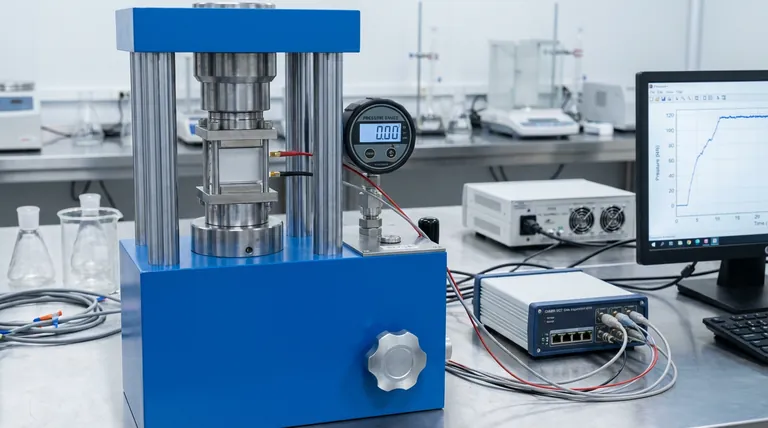
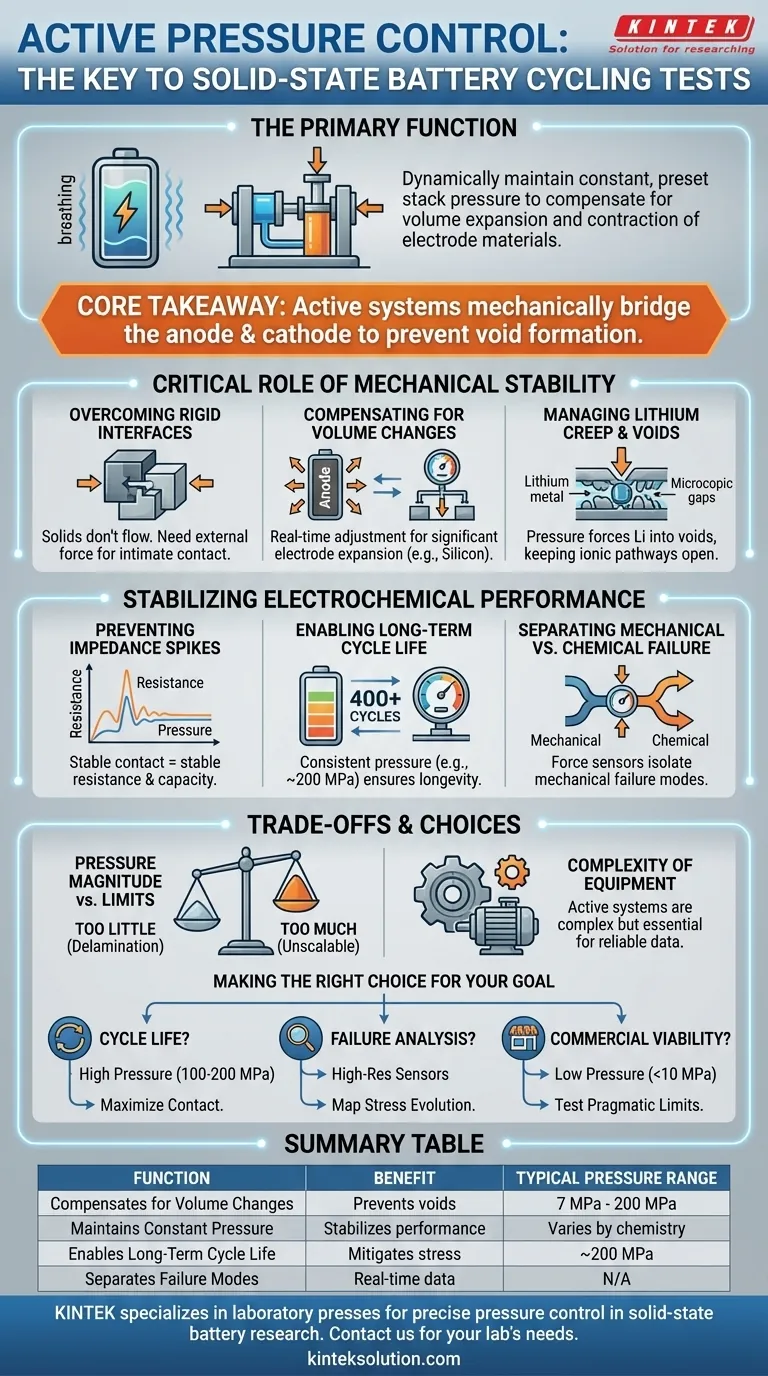
The primary function of an active pressure control system is to dynamically maintain a constant, preset stack pressure on an all-solid-state battery throughout the charge-discharge cycle. Unlike passive clamps, this system automatically adjusts to compensate for the significant volume expansion and contraction of electrode materials, ensuring continuous physical contact at the rigid solid-solid interfaces.
Core Takeaway All-solid-state batteries "breathe" during operation as materials expand and contract. Because solid electrolytes cannot flow like liquids to fill gaps, an active pressure system is essential to mechanically bridge the anode and cathode, preventing the formation of voids that lead to immediate performance degradation.
The Critical Role of Mechanical Stability
Overcoming Rigid Interface Limitations
Liquid electrolytes naturally fill voids, but solid-state batteries rely on rigid solid-solid interfaces.
Without external force, these components cannot maintain the intimate contact required for ion transport.
Active pressure systems apply substantial force (ranging from roughly 7 MPa to 200 MPa depending on design) to force these solids together, minimizing interfacial resistance.
Compensating for Electrode Volume Changes
During lithium plating (charging) and stripping (discharging), electrodes undergo significant volumetric changes.
Silicon anodes, in particular, experience massive expansion, while lithium metal anodes strip away, potentially leaving gaps.
An active system detects these shifts and adjusts the mechanical load in real-time to counteract delamination or separation.
Managing Lithium Creep and Voids
Stripping lithium can create microscopic voids at the interface, severing the ionic pathway.
By maintaining constant pressure, the system utilizes the creep properties of lithium metal to physically squeeze the material into these voids.
This prevents contact loss and ensures the ionic pathways remain open and unobstructed over hundreds of cycles.
stabilizing Electrochemical Performance
Preventing Impedance Spikes
When contact between the anode and solid electrolyte loosens, impedance (resistance) rises rapidly.
This results in unstable charging overpotentials and a significant drop in capacity.
Active pressure control stabilizes these values, directly contributing to improved initial cycle capacity retention.
Enabling Long-Term Cycle Life
Reliable long-term performance requires more than just initial contact; it requires consistency.
References indicate that sustained pressures (e.g., 200 MPa) can help maintain capacity for over 400 cycles.
This longevity is achieved by mitigating interfacial stress relaxation that naturally occurs during repeated cycling.
Separating Mechanical vs. Chemical Failure
Specialized fixtures with force sensors allow researchers to monitor internal stress evolution in real-time.
This data allows you to distinguish between failure caused by electrochemical degradation and failure caused by simple mechanical delamination.
It provides a clearer picture of the electrochemical-mechanical coupling mechanisms at play.
Understanding the Trade-offs
Pressure Magnitude vs. Material Limits
While pressure is necessary, the required magnitude varies wildly based on cell chemistry, from 6.8 MPa to 200 MPa.
Too little pressure leads to immediate delamination and high resistance.
Too much pressure may simulate packaging conditions but requires heavy, complex machinery that is difficult to scale outside a laboratory setting.
Complexity of Testing Equipment
Active systems are significantly more complex than passive screw-clamps.
They require feedback loops, motors, or hydraulic systems to adjust the stack pressure continuously.
However, relying on passive fixtures for materials with high volume change (like Silicon) renders data unreliable, as the pressure will fluctuate uncontrollably as the cell expands.
Making the Right Choice for Your Goal
To obtain valid data from your solid-state battery testing, align your pressure strategy with your specific research objectives:
- If your primary focus is Cycle Life: Prioritize higher, constant pressures (100–200 MPa) to maximize particle contact and utilize lithium creep to prevent void formation.
- If your primary focus is Failure Analysis: Use a system with high-resolution force sensors to map internal stress evolution against voltage drops, isolating mechanical failure modes.
- If your primary focus is Commercial Viability: Test at lower, pragmatic pressures (e.g., <10 MPa) to determine if the chemistry can survive without the aid of massive external containment forces.
Ultimately, active pressure control is not just a testing parameter; it is a fundamental requirement for maintaining the ionic bridge in a system that lacks liquid flow.
Summary Table:
| Function | Benefit | Typical Pressure Range |
|---|---|---|
| Compensates for Electrode Volume Changes | Prevents delamination and void formation at solid-solid interfaces. | 7 MPa - 200 MPa |
| Maintains Constant Stack Pressure | Ensures continuous ionic contact, stabilizing impedance and capacity. | Varies by chemistry |
| Enables Long-Term Cycle Life | Mitigates interfacial stress relaxation for hundreds of cycles. | ~200 MPa for longevity |
| Separates Mechanical vs. Chemical Failure | Provides real-time data on stress evolution for accurate failure analysis. | N/A |
Need a reliable lab press to conduct precise pressure control tests for your solid-state battery research?
KINTEK specializes in laboratory press machines, including automatic and heated lab presses, designed to deliver the consistent, high-pressure conditions required for accurate all-solid-state battery cycling tests. Our equipment helps researchers like you achieve reliable data on cycle life, failure modes, and commercial viability.
Contact us today to find the perfect press solution for your laboratory's needs and enhance your battery development workflow.
Visual Guide
Related Products
- Automatic Laboratory Hydraulic Press Lab Pellet Press Machine
- Automatic Laboratory Hydraulic Press for XRF and KBR Pellet Pressing
- Automatic Lab Cold Isostatic Pressing CIP Machine
- Automatic Heated Hydraulic Press Machine with Heated Plates for Laboratory
- Automatic Heated Hydraulic Press Machine with Hot Plates for Laboratory
People Also Ask
- What is the primary purpose of a manual lab hydraulic pellet press? Ensure Accurate Sample Prep for XRF and FTIR
- What is the primary purpose of manual lab hydraulic pellet presses? Achieve High-Precision Sample Preparation for Spectroscopy
- Why are high-precision automatic hydraulic presses required for Martian ISRU? Ensure Reliable Regolith Forming
- How does an automatic laboratory hydraulic press improve KBr pellet preparation? Achieve Precision IR Spectroscopy
- What are the advantages of using an automatic laboratory hydraulic press? Enhance Precision in Sample Preparation





