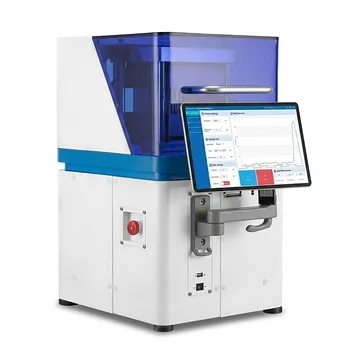
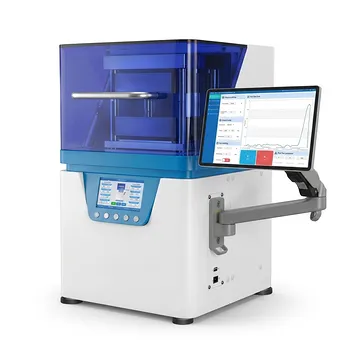
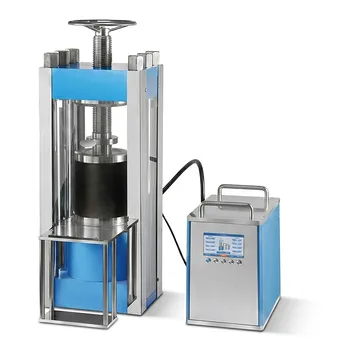
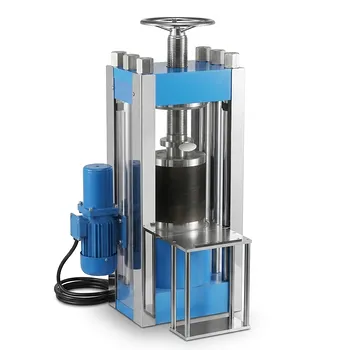
Heated lab presses serve a critical function in pharmaceutical manufacturing by compressing powdered drug substances and excipients into solid tablets through the simultaneous application of heat and force. This process moves beyond simple mechanical shaping to fundamentally alter particle interaction, ensuring the final product is both structurally sound and medicinally accurate.
Core Takeaway: The addition of heat to the compression process is the defining factor that improves particle bonding. This results in tablets with superior mechanical strength, uniform drug distribution, and consistent release profiles that cold compression alone often cannot achieve.
The Mechanics of Tablet Formation
Compression of Active Ingredients
The primary role of the press is to consolidate loose material. It takes powdered drug substances and mixes them with excipients (inactive substances used as carriers). The press applies force to compact these loose powders into a defined, solid dosage form.
Enhanced Particle Bonding
While pressure forces particles together, heat acts as a catalyst for stability. The application of heat during compaction improves the bonding of particles. This thermal assistance creates a denser, more cohesive structure, resulting in tablets that possess high mechanical strength and long-term stability.
Ensuring Quality and Consistency
Uniform Drug Distribution
A major challenge in pill making is ensuring the active ingredient is spread evenly throughout the tablet. Heated lab presses utilize flat heating elements to ensure uniform temperature distribution. This precise control facilitates the even dispersion of drugs, guaranteeing accurate dosage in every single pill.
Controlled Release Properties
The physical structure of a tablet dictates how it breaks down in the body. By optimizing compaction through heat, manufacturers can engineer consistent release properties. This ensures the drug dissolves at the intended rate, which is vital for the medication's efficacy.
Encapsulation and Bioavailability
Beyond standard tablets, these presses are used to encapsulate drugs into specific carriers. This advanced application is critical for enhancing drug delivery and bioavailability, helping to protect the drug until it reaches the target area in the body.
Critical Considerations and Trade-offs
The Necessity of Precision
While heat improves bonding, it introduces a variable that must be tightly managed. The press must offer precise temperature control to avoid damaging heat-sensitive active ingredients. The benefit of "enhanced heating efficiency" mentioned in technical specifications is only valuable if it can be maintained uniformly across the workpiece to prevent hot spots that could alter the drug's chemistry.
Energy and Safety Implications
Modern heated presses are designed to minimize excess heat generation. This is a crucial trade-off to consider: you need enough heat to bond the tablet, but efficient insulation and design are required to reduce energy consumption and maintain a safe, comfortable work environment for lab personnel.
Making the Right Choice for Your Goal
When integrating a heated lab press into your pharmaceutical workflow, align the equipment capabilities with your specific research or production targets:
- If your primary focus is Structural Integrity: Prioritize presses that offer high-pressure capabilities alongside heating to maximize mechanical strength and stability.
- If your primary focus is Drug Efficacy: Focus on machines with the most precise temperature uniformity to ensure consistent release properties and accurate dosage distribution.
The ultimate value of a heated lab press lies in its ability to turn raw powder into a reliable, high-quality medical product through the controlled synergy of heat and pressure.
Summary Table:
| Feature | Function in Pill Making | Benefit to Final Product |
|---|---|---|
| Thermal Compaction | Enhances particle bonding during pressing | Increased mechanical strength & stability |
| Uniform Heating | Precise dispersion of active ingredients | Consistent dosage and accurate drug delivery |
| Controlled Pressure | Consolidates powder and excipients | Engineered release profiles and density |
| Encapsulation | Integration into specific carriers | Improved bioavailability and drug protection |
Elevate Your Pharmaceutical Research with KINTEK
Precision is the heartbeat of pharmaceutical manufacturing. KINTEK specializes in comprehensive laboratory pressing solutions tailored for high-stakes applications. Whether you are conducting cutting-edge battery research or developing life-saving medications, our range of manual, automatic, heated, and multifunctional presses—including glovebox-compatible and isostatic models—delivers the uniform heat and pressure required for superior product integrity.
Our value to you:
- Unmatched Precision: Maintain the chemical stability of heat-sensitive ingredients with advanced thermal control.
- Versatile Solutions: From cold isostatic presses to advanced heated models, we match your specific material needs.
- Efficiency & Safety: Optimized insulation reduces energy consumption while maintaining a safe lab environment.
Ready to achieve consistent release profiles and structural excellence in your tablets? Contact KINTEK today to find your perfect pressing solution!
Related Products
- 24T 30T 60T Heated Hydraulic Lab Press Machine with Hot Plates for Laboratory
- Automatic Heated Hydraulic Lab Press 120x120mm Plate Fully Automated Material Research Press
- Automatic Heated Hydraulic Lab Press with Programmable Touch Screen Controls and Precision Temperature Regulation
- Automatic Heated Hydraulic Lab Press Machine 200x200 Plate Size for Battery Research and Materials Science
- Manual Heated Hydraulic Lab Press with Integrated Hot Plates Hydraulic Press Machine
People Also Ask
- Function of a Laboratory Hydraulic Press with Heated Platens in SSE? Enhance Battery Density & Conductivity
- Why is a laboratory hydraulic press with heating plates required for PLA/TEC films? Achieve Precise Sample Integrity
- What role does a laboratory heated hydraulic press play in LTCC? Essential for High-Density Ceramic Lamination
- Why reduce load when applying composite strengthening tabs? Protect Specimen Integrity and Data Accuracy
- Why is a laboratory heated hydraulic press required? Ensure Precise Vulcanization for NBR/EPDM Nanocomposites