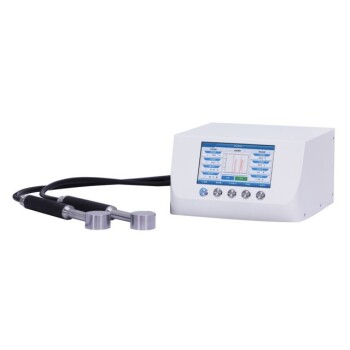
High-precision heating equipment functions as the critical control mechanism in the melt diffusion process, specifically by stabilizing temperatures above sulfur's melting point of 155°C. This equipment ensures the sulfur achieves sufficient fluidity to penetrate the cathode's carbon matrix while simultaneously inducing specific chemical changes that enhance battery stability.
Core Takeaway The role of precision heating extends beyond simple liquefaction; it is an engineering tool used to optimize both the physical distribution of sulfur and its chemical structure. By maintaining exact thermal conditions, the process guarantees deep pore infiltration and the formation of short-chain isomers essential for a stable quasi-solid-state conversion mechanism.
The Mechanics of Physical Infiltration
Stabilizing Sulfur Fluidity
To effectively utilize melt diffusion, sulfur must be maintained in a liquid state. High-precision equipment stabilizes the temperature above 155°C, ensuring the sulfur remains fluid throughout the process.
Utilizing Capillary Action
Once liquefied, the sulfur must navigate the complex architecture of the cathode. The maintained fluidity allows sulfur to penetrate the microporous carbon matrix driven purely by capillary action.
Ensuring Matrix Saturation
Precision heating prevents temperature drops that could increase viscosity prematurely. This guarantees that the sulfur fully infiltrates the available pore volume rather than coating only the surface.
Controlling Sulfur Chemistry
Promoting Short-Chain Isomers
Beyond physical melting, precise temperature control dictates the molecular arrangement of the sulfur. The equipment allows for the specific formation of short-chain sulfur isomers, such as S2.
Enabling Quasi-Solid-State Conversion
The presence of these specific isomers changes how the battery operates electrochemically. They facilitate a quasi-solid-state conversion mechanism, which is distinct from the typical dissolution-precipitation process.
Enhancing Cathode Stability
By promoting this specific conversion mechanism, the heating process directly contributes to the long-term stability of the cathode. This reduces the degradation often associated with Lithium-Sulfur battery cycling.
Understanding the Trade-offs
The Risk of Thermal Fluctuation
If the heating equipment lacks precision, temperature fluctuations can occur. A drop in temperature disrupts the fluidity required for capillary action, leading to uneven sulfur distribution and poor electrical contact.
Sensitivity of Isomer Formation
The formation of S2 isomers is highly sensitive to thermal conditions. Inaccurate heating may fail to produce these isomers, reverting the battery to a less stable conversion mechanism and reducing overall performance.
Making the Right Choice for Your Goal
To optimize your Lithium-Sulfur cathode preparation, consider your specific performance objectives:
- If your primary focus is Physical Loading: Prioritize heating consistency above 155°C to maximize capillary action and ensure the sulfur fully occupies the microporous carbon volume.
- If your primary focus is Cycle Stability: Focus on the precision of the temperature hold to guarantee the formation of S2 isomers and the enablement of the quasi-solid-state conversion mechanism.
Precision heating is not merely a utility; it is the fundamental driver of both the structural integrity and electrochemical efficiency of the composite cathode.
Summary Table:
| Parameter | Function in Melt Diffusion | Impact on Li-S Battery |
|---|---|---|
| Temperature (>155°C) | Maintains sulfur fluidity & capillary action | Ensures deep infiltration of microporous carbon |
| Thermal Precision | Facilitates short-chain isomer (S2) formation | Enables stable quasi-solid-state conversion |
| Consistency | Prevents premature viscosity increase | Eliminates surface coating for better electrical contact |
| Isomer Control | Dictates molecular arrangement of sulfur | Reduces cathode degradation during cycling |
Elevate Your Battery Research with KINTEK Precision Solutions
Unlock the full potential of your Lithium-Sulfur battery development with KINTEK’s high-precision laboratory pressing and heating solutions. Whether you are focusing on deep pore infiltration or the formation of critical sulfur isomers, our equipment provides the thermal stability required for advanced melt diffusion processes.
Why choose KINTEK for your lab?
- Comprehensive Pressing Range: Manual, automatic, heated, and multifunctional models tailored for cathode preparation.
- Specialized Environments: Glovebox-compatible designs and isostatic presses (CIP/WIP) for high-density material research.
- Reliable Thermal Control: Specialized systems designed to maintain the exact conditions needed for quasi-solid-state conversion.
Ready to enhance your research efficiency and cathode stability? Contact our laboratory experts today to find the perfect solution for your battery research needs.
References
- Yanming Shao, Paul R. Shearing. Contemporary Trends in Lithium‐Sulfur Battery Design: A Comparative Review of Liquid, Quasi‐Solid, and All‐Solid‐State Architectures and Mechanisms. DOI: 10.1002/aenm.202503239
This article is also based on technical information from Kintek Solution Knowledge Base .
Related Products
- Infrared Heating Quantitative Flat Plate Mold for Precise Temperature Control
- Automatic High Temperature Heated Hydraulic Press Machine with Heated Plates for Lab
- Automatic Heated Hydraulic Press Machine with Heated Plates for Laboratory
- Automatic Heated Hydraulic Press Machine with Hot Plates for Laboratory
- 24T 30T 60T Heated Hydraulic Lab Press Machine with Hot Plates for Laboratory
People Also Ask
- How do precision temperature-controlled heating plates function in electrolyte thermal stability storage experiments?
- What is the importance of a precision temperature-controlled heating module? Ensure Aluminum-Cadmium Thermal Stability
- How does heating platen precision affect rubber specimens? Achieve uniform density and reliable testing results.
- How are thin polymer films produced for spectroscopic analysis? Expert Guide to Heat and Low-Pressure Methods
- What accessories and field services can be used to optimize the capabilities of presses? Maximize Your Lab Performance