
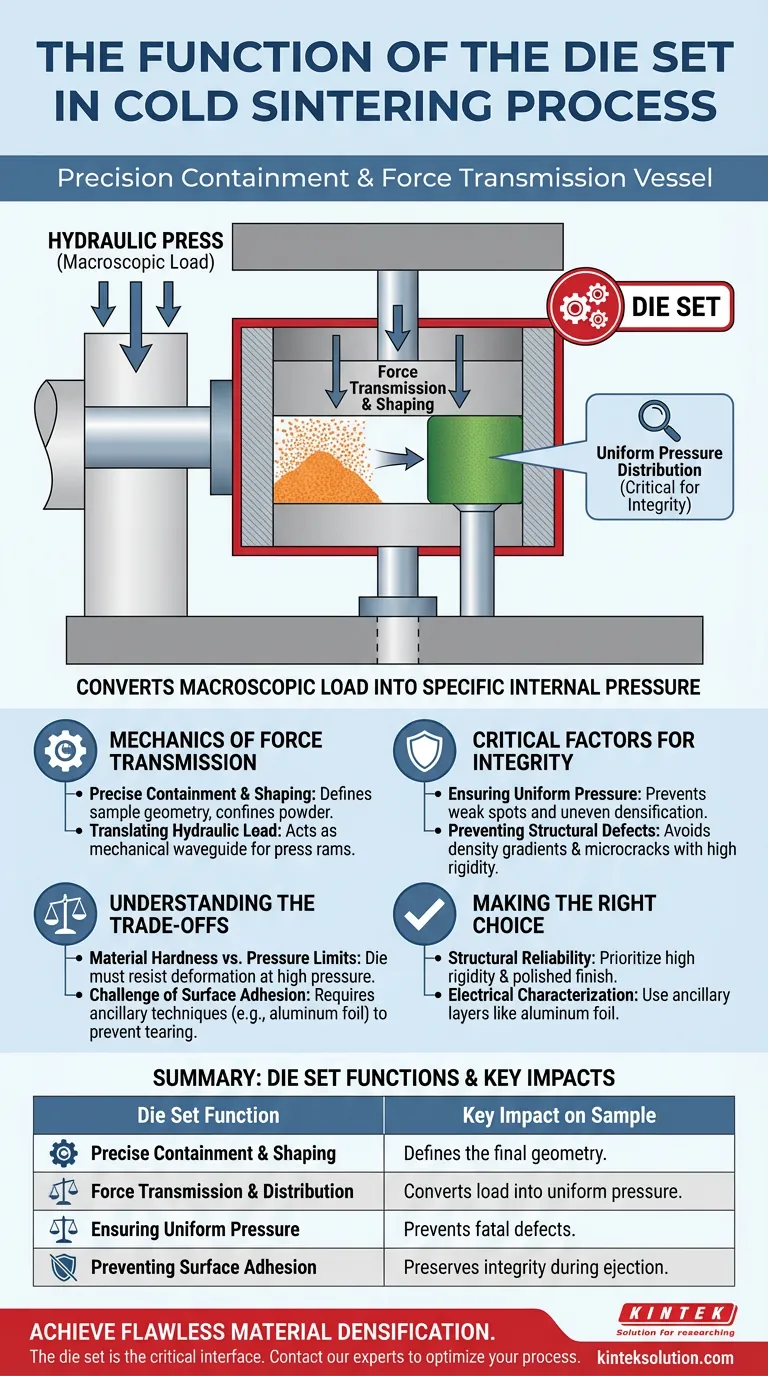
The primary function of the die set in the Cold Sintering Process is to serve as a precision containment vessel that shapes the powder sample while acting as the medium for force transmission. It bridges the gap between the hydraulic press and the material, converting the machine's macroscopic load into the specific internal pressure required to densify the powder into a cohesive solid.
The die set is more than a simple mold; it is the critical interface that determines the structural integrity of your material. Its rigidity and surface quality directly control the uniformity of pressure distribution, which is the single most important factor in preventing fatal defects like microcracks and density gradients.
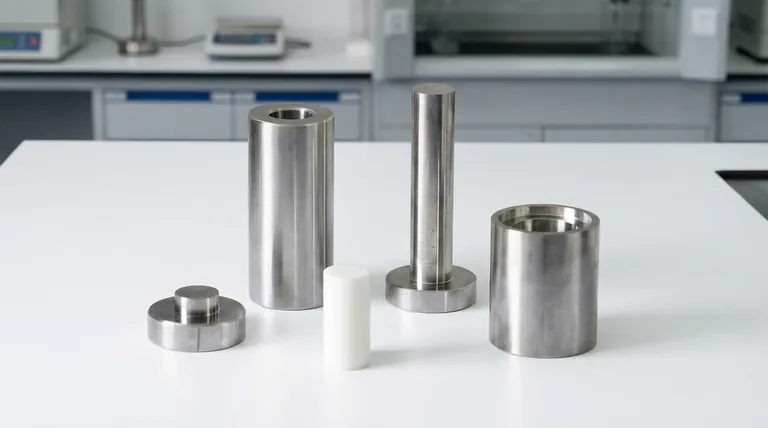
The Mechanics of Force Transmission
Precise Containment and Shaping
The most immediate role of the die set is to provide a high-strength cavity that defines the physical geometry of the sample. It confines the loose powder within a specific shape, such as a cylinder, ensuring the material remains in place during the initial stages of loading.
Translating Hydraulic Load
While the hydraulic press generates the raw power, the die set is responsible for delivering that force to the powder compact. It acts as a mechanical waveguide, transmitting the external load from the press rams directly into the material structure.
Critical Factors for Sample Integrity
Ensuring Uniform Pressure Distribution
The internal finish and mechanical precision of the die set dictate how evenly pressure propagates through the powder. Uniform distribution is a non-negotiable requirement for high-quality sintering. Without it, the material will densify unevenly, leading to weak spots and unpredictable performance.
Preventing Structural Defects
A die set with poor rigidity or surface imperfections causes density gradients to form within the sample. These gradients create internal stress concentrations that frequently result in microcracks. By maintaining strict dimensional stability, the die ensures the final device is free of these microscopic flaws.
Understanding the Trade-offs
Material Hardness vs. Pressure Limits
The die set must possess exceptional hardness and wear resistance to endure high pressures, such as 375 MPa, without failing. However, every die has a yield point; if the pressure requirements of your powder exceed the material limits of the die (e.g., carbon steel), the tool will deform, ruining the sample's geometry.
The Challenge of Surface Adhesion
High pressure often forces powder to adhere to the die plungers, which can tear the sample upon ejection. To mitigate this trade-off, ancillary techniques are often required. For example, placing aluminum foil between the sample and the plungers prevents sticking and preserves the surface integrity of the pressed part.
Making the Right Choice for Your Goal
To ensure consistent results in your Cold Sintering Process, you must match your tooling strategy to your specific experimental objectives.
- If your primary focus is structural reliability: Prioritize a die set with high rigidity and a polished surface finish to minimize density gradients and prevent microcracking.
- If your primary focus is electrical characterization: Utilize ancillary layers like aluminum foil during pressing, as they prevent contamination and can serve as temporary electrodes for subsequent testing.
The quality of your die set sets the upper limit for the quality of your final sintered material.
Summary Table:
| Die Set Function | Key Impact on Sample |
|---|---|
| Precise Containment & Shaping | Defines the final geometry of the sintered part. |
| Force Transmission & Distribution | Converts hydraulic press load into uniform internal pressure. |
| Ensuring Uniform Pressure | Prevents fatal defects like microcracks and density gradients. |
| Preventing Surface Adhesion | Preserves sample integrity during ejection (e.g., using foil layers). |
Achieve flawless material densification with the right tooling. The die set is the critical interface that determines the success of your Cold Sintering Process. KINTEK specializes in high-precision lab press machines, including automatic and heated lab presses, and understands the exacting demands of laboratory sintering. Our expertise ensures you have the robust, reliable equipment needed for defect-free results. Let's discuss your specific requirements – contact our experts today to optimize your process.
Visual Guide
Related Products
- Lab Ring Press Mold for Sample Preparation
- Lab Cylindrical Press Mold with Scale
- Square Bidirectional Pressure Mold for Lab
- XRF KBR Steel Ring Lab Powder Pellet Pressing Mold for FTIR
- Lab Infrared Press Mold for No Demolding
People Also Ask
- What is the purpose of incorporating cartridge heaters into a lab press mold for MLCC block compression? Optimize Results
- What is the role of a laboratory press in COF electrolyte prep? Achieving High-Performance Pellet Densification
- Why is precise cooling management of the lab press mold necessary? Protect Core Integrity in Thermoforming
- What is the function of a pressing tool in thermoplastic panels? Master Precision Shaping & Fusion Bonding
- What impact does a sample preparation press have on testing results when researching MXene as an electrolyte additive?






