
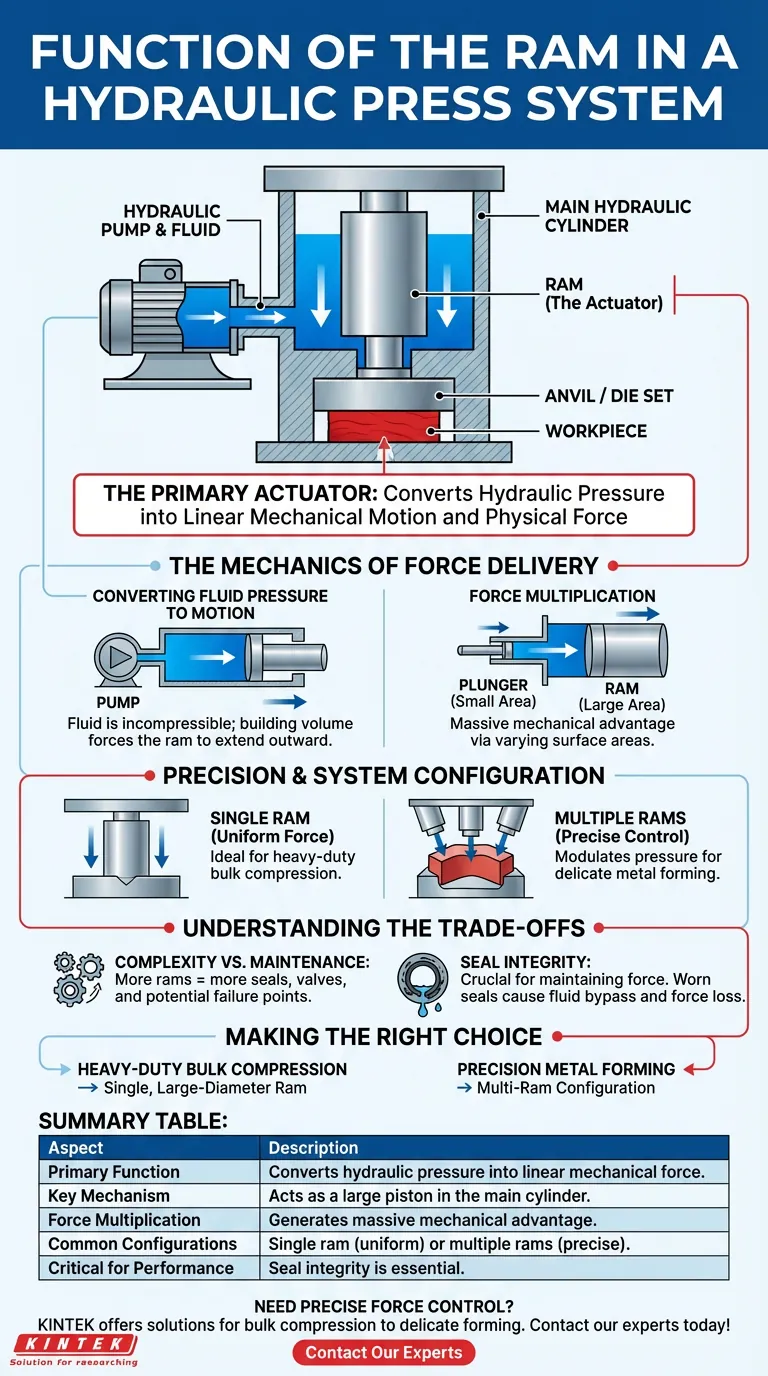
The ram is the primary actuator within a hydraulic press system responsible for delivering compressive force to a workpiece. It functions as a large, sliding piston housed within the main hydraulic cylinder, converting the hydraulic pressure generated by the pump into linear mechanical motion and physical force.
The ram acts as the bridge between hydraulic potential and mechanical work. While the pump creates pressure, the ram is the component that translates that energy into the specific tonnage required to shape, flatten, or bond materials.
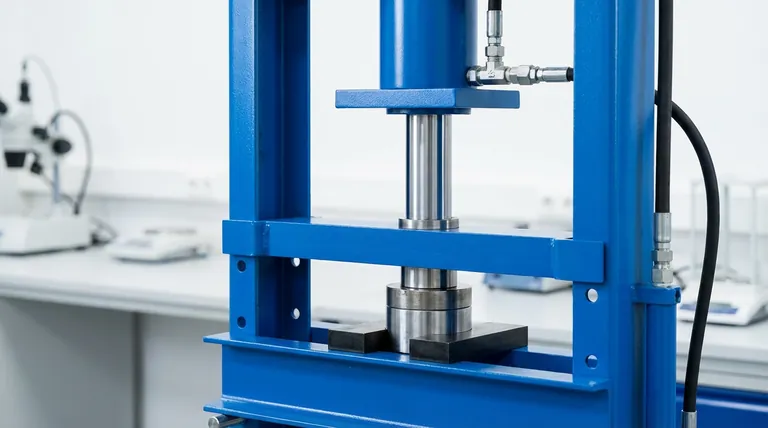
The Mechanics of Force Delivery
Converting Fluid Pressure to Motion
The ram operates inside the main hydraulic cylinder. As the hydraulic pump forces fluid into this cylinder, the pressure builds behind the ram.
Because fluids are virtually incompressible, this accumulating volume forces the ram to extend outward. This linear movement is what physically contacts the tooling or material to perform the work.
Force Multiplication
The system relies on the relationship between a smaller input piston (often called a plunger) and the larger output piston (the ram).
Fluid acts on the varying surface areas of these components. By driving fluid from a small plunger into a large surface area ram, the system generates a massive mechanical advantage, multiplying the input force significantly at the output.
Transfer to the Anvil
In many configurations, the ram does not press the material directly. Instead, it transmits its force to an anvil or a die set.
This setup ensures that the raw tonnage of the ram is distributed evenly according to the specific shape required for the task.
Precision and System Configuration
Single vs. Multiple Rams
Standard hydraulic presses typically utilize a single, large ram to deliver uniform downward force. This is sufficient for general-purpose compression tasks.
However, advanced applications often require multiple smaller rams rather than one large unit. This configuration allows for finer control over hydraulic thrust force.
Control for Delicate Operations
Using multiple rams enables the operator to modulate pressure across different areas of the workpiece.
This precise distribution of force is critical for delicate metal forming or precision stamping, where uneven pressure could crack or deform the material incorrectly.
Understanding the Trade-offs
Complexity vs. Maintenance
While multi-ram systems offer superior precision, they introduce complexity to the hydraulic circuit.
More rams require more seals, valves, and routing via the accumulator. This increases the potential points of failure compared to a simple, single-ram design.
Seal Integrity
The ram is the moving boundary of the pressurized system. Its effectiveness is entirely dependent on the integrity of the seals between the ram and the cylinder wall.
If these seals wear due to friction or debris, hydraulic fluid will bypass the ram. This results in a significant loss of compressive force and efficiency.
Making the Right Choice for Your Goal
To select the correct hydraulic press configuration, you must align the ram style with your specific output requirements.
- If your primary focus is heavy-duty bulk compression: Prioritize a single, large-diameter ram system to maximize raw tonnage and minimize maintenance points.
- If your primary focus is precision metal forming: Opt for a multi-ram configuration to gain granular control over thrust distribution and ensure complex shapes are stamped accurately.
The effectiveness of any hydraulic press is ultimately defined by how efficiently the ram can translate fluid pressure into controlled mechanical power.
Summary Table:
| Aspect | Description |
|---|---|
| Primary Function | Converts hydraulic pressure into linear mechanical force. |
| Key Mechanism | Acts as a large piston in the main cylinder, forced by incompressible fluid. |
| Force Multiplication | Generates massive mechanical advantage by acting on a large surface area. |
| Common Configurations | Single ram (uniform force) or multiple rams (precise, distributed force). |
| Critical for Performance | Seal integrity is essential to maintain force and efficiency. |
Need precise force control for your laboratory applications?
Whether your work requires the raw tonnage of a single-ram system for bulk compression or the meticulous control of a multi-ram press for delicate metal forming, KINTEK has the solution. Our expertise in lab press machines—including automatic lab presses, isostatic presses, and heated lab presses—ensures you get the precise force delivery your research demands.
Let us help you optimize your process. Contact our experts today to discuss your specific requirements and find the perfect hydraulic press for your laboratory.
Visual Guide
Related Products
- Laboratory Split Manual Heated Hydraulic Press Machine with Hot Plates
- Automatic Heated Hydraulic Press Machine with Heated Plates for Laboratory
- Manual Heated Hydraulic Lab Press with Integrated Hot Plates Hydraulic Press Machine
- Automatic High Temperature Heated Hydraulic Press Machine with Heated Plates for Lab
- Laboratory Manual Heated Hydraulic Press Machine with Hot Plates
People Also Ask
- Why is a laboratory hydraulic press with heating plates required for PLA/TEC films? Achieve Precise Sample Integrity
- Why reduce load when applying composite strengthening tabs? Protect Specimen Integrity and Data Accuracy
- What role does a laboratory heated hydraulic press play in LTCC? Essential for High-Density Ceramic Lamination
- Why is a laboratory heated hydraulic press required? Ensure Precise Vulcanization for NBR/EPDM Nanocomposites
- What is the primary function of a laboratory heated hydraulic press? Mastering Thermoplastic Carbon Fiber Composites



















