
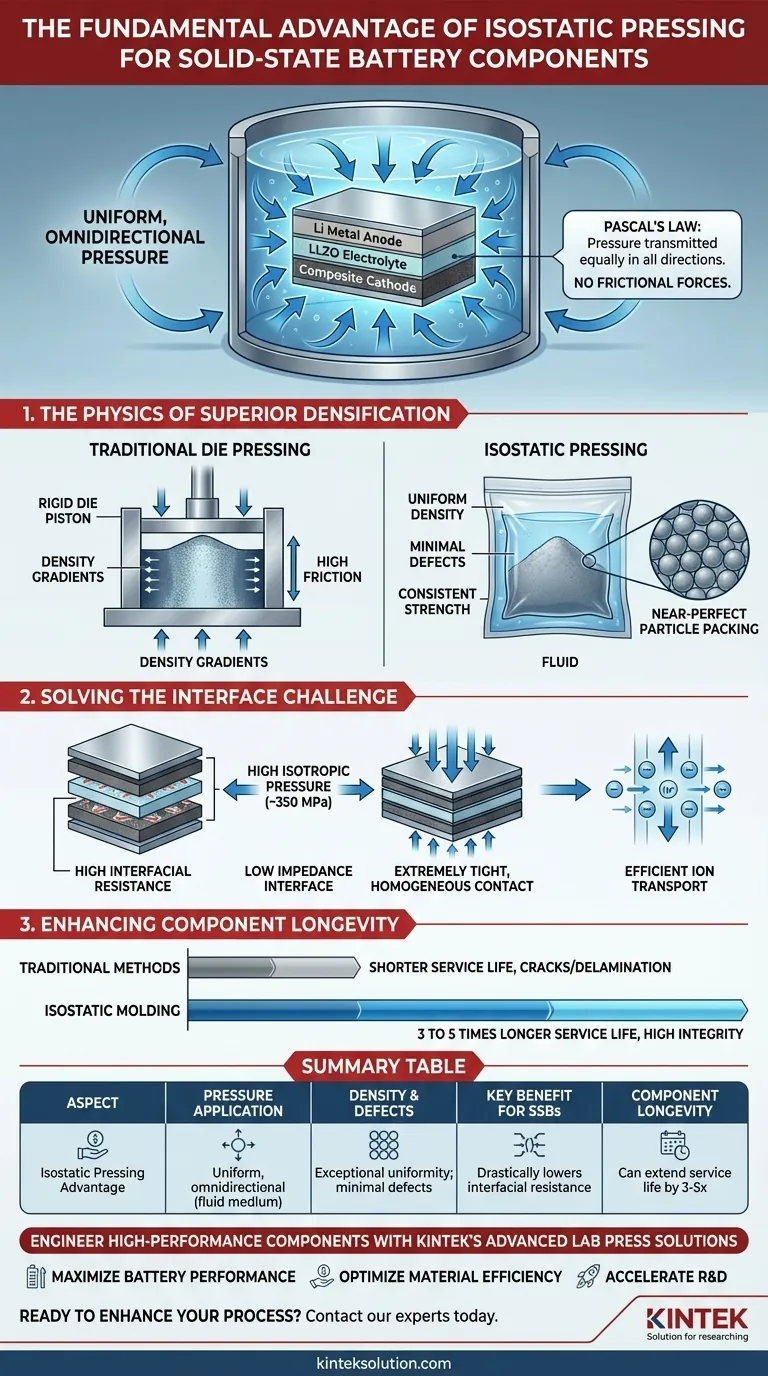
The fundamental advantage of isostatic pressing is the ability to apply uniform, omnidirectional pressure to a component through a fluid medium. Unlike traditional uniaxial pressing, which suffers from friction and directional force limitations, isostatic pressing utilizes Pascal's law to ensure that equal pressure is applied from every side simultaneously. This results in components with exceptional density uniformity, minimal internal defects, and consistent mechanical strength throughout the entire structure.
Isostatic pressing eliminates the density gradients and structural inhomogeneities inherent in mechanical die pressing. By achieving near-perfect density uniformity and intimate physical contact between layers, it solves the critical challenge of high interfacial resistance in solid-state battery assemblies.
The Physics of Superior Densification
Harnessing Pascal’s Law
The core mechanism of isostatic pressing is the use of a liquid or gas as a pressure-transmitting medium.
According to Pascal’s law, pressure applied to this confined fluid is transmitted equally in all directions. This allows the force to act perpendicular to every surface of the component, regardless of its geometry.
Eliminating Friction and Gradients
In traditional die pressing, friction between the powder and the die walls creates "density gradients," leading to parts that are denser on the edges than in the center.
Isostatic pressing completely eliminates these frictional forces. Because the pressure is hydrostatic, the material compacts evenly, ensuring the density is consistent from the surface to the core.
Maximizing Material Integrity
This method is highly effective at reducing the porosity of powder mixtures.
By encapsulating the material in a flexible membrane or hermetic container, the process prevents the medium from entering the sample while forcing pores to close. This leads to higher compact densities, which are a prerequisite for achieving optimal material performance and durability.
Solving the Solid-State Interface Challenge
Creating Low-Impedance Interfaces
For solid-state batteries, the interface between solid layers—such as the lithium metal anode, the LLZO electrolyte, and the composite cathode—is often the point of failure.
Isostatic pressing applies high isotropic pressure (e.g., 350 megapascals) to these stacked components. This forces the materials into an extremely tight, homogeneous physical contact, significantly lowering interfacial resistance.
Ensuring Efficient Ion Transport
A battery cannot function efficiently if ions cannot move freely between layers.
The mechanical integrity provided by isostatic pressing creates a well-formed, low-impedance solid-solid interface. This is a fundamental requirement for stable lithium-ion transport and high-performance cycling.
Enhancing Component Longevity
Uniform density translates directly to service life.
Components free from compact defects and internal stresses are less likely to crack or delaminate during operation. Evidence from similar applications suggests that isostatic molding can extend service life by 3 to 5 times compared to traditional molding methods.
Understanding the Trade-offs
Process Complexity
While isostatic pressing offers superior quality, it requires more complex tooling than rigid die pressing.
The material must be encapsulated in a flexible mold or container to prevent the pressurizing fluid from contaminating the sample. This adds a step to the manufacturing workflow that is not present in simple mechanical pressing.
Geometric Considerations
Isostatic pressing is excellent for complex shapes because pressure is applied from all sides.
However, the final dimensions are determined by the compression of the powder and the flexible mold, rather than fixed rigid walls. This requires precise calculation of shrinkage to ensure the final part meets dimensional tolerances.
Making the Right Choice for Your Goal
To determine if isostatic pressing is the correct solution for your manufacturing process, consider your primary objectives:
- If your primary focus is maximizing battery performance: Prioritize isostatic pressing to achieve the high density and low interfacial resistance required for efficient ion transport.
- If your primary focus is component geometric complexity: Use isostatic pressing to compact complex shapes that would be impossible or inconsistent with uniaxial die pressing.
- If your primary focus is material efficiency: Leverage isostatic compaction to remove constraints on part geometry and ensure efficient utilization of expensive powder materials.
By shifting from directional mechanical force to omnidirectional fluid pressure, you move from producing merely shaped parts to engineering high-integrity, high-performance energy storage components.
Summary Table:
| Aspect | Isostatic Pressing Advantage |
|---|---|
| Pressure Application | Uniform, omnidirectional (via fluid medium) |
| Density & Defects | Exceptional uniformity; minimal internal defects |
| Key Benefit for SSBs | Drastically lowers interfacial resistance for efficient ion transport |
| Component Longevity | Can extend service life by 3-5x compared to traditional methods |
Engineer high-performance solid-state battery components with KINTEK's advanced lab press solutions.
Isostatic pressing is critical for achieving the density and interface integrity your R&D demands. KINTEK specializes in precision lab press machines, including isostatic presses, designed specifically for laboratory-scale manufacturing and development.
Our expertise helps you:
- Maximize Battery Performance: Achieve the high density and low interfacial resistance required for efficient ion transport.
- Optimize Material Efficiency: Ensure consistent results and efficient use of expensive powder materials.
- Accelerate R&D: Reliable, laboratory-focused equipment built for innovation.
Ready to enhance your solid-state battery manufacturing process? Contact our experts today to find the perfect press for your laboratory's needs.
Visual Guide
Related Products
- Warm Isostatic Press for Solid State Battery Research Warm Isostatic Press
- Lab Isostatic Pressing Molds for Isostatic Molding
- Automatic Lab Cold Isostatic Pressing CIP Machine
- Manual Cold Isostatic Pressing CIP Machine Pellet Press
- Electric Lab Cold Isostatic Press CIP Machine
People Also Ask
- Why must composite cathodes be sealed in vacuum lamination bags for WIP? Ensure Battery Stability and Density
- What is the function of elastic molds in warm isostatic pressing? Achieve Uniform Density in Composite Particles
- How do sacrificial volume materials (SVM) maintain microchannels in isostatic pressing? Ensure Structural Integrity
- What is the role of the flexible material in warm isostatic pressing? Key to Uniform Density & Precision
- What is the process involved in warm isostatic pressing? Mastering Uniform Density with WIP Technology










