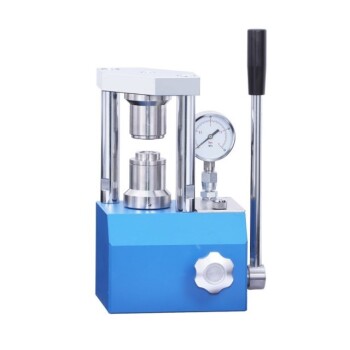
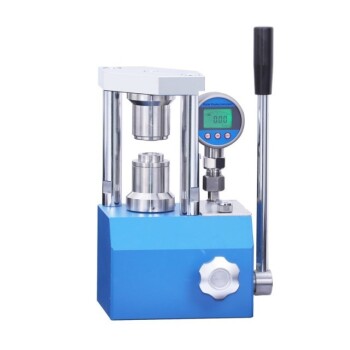
The primary impact of a high-precision lab press machine on Lithium-Sulfur (Li-S) full cell battery assembly is the creation of a mechanically uniform and electrochemically stable interface. By delivering precise, uniform sealing pressure, the machine ensures optimal contact between the cathode, separator, and stabilized anode. This contact is the prerequisite for minimizing internal resistance and enabling the cell to function correctly under challenging operating conditions.
Ideally, a lab press acts as a standardized process control, not just a sealing tool. By eliminating variables in physical assembly, it allows researchers to isolate the true electrochemical performance of Li-S materials, particularly when minimizing electrolyte usage to boost energy density.
The Critical Role of Interface Integrity
Optimizing Physical Contact
In a Li-S full cell, the distinct layers—cathode, separator, and anode—must function as a cohesive unit.
A high-precision press eliminates microscopic gaps between these layers. This ensures a tight interfacial contact that allows ions to move freely across the cell components without physical obstruction.
Reducing Interface Impedance
Resistance at the boundaries of cell components (interface impedance) is a major efficiency killer.
By applying uniform pressure, the lab press lowers this impedance significantly. Lower impedance translates directly to better voltage efficiency and power output during battery cycling.
Managing Liquid Dynamics in Li-S Cells
Enabling Lean-Electrolyte Conditions
To achieve high energy density, Li-S batteries must operate with a minimal amount of electrolyte (lean-electrolyte conditions).
The press plays a vital role here. By forcing components together efficiently, it ensures that the limited electrolyte available is utilized effectively, rather than pooling in voids or gaps.
Ensuring Uniform Polysulfide Wetting
Li-S chemistry involves liquid polysulfides that must permeate the porous electrode structure.
High-precision compression facilitates the uniform wetting of these polysulfides within the electrode pores. This ensures that the active material is fully utilized, rather than having "dry" spots that contribute nothing to the battery's capacity.
Stability at High Area Capacities
High-performance cells often use thicker electrodes to achieve high area capacities.
These thicker structures are more prone to mechanical instability. A precision press maintains the structural integrity of these high-capacity cells, ensuring electrochemical stability even as the cell undergoes the physical stress of cycling.
Common Pitfalls to Avoid
The Risk of Over-Compression
While contact is critical, excessive pressure can be detrimental.
If the press applies too much force, it can crush the porous structure of the cathode or separator. This "pore closure" prevents the electrolyte from flowing and blocks ion transport, effectively choking the battery.
Inconsistent Pressure Distribution
Not all presses deliver force evenly across the entire surface area.
A press that lacks precision may seal one side of the coin cell tighter than the other. This leads to current density hotspots, causing uneven degradation of the lithium anode and premature cell failure.
Making the Right Choice for Your Goal
To maximize the value of your assembly process, align your equipment usage with your specific research objectives:
- If your primary focus is High Energy Density: Prioritize pressure protocols that facilitate full wetting under lean-electrolyte conditions without crushing the separator.
- If your primary focus is Cycle Life: Ensure the press provides a hermetic seal to prevent electrolyte evaporation and block external moisture, which ensures long-term reproducibility.
- If your primary focus is Standardization: Use the machine to remove human error, ensuring that impedance measurements reflect material properties rather than assembly variations.
Precision in assembly is the silent foundation of reproducible, high-performance Li-S battery research.
Summary Table:
| Impact Factor | Benefit of High-Precision Pressing | Risk of Poor Precision |
|---|---|---|
| Interfacial Contact | Minimizes internal resistance & improves ion transport | High impedance & poor electrochemical contact |
| Electrolyte Management | Enables lean-electrolyte conditions & uniform wetting | Pooling in voids or "dry spots" in electrodes |
| Structural Integrity | Maintains stable contact for high-capacity electrodes | Crushed pores or uneven current density hotspots |
| Research Quality | High reproducibility & standardized process control | Data variation due to human error & assembly flaws |
Maximize Your Li-S Research with KINTEK Precision
Unlock the true potential of your battery materials by eliminating assembly variables. KINTEK specializes in comprehensive laboratory pressing solutions, offering manual, automatic, heated, multifunctional, and glovebox-compatible models, as well as cold and warm isostatic presses tailored for advanced battery research.
Our high-precision systems ensure:
- Uniform Pressure Distribution: Eliminate hotspots and ensure long-cycle stability.
- Optimized Interface Integrity: Lower impedance for high-power output.
- Scalable Solutions: From coin cells to complex isostatic pressing requirements.
Ready to elevate your lab's efficiency and data reproducibility? Contact KINTEK today to find the perfect press for your specific research goals.
References
- Cheng‐Che Wu, Sheng‐Heng Chung. Porosity‐Controlled Carbon for the Stabilization of Cathode/Anode Electrodes of High‐Loading Lithium–Sulfur Full Cells. DOI: 10.1002/ceur.202500070
This article is also based on technical information from Kintek Solution Knowledge Base .
Related Products
- Button Battery Sealing Press Machine for Lab
- Laboratory Hydraulic Press Lab Pellet Press Button Battery Press
- Warm Isostatic Press for Solid State Battery Research Warm Isostatic Press
- Lab Infrared Press Mold for Laboratory Applications
- Lab Cylindrical Press Mold for Laboratory Use
People Also Ask
- Why use standardized CR2032 components & high-precision presses? Ensure reliability in lithium metal battery research.
- Why is a laboratory battery sealing press essential for desolvation energy testing? Ensure Reliable Kinetic Data
- Why is a laboratory hydraulic press or battery sealing machine essential? Ensure Coin Cell Data Integrity
- How do laboratory battery sealing machines ensure performance consistency? Master Your Lithium and LFP Battery Assembly
- What role does a laboratory sealing press play in thermal analysis of solid dispersion films? Ensure Data Integrity