High-precision pressure control is the determining factor in achieving a uniform, defect-free PH-LLZTO solid-state electrolyte structure. It ensures that the distinct components—LLZTO particles, polymer matrix, and conductive lithium salts—are fully compressed and tightly rearranged. This mechanical precision is essential for eliminating density gradients and microscopic pores that otherwise compromise battery performance.
The core objective of high-precision pressing is to enforce homogeneity across the composite material. By eliminating voids and ensuring uniform density, you actively minimize internal resistance and prevent the formation of dangerous lithium dendrites.
The Physics of Densification
Optimizing Particle Rearrangement
The PH-LLZTO electrolyte is a composite material requiring the integration of rigid particles with a polymer matrix. High-precision pressure forces these disparate elements to rearrange tightly. This establishes intimate physical contact between the active materials and the conductive salts.
Eliminating Microscopic Pores
Any voids left within the material act as barriers to ion transport. A laboratory press capable of delivering stable, uniform force compresses the material to near-theoretical density. This process effectively squeezes out air bubbles and closes microscopic gaps that would otherwise impede performance.
Removing Density Gradients
Inconsistent pressure application leads to uneven density across the electrolyte film. Precision control ensures the force is applied uniformly across the entire mold surface. This prevents the creation of low-density regions where structural weaknesses often originate.
Critical Impact on Battery Performance
Reducing Internal Resistance
The primary electrochemical benefit of this high-density pressing is a significant reduction in internal resistance. Tighter particle packing creates a continuous pathway for ionic conduction. This allows the battery to operate efficiently without energy loss at the grain boundaries.
Preventing Lithium Dendrites
This is the most critical safety implication of the molding stage. Localized current concentrations often occur in low-density areas or near pores, acting as nucleation sites for lithium dendrites. By enforcing uniform density, high-precision pressing removes these "hotspots," thereby suppressing dendrite growth and preventing short circuits.
Structural Integrity and Green Bodies
Establishing Green Body Strength
Before any sintering or final processing occurs, the molded material (the "green body") must be structurally sound. Accurate pressure control ensures the powder compacts into a robust pellet that retains its shape.
Preventing Processing Defects
If the initial compression is uneven, the material becomes prone to deformation or cracking during subsequent stages. A precisely molded green body minimizes these risks, ensuring the electrolyte remains intact during handling and potential heat treatments.
Understanding the Risks and Trade-offs
The Cost of Pressure Fluctuations
If the hydraulic press fails to maintain stable pressure or precise dwell times, the resulting electrolyte will suffer from density variations. Even minor inconsistencies can lead to localized failures where current density spikes during operation.
Balancing Force and Geometry
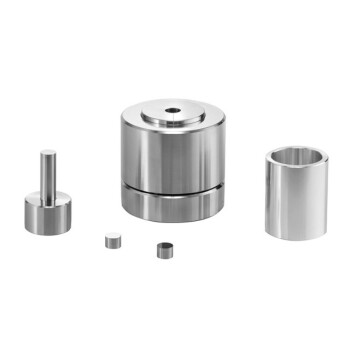
While high pressure (often 300–500 MPa) is necessary for densification, it must be applied within the specific geometric limits of the mold (e.g., 13mm dies). Over-pressing beyond the mold's tolerance can damage tooling, while under-pressing leaves voids. Precision allows you to find and hold the exact optimal pressure for the specific PH-LLZTO formulation.
Making the Right Choice for Your Goal
To maximize the efficacy of your PH-LLZTO electrolyte, align your pressing strategy with your specific research objectives:
- If your primary focus is Cycle Life and Safety: Prioritize pressure uniformity to eliminate density gradients, which is the most effective mechanical method for suppressing lithium dendrite growth.
- If your primary focus is Ionic Conductivity: Focus on achieving maximum density to eliminate microscopic pores and minimize grain boundary resistance.
Ultimately, the laboratory press is not just a shaping tool; it is a critical instrument for engineering the internal microstructure that defines your battery's success.
Summary Table:
| Factor | Impact on PH-LLZTO Electrolyte | Benefit to Battery Performance |
|---|---|---|
| Particle Rearrangement | Forces tight integration of LLZTO and polymer | Establishes intimate contact and conduction paths |
| Void Elimination | Squeezes out air bubbles and microscopic pores | Minimizes internal resistance and energy loss |
| Uniform Density | Prevents localized low-density regions | Suppresses lithium dendrite growth and short circuits |
| Green Body Strength | Ensures robust structural integrity | Prevents cracking or deformation during sintering |
Elevate Your Battery Research with KINTEK Precision
Precise microstructure engineering is the foundation of high-performance solid-state batteries. KINTEK specializes in comprehensive laboratory pressing solutions designed to meet the rigorous demands of PH-LLZTO molding. Whether you are conducting fundamental material research or pilot-scale testing, our range of equipment ensures the high-precision force delivery your project requires.
Our laboratory press solutions include:
- Manual and Automatic Hydraulic Presses for repeatable force application.
- Heated and Multifunctional models for specialized composite processing.
- Glovebox-compatible systems for air-sensitive solid-state materials.
- Cold (CIP) and Warm Isostatic Presses (WIP) for ultimate density uniformity.
Don't let pressure fluctuations compromise your electrolyte integrity. Contact KINTEK today to find the perfect pressing solution for your lab and ensure defect-free results every time.
References
- Yuchen Wang, Meinan Liu. Delicate design of lithium‐ion bridges in hybrid solid electrolyte for wide‐temperature adaptive solid‐state lithium metal batteries. DOI: 10.1002/inf2.70095
This article is also based on technical information from Kintek Solution Knowledge Base .
Related Products
- Lab Isostatic Pressing Molds for Isostatic Molding
- Lab Polygon Press Mold
- Assemble Square Lab Press Mold for Laboratory Use
- Lab Infrared Press Mold for Laboratory Applications
- Lab Cylindrical Press Mold for Laboratory Use
People Also Ask
- What is the purpose of incorporating cartridge heaters into a lab press mold for MLCC block compression? Optimize Results
- How do laboratory press machines resolve increased impedance in solid-state batteries? Achieve Low-Resistance Interfaces
- What is the function of an isostatic lab press in energy storage research? Achieve Superior Material Standardization
- How does controlling the parameters of a laboratory isostatic press contribute to reducing deformation in LTCC channels?
- What is the function of a laboratory isostatic press? Mastering Homogeneity in Aluminum Matrix Composites