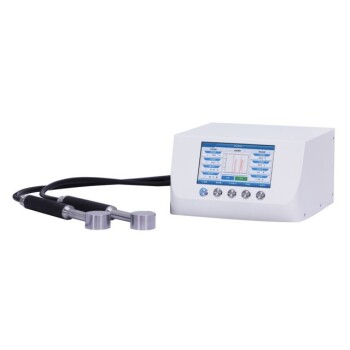
The built-in heater and preheating system are critical for establishing data validity. They function by allowing in-situ drying and degassing of samples at temperatures up to 400 °C. This process ensures that the sample is free from environmental contaminants before the actual hydrogen diffusion test begins.
Accurate hydrogen diffusion measurements rely entirely on a defined starting point. By stripping away residual moisture and trapped gases under high vacuum, the preheating system creates a "dry state baseline" that eliminates interference and ensures the resulting data purely reflects hydrogen behavior.
Establishing a Reliable Baseline
Eliminating Environmental Noise
Samples naturally absorb moisture and other gases from the atmosphere before testing. These impurities exist within the material's surface or bulk and can behave similarly to the hydrogen you are trying to measure.
The preheating system drives these volatile elements out of the sample. By removing them, you ensure they do not skew the diffusion coefficient measurements during the experiment.
Defining the Dry State
To calculate accurate diffusion rates, you must know the exact condition of the sample at time zero. The heater facilitates a "dry state" by subjecting the material to high-temperature and high-vacuum conditions.
This creates a verified, neutral baseline. Without this step, the starting condition of the sample is an unknown variable, rendering subsequent calculations unreliable.
The Advantage of In-Situ Processing
Preventing Re-contamination
The term "in-situ" indicates that the drying happens inside the testing chamber. This is a vital feature for maintaining sample purity.
If you were to degas a sample in a separate oven and then transport it to the tester, it would immediately re-absorb atmospheric moisture. The built-in system prevents this exposure, keeping the sample pristine between drying and testing.
Improving Measurement Accuracy
The ultimate goal of the system is to isolate the variable of interest: the hydrogen diffusion coefficient.
By utilizing the preheater to remove pre-existing gases, you eliminate the possibility of "false positives" or erratic data spikes caused by impurities. This ensures the sensor detects only the hydrogen introduced during the test.
Operational Considerations and Trade-offs
Temperature Limitations
While the system supports temperatures up to 400 °C, it is crucial to match the temperature to your specific material.
You must ensure that the degassing temperature is high enough to remove impurities but not so high that it alters the microstructure of the sample. Changing the material's structure would invalidate the diffusion characteristics you representatively want to measure.
Balancing Time and Purity
Achieving a completely dry state is not instantaneous. Thorough degassing requires holding the sample at temperature under vacuum for a sufficient period.
This adds time to the overall testing protocol. However, rushing this step creates a trade-off where saved time results in compromised data quality due to lingering background noise.
Optimizing Your Experimental Protocol
To ensure your hydrogen diffusion data is scientifically defensible, consider the following approach regarding the preheating system:
- If your primary focus is absolute measurement accuracy: Utilize the heater to reach the maximum safe temperature for your material (up to 400 °C) to ensure the complete removal of all residual moisture.
- If your primary focus is testing temperature-sensitive materials: Carefully select a drying temperature that is sufficient to volatilize surface moisture but remains below the threshold for microstructural changes.
Ultimately, the preheating system is not just an accessory; it is the fundamental tool that transforms a raw sample into a reliable test subject.
Summary Table:
| Feature | Function in Hydrogen Diffusion | Impact on Data Quality |
|---|---|---|
| In-Situ Heating | Drying/degassing up to 400 °C inside the chamber | Prevents re-contamination and ensures sample purity. |
| High-Vacuum Preheating | Removes volatile impurities and trapped gases | Eliminates background noise and 'false positive' signals. |
| Dry State Baseline | Establishes a verified 'Time Zero' condition | Provides a consistent, defensible starting point for calculations. |
| Microstructure Control | Precision temperature regulation | Protects material properties from unintended structural changes. |
Precision Sample Preparation with KINTEK
Don't let residual moisture compromise your research integrity. KINTEK specializes in comprehensive laboratory pressing and sample preparation solutions designed for high-stakes research. Whether you need manual, automatic, heated, or multifunctional presses, or specialized cold and warm isostatic systems for battery research, our technology ensures your materials are processed under perfect conditions.
Ready to elevate your hydrogen diffusion and material testing accuracy? Contact our laboratory experts today to find the ideal pressing or heating solution tailored to your experimental needs.
References
- Eloisa Salina Borello, Dario Viberti. Underground Hydrogen Storage Safety: Experimental Study of Hydrogen Diffusion through Caprocks. DOI: 10.3390/en17020394
This article is also based on technical information from Kintek Solution Knowledge Base .
Related Products
People Also Ask
- How do precision temperature-controlled heating plates function in electrolyte thermal stability storage experiments?
- What is the importance of a precision temperature-controlled heating module? Ensure Aluminum-Cadmium Thermal Stability
- How does heating platen precision affect rubber specimens? Achieve uniform density and reliable testing results.
- How are thin polymer films produced for spectroscopic analysis? Expert Guide to Heat and Low-Pressure Methods
- What accessories and field services can be used to optimize the capabilities of presses? Maximize Your Lab Performance